Get Full Government Meeting Transcripts, Videos, & Alerts Forever!
Get email alerts on the Idwr Budget Records Staffing topic
No spam. Unsubscribe anytime.
IDWR seeks staff, technology funding after records system failure; warns of large adjudication workload
Summary
The Idaho Department of Water Resources told lawmakers it is recovering from a catastrophic failure of its online water‑records document management system (Laserfiche) in October 2023 and seeks FY26 funding to add staff and upgrade tools, including five positions to create a water administration bureau.
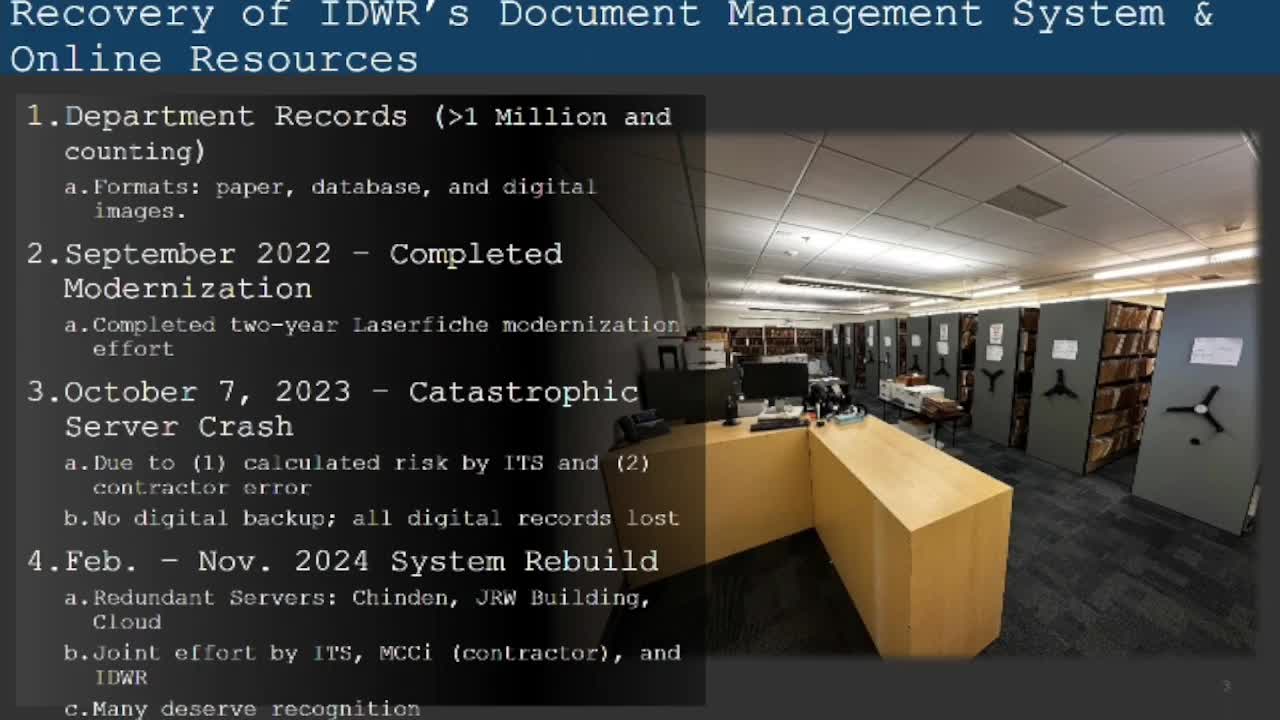
Director Matthew Weaver told the House Resources Committee that the Idaho Department of Water Resources suffered a catastrophic failure of its online water rights record document management system in October 2023 after migrating more than one million records into a new Laserfiche environment. The department worked with the Office of Information Technology Services and contractors to rebuild servers and repopulate lost data; Weaver said the effort is “largely concluded” but a gap period’s records remain incomplete and the department expects to finish restoration by the end of the year.
Weaver said the system had triple redundancy after restoration and emphasized the department relied on the Office of Information Technology Services (ITS) for servers and hosting. He described ongoing work to fill a gap between the time the new system was stood up and the crash and said the public’s ability to access some documents was interrupted during recovery efforts.
Budget and staffing requests: Weaver reviewed five FY‑2026 decision units the department requested: a transfer to staff aquifer monitoring and measuring positions funded via loan repayments from a settlement agreement (Pristine Springs settlement) that provides about $716,000 per year through fiscal 2028; a full‑time public information officer (the department currently relies on a part‑time contractor); ongoing funding to cover GIS licensing and software; a one‑time build of an online beneficial‑use submittal application; and funding for five new positions to create a water administration bureau to support priority administration and water district creation and modification.
Weaver said the proposed five‑person water administration bureau would expand an existing section of about 11 full‑time equivalents that today reside in the department’s water compliance bureau; adding five positions would create a bureau reporting directly to the director and would allow the agency to create or modify roughly two water districts a year at current plans, a pace Weaver described as leaving “many, many decades” of work to finish if demand remains.
Adjudication workload risk: Weaver also warned that court developments could require the department to process deferred domestic and stock water claims in the Snake River Basin adjudication. He said if a state‑court stay is lifted, the department may have to accept tens of thousands or more claims — “if not in excess of a hundred thousand” — and that the agency has no staff currently dedicated to that scale of work.
Weaver summarized other program priorities briefly: support for the Idaho Water Resource Board’s projects (recharge, flood management loans and grants), the department’s adjudication program, water administration and watermaster duties. He also noted litigation outcomes: a federal court recent ruling upheld the constitutionality, as applied, of certain Idaho Code provisions used to issue show‑cause orders (cited in testimony as Idaho Code §42‑222 and §42‑224), while other statute claims were decided for the federal government on supremacy‑clause grounds; appeals may follow.
Ending: the director asked for committee questions and said he would provide clean slide materials to committee members. Committee members asked about timelines, the department’s hearing‑officer role in contested cases and how document restoration and telemetry projects can be prioritized.