Get Full Government Meeting Transcripts, Videos, & Alerts Forever!
Get email alerts on the Women Sports Title Ix topic
No spam. Unsubscribe anytime.
Committee backs resolution honoring Boise State women's volleyball for forfeits and urges NCAA, Mountain West policy changes
Summary
The House State Affairs Committee voted to send House Concurrent Resolution 2 — introduced by Rep. Barbara Ehart to commend Boise State's women's volleyball team — to the floor with a do‑pass recommendation after extended testimony both for and against the resolution.
The House State Affairs Committee voted to send House Concurrent Resolution 2 to the House floor with a “do pass” recommendation after testimony that ranged from athletes and advocates praising Boise State University’s women’s volleyball team to witnesses cautioning that the matter should remain with athletic governing bodies.
Rep. Barbara Ehart (R‑District 33), sponsor of the resolution, told the committee the measure recognizes Boise State’s team for forfeiting three matches — including a Mountain West Tournament match that might have been their path to the NCAA tournament — in protest over competing against a biological male on an opponent’s roster. “They demonstrated true integrity at that time by sticking with their principles and saying, you know what, it’s not right, it’s not right that we should have to play against a biological male and not only is it not right, it’s not safe,” Ehart said.
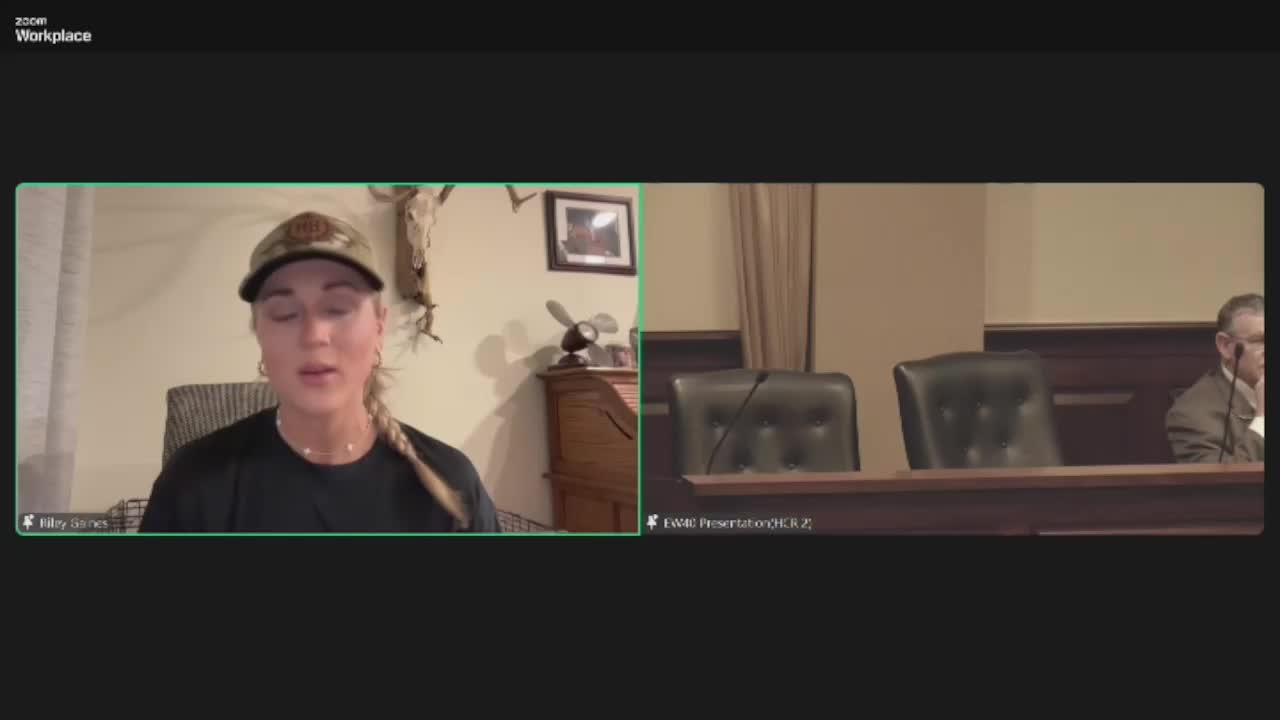
Several witnesses supported the resolution. Riley Gaines, who identified herself as an ambassador for Independent Women’s Voice and director of the Riley Gaines Center, urged lawmakers to “protect women’s sports” and said Boise State’s players showed “bravery” in stepping away from competition. Marshy Smith, who said she is a former NCAA captain and co‑founder of the Independent Council on Women’s Sports, described organizing a network of athletes and legal counsel and noted lawsuits brought against the Mountain West Conference and the NCAA by female athletes. Edward Clark, policy assistant with the Idaho Family Policy Center, told the committee that allowing biological males to compete in women’s sports is “both unfair and unsafe,” and described injuries and medal transfers he said had occurred in other jurisdictions.
Several witnesses opposed the resolution or urged caution. Nixon Matthews, who said he represented himself, argued the number of transgender NCAA athletes is extremely small and urged decisions be left to sports governing bodies such as the NCAA. Matthews cited a figure from NCAA leadership that, he said, fewer than 10 of roughly 510,000 NCAA athletes are transgender and noted existing NCAA eligibility rules that set hormone thresholds and waiting periods.
Committee members debated before the vote. Rep. Green said he heard and respected the testimony from women athletes but would vote no because he believed the resolution would “perpetrate a message that is still hurtful to a community who feels marginalized.” Rep. Keeley said she respected the witnesses and Boise State but opposed sending the resolution forward without a replacement rule or process to redefine eligibility, warning that moving now could “set us backward.”
Representative Crane moved to send HCR2 to the floor with a do‑pass recommendation. The motion carried; Representative Green and Representative Achilles were recorded as voting no.
The resolution commends Boise State University and urges the Mountain West Conference and the NCAA to change their policies; the committee record does not show the resolution adopting new eligibility rules or creating statutory change. Committee members noted the matter involves national governing bodies, existing lawsuits, and Title IX considerations. The committee adjourned after the vote; the resolution advanced to the next stage of the legislative process.