Get Full Government Meeting Transcripts, Videos, & Alerts Forever!
Get email alerts on the Anti Slapp Sb1001 topic
No spam. Unsubscribe anytime.
Senate committee advances anti‑SLAPP bill to speed dismissal of meritless lawsuits
Summary
The Senate Judiciary and Rules Committee gave Senate Bill 1,001 a due‑pass recommendation after sponsor Sen. Brian Lenny and witnesses said the measure would create an expedited judicial process to dismiss strategic lawsuits against public participation (SLAPPs) and protect free speech in Idaho courts.
Boise — The Idaho Senate Judiciary and Rules Committee voted to send Senate Bill 1,001 to the Senate floor with a due‑pass recommendation after testimony that the bill would provide Idaho judges an early mechanism to dismiss so‑called SLAPP lawsuits that seek to punish or silence public participation.
Senator Brian Lenny, sponsor of SB1001, told the committee the bill implements a Uniform Law Commission model—known in testimony as the Uniform Public Expression Protection Act (UPEPA)—to give courts an "early off ramp" for meritless lawsuits designed to "intimidate, to distract, to bankrupt, to punish" free speech. "This is a free speech protection bill that provides a comprehensive, efficient mechanism for the quick resolution of SLAPP lawsuits," Lenny said.
Caitlin Wolf, appearing remotely for the Uniform Law Commission, explained the bill's procedure: a defendant facing a SLAPP suit may move for expedited review, triggering a stay of discovery and a hearing—typically within 60 days—where the judge evaluates whether the plaintiff has stated a viable cause of action or established a prima facie case. "Prima facie ... means on its face," Wolf said, describing the judge's task of assessing whether the complaint alleges sufficient facts to proceed. If the judge finds the suit meritless, the case can be dismissed early; if not, it proceeds under normal civil‑procedure rules. Wolf said 35 states already have some form of anti‑SLAPP protection.
Multiple witnesses from across the political spectrum supported the bill. Catherine Hartley of the Pacific Justice Institute, Ken McClure of the Idaho Liability Reform Coalition, Cynthia Gibson of the Idaho Conservation League, and David Jensen, chair of Idaho's Uniform Law Commissioners, all testified in favor. Hartley said anti‑SLAPP laws "are essential to defend against efforts to chill constitutionally protected speech through meritless harassing or frivolous lawsuits." Ken McClure noted the bill "ticks those boxes" for faster, cheaper resolution and emphasized that meritorious suits can proceed.
A member of the public, Matthew K. Jensen, described personal experience with repeated legal threats online and urged the committee to act before the "process" becomes the punishment. Jensen said he has been "threatened with legal action upwards of 65 times" since 2007 and that such suits can chill public participation.
Committee members asked procedural and legal questions about whether judges or prosecutors had been consulted and about the standard of review. Senator Lenny said he had worked with state court administrators and that the Idaho Supreme Court administrators "didn't have any issue with it." Senator Lent asked about feedback from judges and prosecutors; Lenny said the Supreme Court administrators were not opposed and that some trial lawyer groups were neutral.
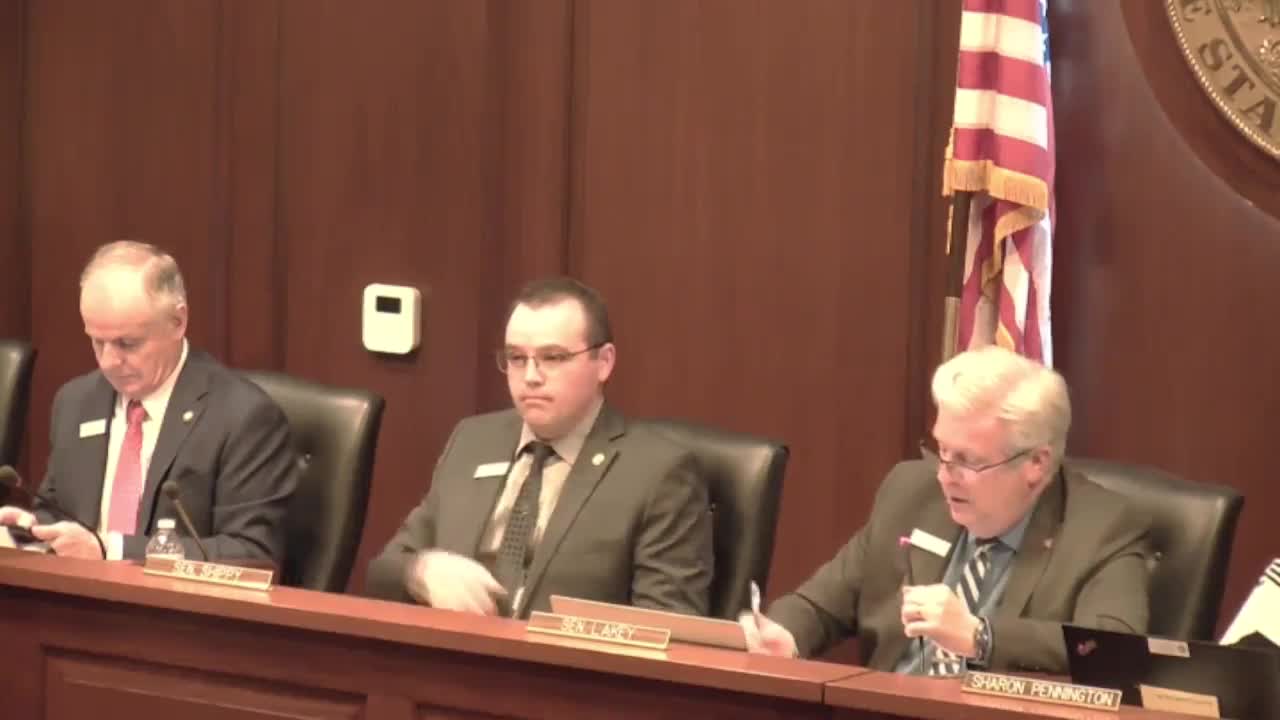
Senator Acdy moved to send SB1001 to the floor with a due‑pass recommendation; Senator Foreman seconded. The motion carried by voice vote. The bill will proceed to the full Senate for further consideration.