Get Full Government Meeting Transcripts, Videos, & Alerts Forever!
Get email alerts on the Prison Security Transport topic
No spam. Unsubscribe anytime.
Corrections cites drones, contraband and ambush to justify transport-team expansion and surveillance tech
Summary
After an inmate transport ambush last spring that wounded staff, Idaho corrections requested funding for mail‑scanning, drone detection, phone transcription (LEO), expanded transport bureau staffing and a body‑worn camera pilot; the department said these are intended to reduce contraband and mitigate transport vulnerabilities.
The Idaho Department of Correction told the Joint Finance Preparations Committee on Feb. 4 that a spring incident in which correctional staff were shot while escorting an inmate to a hospital exposed vulnerabilities in transport and contraband controls, and the agency proposed multiple technology and staffing measures to reduce future risk.
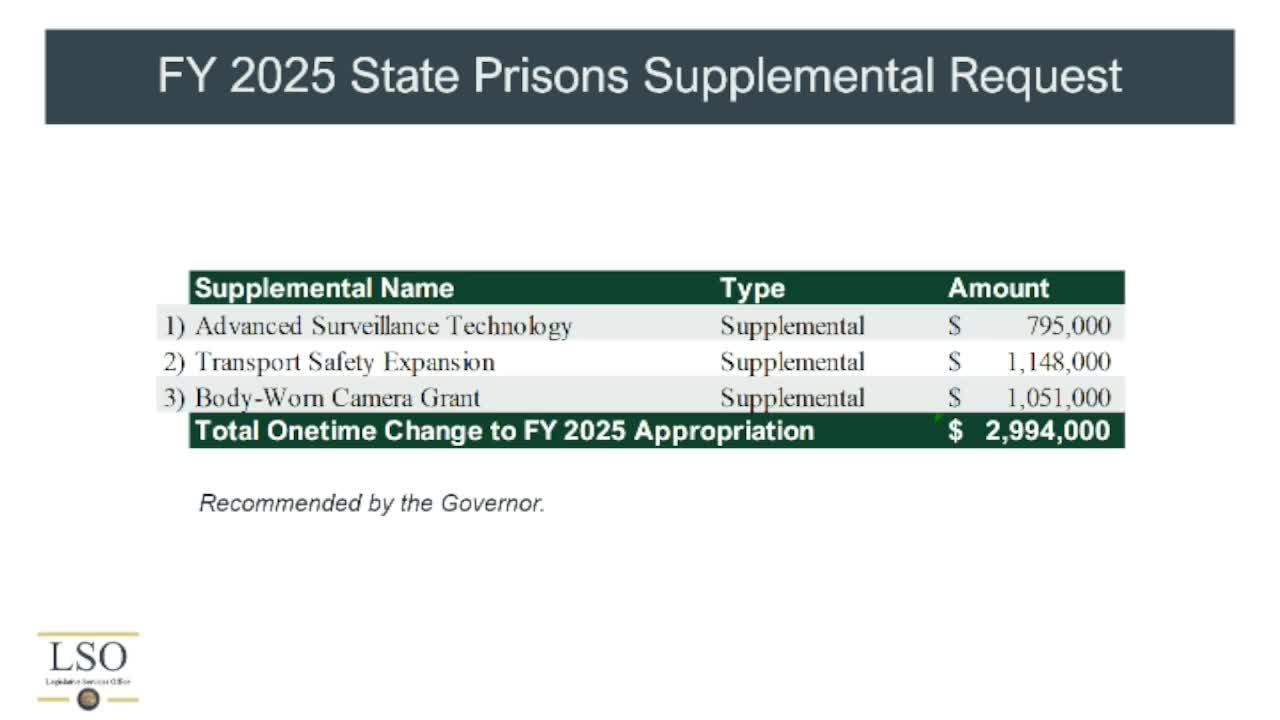
Noah Peterson, legislative budget analyst, summarized the state prisons division requests. He described three supplemental proposals tied to the incident and ongoing security needs: advanced surveillance technology (digital mail scanning, drone detection and phone‑call transcription/analysis), an expansion of the transport bureau and a federal body‑worn camera pilot.
Peterson said the agency requested $795,000 in supplemental funding for partial fiscal 2025 implementation of the surveillance package and $2,397,000 ongoing in fiscal 2026 for the full suite. He broke the ongoing cost into components: digital mail scanning ($1,011,000), drone detection ($385,500) and the LEO phone transcription/analysis technology ($1,000,000).
On transport, the department asked for a one‑time supplemental of $1,148,000 to expand the Transport Safety Bureau. Peterson said that amount would fund 12 positions for the remainder of the fiscal year (about $455,000 in personnel costs) and $693,000 for operating costs that would include seven fully equipped vehicles (six SUVs and a wheelchair van). The agency requested $965,500 ongoing to support the expanded bureau (about $909,000 of that for personnel).
Peterson described a $1.05 million body‑worn camera pilot request chiefly funded by federal dollars, with a small state match. He said the supplemental would buy front‑end equipment and licenses and that the state would face ongoing licensing costs in later years as part of the match.
Director Josh Tewalt told the committee the transport expansion is meant to provide a trained, ready resource for high‑risk transports rather than to assume every emergency transport statewide. He said facility staff historically handle emergency transports as an additional duty, which in certain facilities “means if somebody has to go to the hospital, we're calling an ambulance ... we're gonna pull somebody off of their post and say you're gonna go in the ambulance and then we're gonna send a chase vehicle behind them.” He added that the specialized transport team has higher firearms and medical qualifications and that redeploying such capability statewide without a central team would require significantly more staff.
Tewalt also urged the value of mail digitization and drone detection. He said digitizing mail removes the department’s “most porous point of entry for contraband” and frees staff for other security tasks. On drone threats, he said the sophistication and frequency of drone drops have increased and that layered detection can identify and help intercept contraband deliveries and help law enforcement pursue operators.
The governor’s recommendation differed from the agency on one item: the agency requested a one‑time $83,200 purchase of a skid‑steer for St. Anthony to do snow removal; the governor recommended $30,000 ongoing to contract snow removal instead. DFM staff told the committee the governor preferred contracting to purchasing seasonal equipment to avoid long‑term equipment replacement costs.
Ending: Lawmakers asked questions but did not take final action on the security or transport requests during the session. Agency and analyst staff said some items will require additional follow‑up or statutory changes if the legislature directs appropriation.