Get Full Government Meeting Transcripts, Videos, & Alerts Forever!
Get email alerts on the Recidiviz Software topic
No spam. Unsubscribe anytime.
Idaho corrections seeks ongoing funding for Recidiviz tools after pilot use in probation and parole
Summary
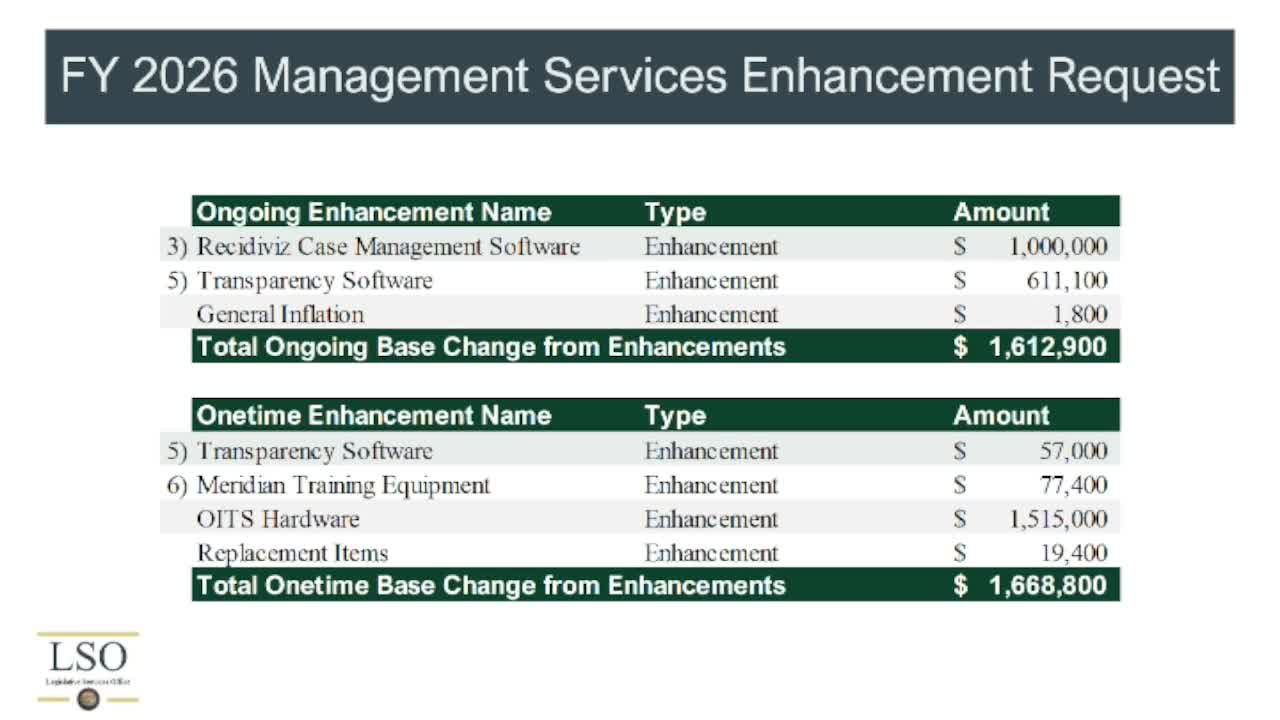
The Idaho Department of Correction asked the Joint Finance Preparations Committee on Feb. 4 to approve ongoing funding for Recidiviz tools the agency has used in probation and parole and now seeks to expand into prisons.
The Idaho Department of Correction asked the Joint Finance Preparations Committee on Feb. 4 to approve ongoing funding for Recidiviz tools the agency has used in probation and parole and now seeks to expand into prisons.
Noah Peterson, budget and policy analyst with the Legislative Services Office, described the request during the Management Services division briefing. He said the department previously received one-time federal funds to build tools and now seeks ongoing appropriation to continue development.
Director Josh Tewalt told the committee Recidiviz is “a nonprofit tech company” that aggregates data from outdated and disparate correctional systems and “automate[s] a lot of processes that take a lot of staff time.” He said the agency uses Recidiviz to produce case-triage tools so probation officers get prioritized lists of who needs attention and to compare outcomes at the officer level.
Tewalt said the department plans to transition that functionality to prison case managers so staff can track individuals’ progress in “a more real time and dynamic way” and use the work completed to inform classification tools. He added that because Recidiviz is a nonprofit, “every penny we spend is leveraged against private philanthropic dollars. So for every dollar we spend, they match, with private foundation money.”
Committee members asked for evidence of impact. Senator Cook asked for hard ROI data; Peterson said he did not have hard numbers but could work with the agency to produce them. Representative Tanner and others asked for sample dashboards and described interest in seeing what data goes into the system and how it is used.
Tewalt told members the state controls the data shared with Recidiviz under data-sharing agreements and that Recidiviz pulls data from the department’s systems rather than recreating it. He also said the tool allows comparative analysis with other participating jurisdictions while protecting identifying details.
Several legislators expressed concern about moving a program initiated with federal funds to ongoing general-fund support. Tewalt responded that the department has used federal grants to pilot innovations and comes to the legislature for general-fund support only when a program is scalable and proven useful.
The department did not present detailed, committee-ready ROI figures during the hearing but said it would provide dashboards and usage data to the committee on request.
Ending: The committee did not take a vote on this request during the session. Staff said they would follow up with the department and the Legislative Services Office to provide requested dashboard views and any available outcome data.