Get Full Government Meeting Transcripts, Videos, & Alerts Forever!
Get email alerts on the Tax Policy topic
No spam. Unsubscribe anytime.
Staff briefing: sales tax distributions have reduced general fund share; Techum bond carve-outs and tax-relief fund cited
Summary
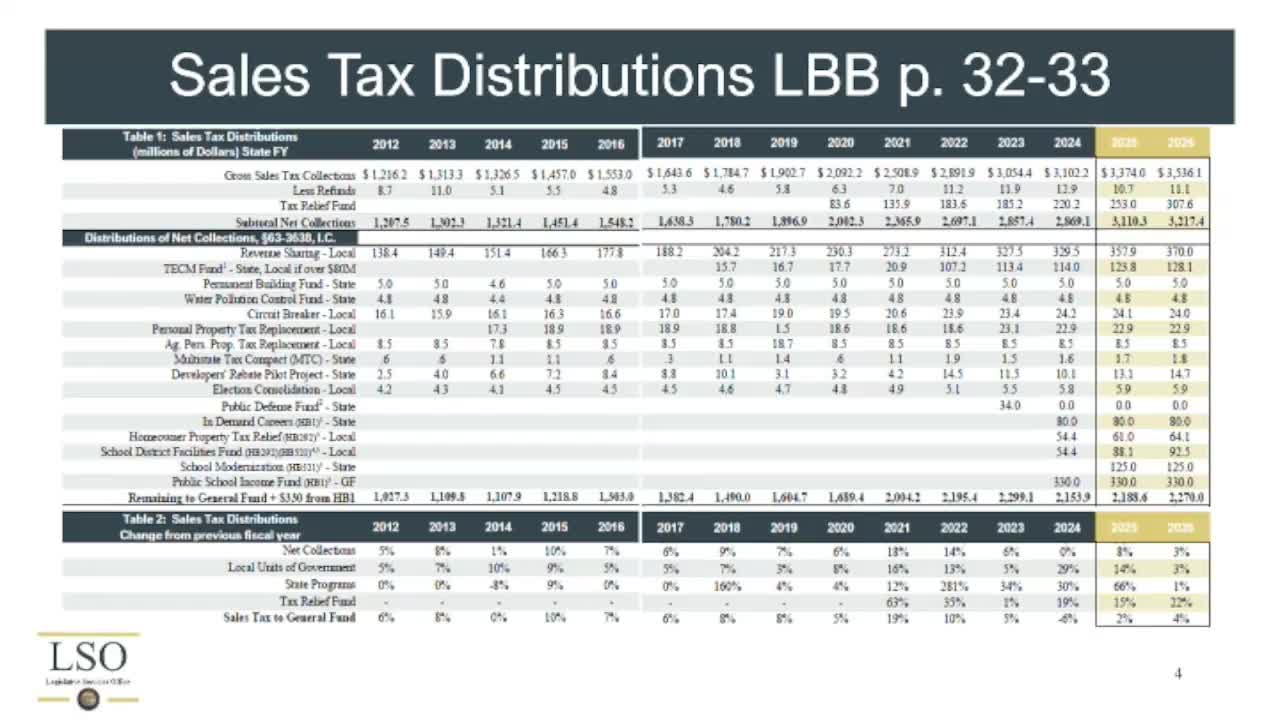
Legislative budget staff briefed JFAC on how statutory sales-tax distributions — including the tax-relief fund and Techum allocations — reduce the share of sales tax available to Idaho’s general fund.
Legislative budget staff told JFAC that statutory distributions have reduced the share of gross sales-tax collections routed to Idaho’s general fund and cautioned that new earmarks could further limit the revenues available to appropriate.
Keith Bybee, Division Manager for Budget Policy Analysis, walked members through the sales tax distribution formula in statute (63-36) and the components that reduce gross collections before the general fund receives a share: refunds, the tax-relief fund (receiving online-retail sales tax receipts), and a series of statutory earmarks and distributions to local governments and state programs. Bybee said that, historically, the general fund received roughly 85–86% of sales-tax collections but that by fiscal 2025 the general fund is projected to receive about 65% after the statutory distributions are applied.
Bybee noted several specific statutory distributions: revenue sharing with local units (11.5% of net collections), a 4.5% allocation for Techum (with $80 million of that earmarked for bonding in current law), and recent allocations for school modernization and other state programs. The tax-relief fund redirects online-retailer sales-tax revenue and is projected to be a significant driver of growth in the “other” category of revenues.
On possible changes, legislators asked about the governor’s proposal to add roughly $50 million for Techum projects. Bybee said he had not seen final bill language but explained two ways such a change could be implemented: (1) identify an additional, fixed dollar carve-out for Techum (which would reduce general-fund availability dollar-for-dollar), or (2) absorb the new amount within the existing percentage allocation; the latter would require only small adjustments if the percentage calculation already yields the needed amount. He cautioned that if the change is made in addition to the existing 4.5% formula, the added dollars would reduce amounts otherwise available to the general fund.
Bybee closed by reminding members that sales tax is the state’s most stable revenue source and that reducing the general-fund share of sales tax through statutory earmarks can increase the size and difficulty of cuts the legislature must make in a downturn. He said staff will provide corrected tables and a general-fund daily update before the next hearings.
Ending: Staff will correct and post supporting tables; the committee continues revenue and distribution analysis as it prepares appropriation decisions.