Get Full Government Meeting Transcripts, Videos, & Alerts Forever!
Get email alerts on the State Budget topic
No spam. Unsubscribe anytime.
DFM presents governor’s executive budget emphasizing education, reserves and $100 million in tax relief
Summary
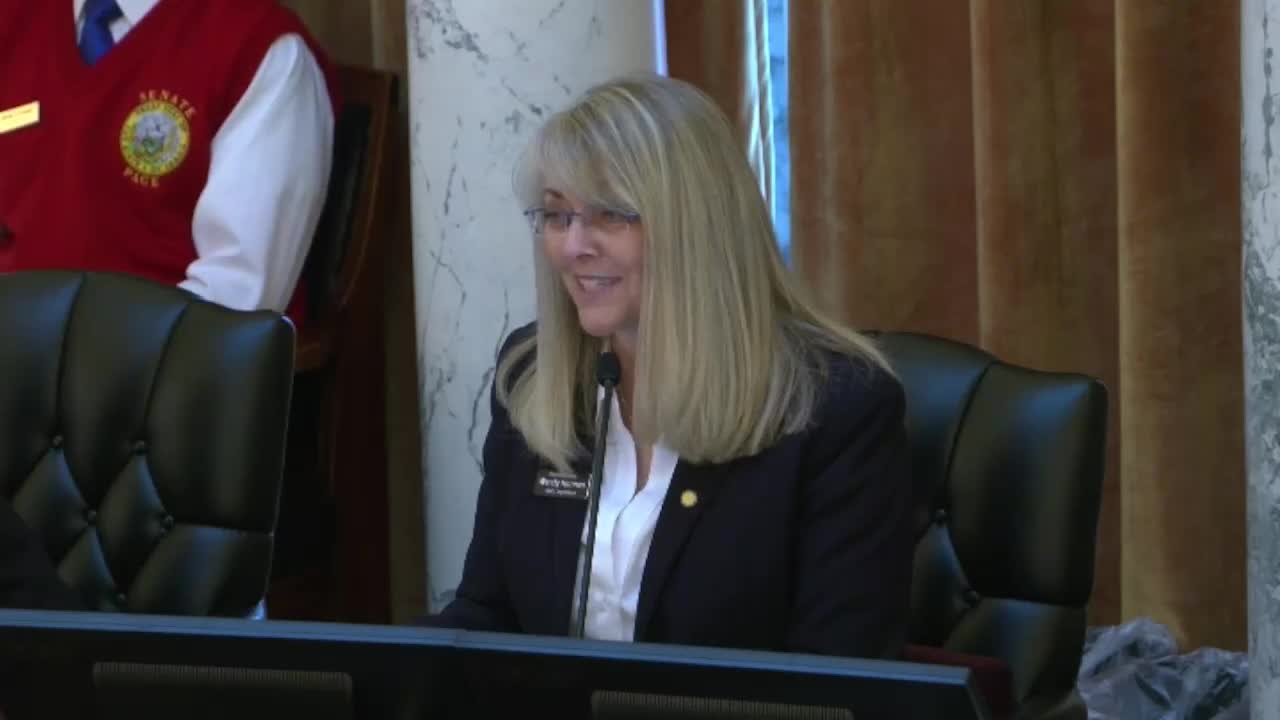
Laurie Wolf, administrator of the Division of Financial Management, presented the governor’s executive budget to the Joint Finance‑Appropriations Committee on Jan. 8, outlining recommended enhancements for fiscal 2026, conservative revenue assumptions and transfers to rainy‑day accounts while reserving $100 million for tax relief.
Laurie Wolf, administrator of the Division of Financial Management, presented the governor’s executive budget to the Joint Finance‑Appropriations Committee on Jan. 8, outlining recommended enhancements for fiscal 2026, conservative revenue assumptions and transfers to rainy‑day accounts while reserving $100 million for tax relief.
Wolf told the committee the plan is “his keeping promises budget,” and said the administration “took a conservative approach” to revenue forecasting as it assembled the package. She described a budget that preserves a structural balance while directing new money to K‑12 education, workforce training, transportation expansion and natural‑resource priorities.
The nut graf: The executive proposal would add about $151 million in recommended enhancements for FY 2026 and maintain a multi‑hundred‑million‑dollar ending balance in each year of the two‑year window. The governor also recommends transfers to state stabilization funds that, if enacted as presented, would leave historically large reserves and set aside $100 million specifically for tax relief.
Most important facts first: Wolf described projected general‑fund revenue for FY 2026 of about $6.2 billion (the administration’s baseline plus adjustments shown to the committee) and a projected ending general‑fund balance for FY 2026 of roughly $227 million after the package of expenditures and transfers that she presented. The administration proposes a transfer of about $59 million to the budget stabilization fund and $50 million to a public education stabilization fund; after those transfers Wolf said the state would hold roughly $1.4 billion in revert/reserve funds (about 22% of the budget), which the administration characterized as a record high.
Revenue and forecasting: Wolf said the administration used a conservative revenue forecast for FY 2026 after reviewing month‑by‑month receipts for FY 2025 (the administration reported FY 2025 collections slightly ahead of earlier projections through November). She told members the administration preferred to hedge against federal‑level uncertainty and to protect ending balances while still funding priority items.
Maintenance and enhancements: The proposed maintenance budget includes standard inflation and contract adjustments, employer benefit cost increases (the administration cited an increase in per‑employee benefit cost from about $13,000 to $14,300), and population‑driven adjustments that the administration labels “population forecast adjustments.” Wolf said total recommended enhancements for FY 2026 were about $151 million, with roughly $129 million ongoing and the remainder one‑time.
Education and workforce: Wolf said the governor’s highest priority is K‑12 education and the executive recommendation would add roughly $150 million for public schools, including $83 million aimed at teacher pay, nearly $30 million for school health insurance, and $50 million set aside for “education choice initiatives” pending a policy bill. She also described a $25 million workforce initiative: $15 million as one‑time grants that require private match to expand capacity at community and technical colleges and $10 million ongoing to support Career and Technical Education program operating costs.
Transportation and infrastructure: The governor’s budget includes a $50 million request to the Idaho Transportation Department to support expansion and congestion mitigation projects, Wolf said, explaining the department expects to exhaust certain bonding capacity built on prior revenue streams (the administration noted ITD has large unfunded expansion needs statewide). The proposal also calls for a roughly 3% increase to the state’s strategic initiatives fund for roads and local projects.
Natural resources and fire funding: Wolf said the governor recommends a supplemental transfer of $60 million in FY 2025 to replenish fire suppression accounts after an active season and requests $40 million ongoing for FY 2026 to stabilize funding for wildfire response. She framed the ongoing amount as intended to keep a steady balance in the suppression account so the state can respond without scrambling for funds each year.
Water and permitting: The executive proposal includes $30 million ongoing for the Idaho Water Resource Board to support prioritized recharge and water‑supply projects, and Wolf said the governor intends to pursue permitting reforms at the state level to speed major projects.
Public safety and cybersecurity: The budget includes $10 million directed to information‑technology security within the state’s central IT authority and $0.5 million for continuation of a fentanyl program. Wolf also listed investments for corrections and contraband control at state prisons.
Public defense: Wolf briefed the committee on funding for the newly consolidated state public defense program. She said the legislature appropriated $52 million when the consolidation was approved last year; the agency’s initial FY 2026 request sought roughly $17 million more. Administrative review, recruiting difficulties and a December state Supreme Court decision increased the estimated funding need. Wolf told the committee the governor recommends a $5.4 million supplemental for FY 2025 and a $16.8 million one‑time addition for FY 2026; she said the total recommended FY 2026 funding for the state public defense program is about $83 million.
Tax relief and reserves: After listing those investments, Wolf said the governor “is holding a hundred million dollars for tax relief for Idahoans” and emphasized simultaneous strengthening of the state’s reserve accounts. Wolf and staff highlighted that keeping robust reserve balances preserves the state’s credit profile and reduces risk in weaker economic years.
Questions from committee: Members asked about differences in year‑over‑year spending growth, the role of transfers versus direct expenditures, the administration’s approach to transportation bonding and why the governor recommended ongoing wildfire funding. Wolf and budget staff answered with the revenue, expenditure and statutory reasons they used to structure the package and said more detail would be available in agency hearings.
What happens next: Committee staff said agency presentations and work‑group meetings will follow; the committee will examine maintenance budgets and enhancements by agency over the coming weeks and is scheduled to set program maintenance budgets on Jan. 17. Administrators and LSO analysts told members they will provide additional detail for items such as GEAR‑funded workforce grants, the technical breakdown of population adjustments, and the public‑defense supplemental before final budget action.
Ending: The governor’s proposal sets the broad priorities and reserves discussed in the presentation; the committee will continue line‑by‑line review during scheduled hearings and work‑group sessions over the next several weeks.