Get Full Government Meeting Transcripts, Videos, & Alerts Forever!
Get email alerts on the House Rules topic
No spam. Unsubscribe anytime.
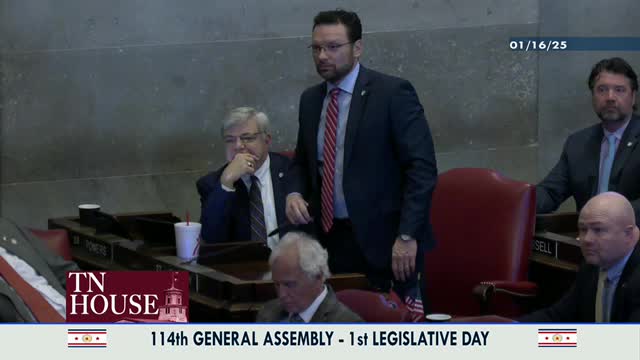
Tennessee House adopts permanent rules, shifts committee final votes to electronic system and adds sanctions and gallery conduct limits
Summary
The Tennessee House of Representatives adopted a package of permanent rules on Jan. 13 that change committee voting to recorded electronic votes for final action, add graduated sanctions under Rule 19 that can include temporary remote voting, and tighten gallery conduct.
The Tennessee House of Representatives adopted a package of permanent rules on Jan. 13 that will change committee voting procedures, add progressive sanctions for members who repeatedly violate decorum rules, and tighten conduct standards for observers in the gallery.
Members voted to adopt the report of the House select committee on rules after extended debate over several provisions, including a requirement that final votes in committees be recorded electronically and an expanded disciplinary pathway under Rule 19 for members deemed to have repeatedly violated chamber rules.
Supporters said the electronic system will modernize committee practice and reduce ambiguity on how members voted during committee action. “The system that was installed while we were gone … now have the ability to be able to do an electronic vote,” Leader Lambert said, adding that the change will make committee final actions comparable to floor votes. Representative Parkinson and others sought clarification about whether voice votes remain possible; speakers said recorded electronic voting will be the default for final committee action but that the calendars committee will remain a voice-vote exception because of the pace and volume of business it handles.
Debate also focused on Rule 19, which sponsors said adds graduated steps for members who are called to order for disorderly conduct. Under the new language, a member who repeatedly violates Rule 19 on a single legislative day may be barred from recognition for the remainder of that day. The rule also provides an option — not an automatic penalty — to permit a member to cast votes remotely from a secured room for several legislative days following the violation. “If a member under Rule 19 gets to this point, it will not go into effect that particular day. They just will not be recognized under Rule 19 for that violation. The next legislative day and the next three legislative days the remote capability will be available to that member,” Representative Garrett said during debate, describing how the floor extension will be used as an alternative to continued in-chamber recognition.
Members pressed for process clarity on the remote option, whether attendance would be recorded as present or absent, and whether the remote room would be mandatory; sponsors said the remote capability is optional and intended as an extension of the floor where the House rules still apply. “It is just like an extension of this floor,” Garrett said. Representative Zachary asked for confirmation that the House rules will apply in the remote room; Garrett answered that the room would be subject to the same rules and limited access.
The package also clarifies bill-limit exceptions and the treatment of ‘‘private acts.’’ Sponsors confirmed that traditional private acts are excluded from a member’s bill limit and said a carefully drafted “general bill of local application” could also, in some circumstances, be exempt from the bill limit if it meets specified drafting criteria and the clerk concurs.
Another notable addition is a clarified rule for gallery conduct. The new language instructs the speaker to remove any person who attempts to attract attention of anyone on the floor or whose conduct the speaker deems detrimental to orderly business; persons removed will be barred from the gallery for the remainder of that legislative day and the next legislative day, and for more egregious or repeated conduct may be prohibited from returning for the remainder of the general assembly. Sponsors compared the approach to common practice in other legislatures and in Congress.
Public-access concerns surfaced during the session when Representative Jones asked the speaker to apologize to “Miss Jane,” a senior visitor from Tullahoma who reportedly stood in line for about an hour, fell and hit her head inside the gallery. Jones characterized the incident as an ADA-accessibility issue and urged the House to prioritize seating and access for older visitors. Sponsors said the gallery rule is intended to preserve observation while limiting disruptions.
The House adopted the rules package after debate; the select committee report was adopted as the permanent rules of order for the 114th General Assembly.
Implementation details and training were discussed on the floor: sponsors said microphones and the installed system can run recorded votes in committees much like floor voting, and clerks will publish committee-level roll-call results online for final actions.
The rules package passed after debate and procedural votes; the House recorded the adoption in the chamber minutes.