Get Full Government Meeting Transcripts, Videos, & Alerts Forever!
Get email alerts on the Public Safety Human Trafficking topic
No spam. Unsubscribe anytime.
Committee backs bill tightening oversight of massage businesses after trafficking concerns
Summary
Lawmakers unanimously reported Senate Bill 221 with amendments after testimony about illicit massage businesses that investigators say are fronts for human trafficking; the bill requires criminal background checks, allows unannounced inspections on complaint, prohibits sleeping quarters and empowers license revocation.
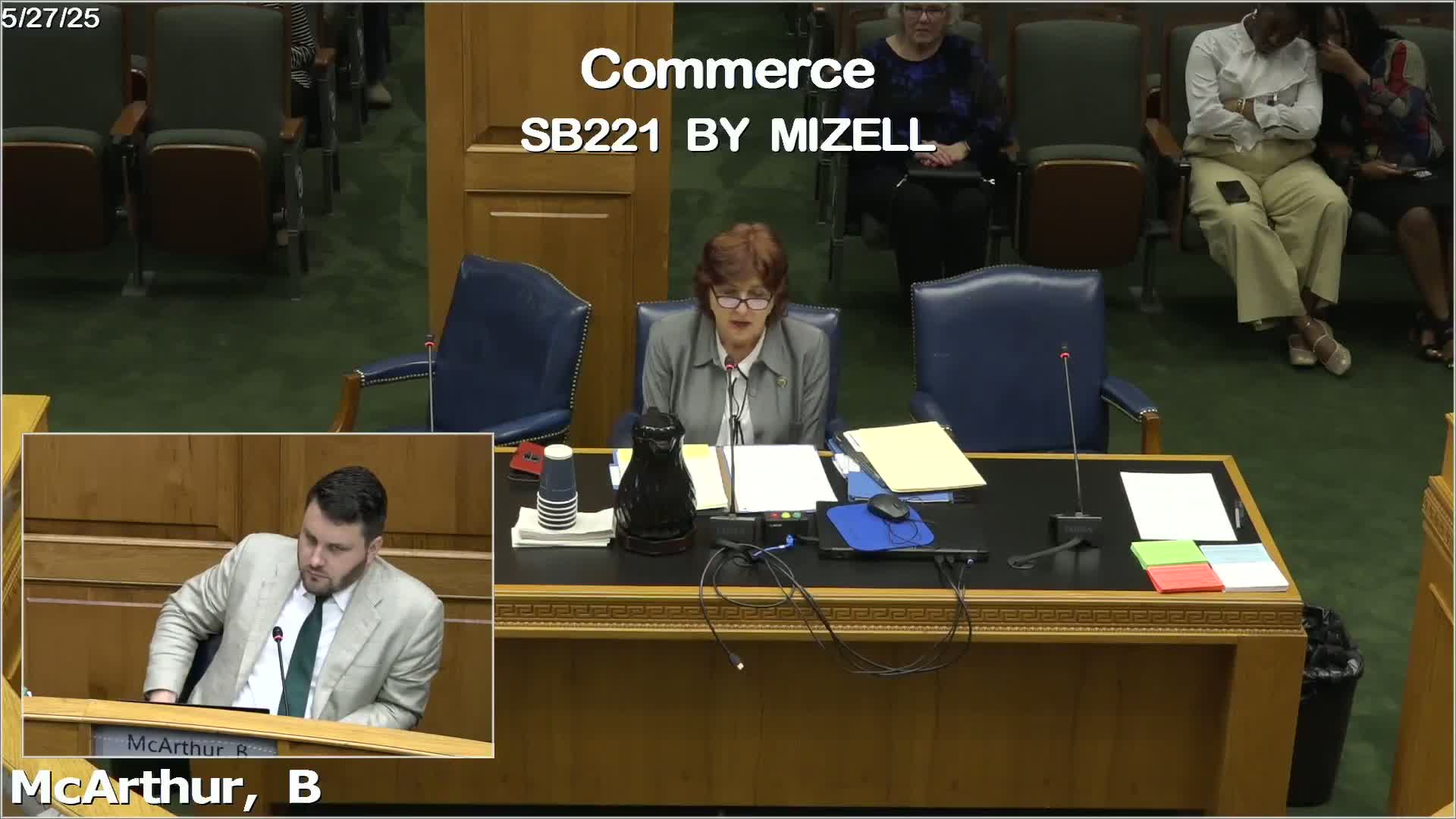
After lawmakers and law‑enforcement representatives described repeated complaints about illicit massage businesses housing and exploiting victims, the House Commerce Committee on May 27 reported Senate Bill 221 with amendments to give regulators and investigators new tools.
Senator Mizell, sponsor of the bill, opened the discussion by recounting complaints from a sheriff’s deputy in East Baton Rouge about premises where “women, mostly immigrant, non‑English‑speaking women, are held in the building, they have sleep quarters in the building, their passports are taken away from them,” and where advertised services differ from what is happening behind closed doors.
The bill includes several provisions intended to disrupt that pattern: it authorizes unannounced inspections following a complaint alleging illicit activity and requires the Board of Massage Therapy to respond to complaints within 10 days; it requires criminal background checks for establishment applicants; it bars establishments from being used as sleeping quarters; it allows license revocation when the law is broken; and it bars issuance of a new massage license at a location that has had confirmed illicit massage activity, an amendment adopted on the Senate floor and carried into this committee.
“I'm tired of seeing the girls walking up the street and waving out the door,” Representative Newell said during committee discussion. Lawmakers stressed concern for victims, many of whom speak little English and face coercion. Several members said existing enforcement is uneven and that the bill aims to give investigators and the massage board clearer authority to act.
Representatives discussed penalties and enforcement capacity. Committee members noted statutory penalties in the bill are misdemeanor fines ($100–$1,000) and up to six months’ imprisonment and suggested that penalties may need to be revisited or strengthened in subsequent sessions. Members cited a Jefferson Parish ordinance that bars reissuance of a parish license for the premises for one year and one day after revocation as an example of a local approach that could inform state policy.
Lawmakers also discussed implementation challenges identified by the Louisiana Legislative Auditor and the need for coordination with local law enforcement, prosecutors and human‑trafficking task forces. Several members asked that the board report back to the legislature with complaint data, responses and outcomes; the bill asks for legislative reporting on complaints and board actions.
Representative Newell moved to report SB 221 with amendments; the committee, by voice vote, reported the bill favorably.