Get Full Government Meeting Transcripts, Videos, & Alerts Forever!
Get email alerts on the Watershed Authority topic
No spam. Unsubscribe anytime.
House Transportation Committee advances bill to create coordinated upland water authority
Summary
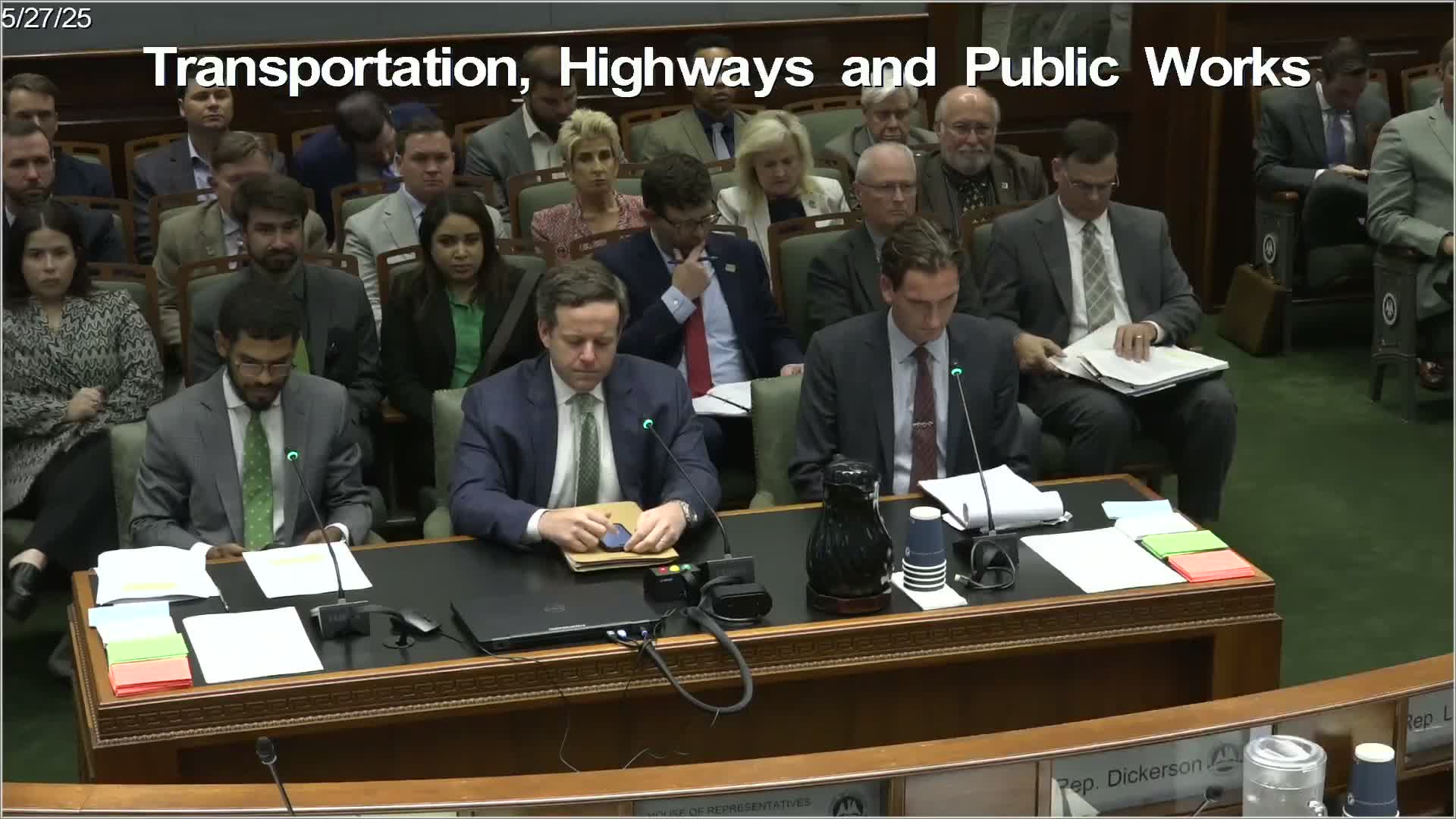
Senate Bill 97 moved forward in the Louisiana House Transportation Committee on Tuesday, May 27, after the panel voted by unanimous consent to report the measure favorably.
Senate Bill 97 moved forward in the Louisiana House Transportation Committee on Tuesday, May 27, after the panel voted by unanimous consent to report the measure favorably.
Supporters, led by Sen. Gary Presley, said the bill would create a new authority to coordinate use of inland waters in noncoastal parishes for recreation, navigation and economic development. "We know that there are two main issues for economic development that we're gonna face over the next 50 years. It's water and power," Presley said during the hearing.
Proponents told the committee the measure is intended to provide a planning and coordination mechanism so local levee districts, ports, drainage districts and other entities can pool data and prepare shovel-ready projects when funding becomes available. Dustin Davidson, deputy secretary at the Department of Energy and Natural Resources, said the intent is planning rather than regulatory preemption: "This is just another tool that those groups may have in order to identify funding or use some state resources on the planning side." Steven Swiber, the state's chief resilience officer, said the bill seeks to replicate aspects of the coastal planning model used by the Coastal Protection and Restoration Authority (CPRA) for inland waters and to help secure federal investment at scale.
Opponents, including Matthew Allen of North Shore River Watch, urged changes to the bill's structure and procedures. Allen said the proposal "risks doing more harm than good" in upland regions and raised concerns about private property rights, the absence of baseline scientific studies and the potential for projects that increase development in flood-prone areas. He asked for longer public-notice periods, baseline environmental and hydrologic studies before projects proceed, and stronger local representation and voluntary conservation mechanisms in the bill.
Committee members questioned whether the proposal would create another layer of government or duplicate existing authorities. Senator Presley and agency witnesses repeatedly said the bill does not remove or diminish the constitutional, statutory or contractual authority of existing levee, drainage, navigation or port districts; Davidson pointed the committee to the bill text (page 22) stating that nothing in the chapter "shall be construed to diminish, impair, or impair the constitutional, statutory, or contractual authority of any levee district, drainage district, navigation district, port commission operating within the upland area." Presley said the intended structure is voluntary coordination and that the governor would appoint the authority's chair from among the members.
Several members pressed for procedural clarifications. The bill as discussed would require an annual master plan submitted to the Department of Natural Resources and to the legislature, supporters said. Questions addressed meeting frequency ("quarterly and as necessary," a witness said), public-notice timing and the degree to which inland districts would retain independent project authority; witnesses answered that local entities would be able to pursue independent projects.
Representative Chasson moved to report Senate Bill 97 favorably. The committee raised no objections and the motion carried by unanimous consent.
The hearing record includes supporters who filed written cards and one witness in opposition who spoke at the table. Committee members and witnesses said they would continue stakeholder discussions on public-notice timing and the inclusion of baseline scientific work in rules or amendments.