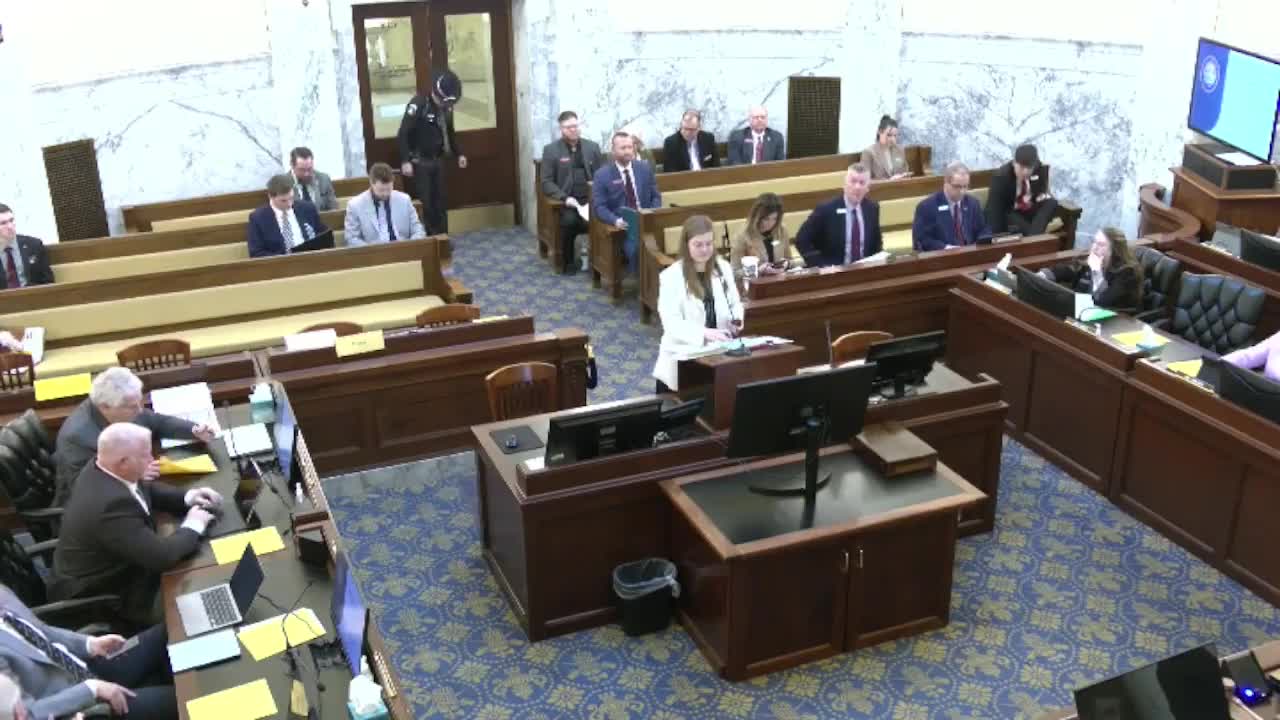
Commerce details broadband funding, BEAD timeline and workforce priorities
Loading...
Summary
The Department of Commerce briefed JFAC on agency structure, broadband spending from state and federal sources, and broader economic development priorities including workforce, housing and childcare; the office outlined BEAD (federal) timelines and local partnership strategies.
The Idaho Department of Commerce outlined its FY2026 budget request, described the status of statewide broadband funding, and discussed broader economic development priorities — workforce, housing and childcare — during the Joint Finance‑Appropriations Committee hearing.
The briefing matters because Commerce administers state broadband funds and federal broadband programs that aim to connect unserved and underserved homes and businesses across Idaho; the department’s decisions shape how ARPA, IIJA and BEAD dollars are allocated and implemented.
Budget analyst Brooke Dupree summarized agency funding and structure. Commerce operates two budgeted programs: the commerce program (42 FTP) and a broadband office (6 FTP) created last legislative session to increase transparency for broadband spending. Dupree said the Idaho Broadband Fund was initially seeded with a $35,000,000 general fund transfer and that ARPA and IIJA federal appropriations have added significantly to the statewide broadband effort.
Dupree and Director Tom Keeley explained recent and anticipated funding flows: the capital projects fund included $120,000,000 from ARPA for broadband, and the state had previously appropriated $100,000,000 of IIJA broadband infrastructure money. Director Keeley and Ramon Sánchez, broadband manager, described the federal BEAD program (approximately $580,000,000 for Idaho under IIJA) and its implementation timeline: pre‑qualification opened in calendar Q1, funding applications were expected in Q2, and grading/evaluation would follow with a final federal submission expected in mid‑to‑late calendar year.
Ramon Sánchez told the committee the Idaho Broadband Fund’s $35,000,000 has about $8.5 million remaining obligated; the ARPA capital projects fund projects are contracted and cover approximately 35,000 homes and businesses across 18 projects. He emphasized collaboration with private internet service providers and local jurisdictions and said Idaho used BEAD planning funds, uniquely among states, to provide planning grants to about 15 local communities to accelerate project readiness.
Legislators asked about technology choices and resilience. Sánchez said BEAD guidance prioritizes fiber, then licensed fixed wireless, with alternative technologies (including low‑Earth‑orbit satellite services such as Starlink) allowed where fiber or fixed wireless are cost‑prohibitive. He said Idaho’s approach is “technologically agnostic” and focuses on delivering required speeds to homes and businesses with the most cost‑effective mix of technologies.
Commerce also addressed workforce and economic development. Director Keeley noted housing, childcare and workforce are key constraints to business growth; the department works with local partners and the Idaho Department of Labor on workforce development, supports private activity bonds for housing and coordinates outreach and best‑practice sharing to help communities accelerate housing and childcare capacity.
On the FY2026 budget, Dupree said maintenance‑type reappropriations for broadband funds were included in the governor’s recommendation and that Commerce requested allocation changes to move reappropriated broadband funds into the broadband office for project oversight and to add one FTP to support distribution of those funds.
Director Keeley closed by urging continued legislative support for commerce priorities and infrastructure investments, saying broadband and workforce initiatives are long‑term projects that will take several years to implement and that the department seeks to maximize return on investment for state dollars.
Committee members did not take immediate action; Commerce committed to continued coordination with BEAD and other federal and local partners as funding rounds proceed.