Get Full Government Meeting Transcripts, Videos, & Alerts Forever!
Get email alerts on the Health Insurance Funding topic
No spam. Unsubscribe anytime.
Joint finance committee approves $14,130 health-insurance funding per full-time state employee
Summary
The Idaho Joint Finance-Appropriations Committee voted to increase the health-insurance appropriation to $14,130 per eligible full-time equivalent (FTE) for fiscal 2026, a compromise figure between committee and governor recommendations; analysts said the change leaves a multi‑million dollar projected reserve.
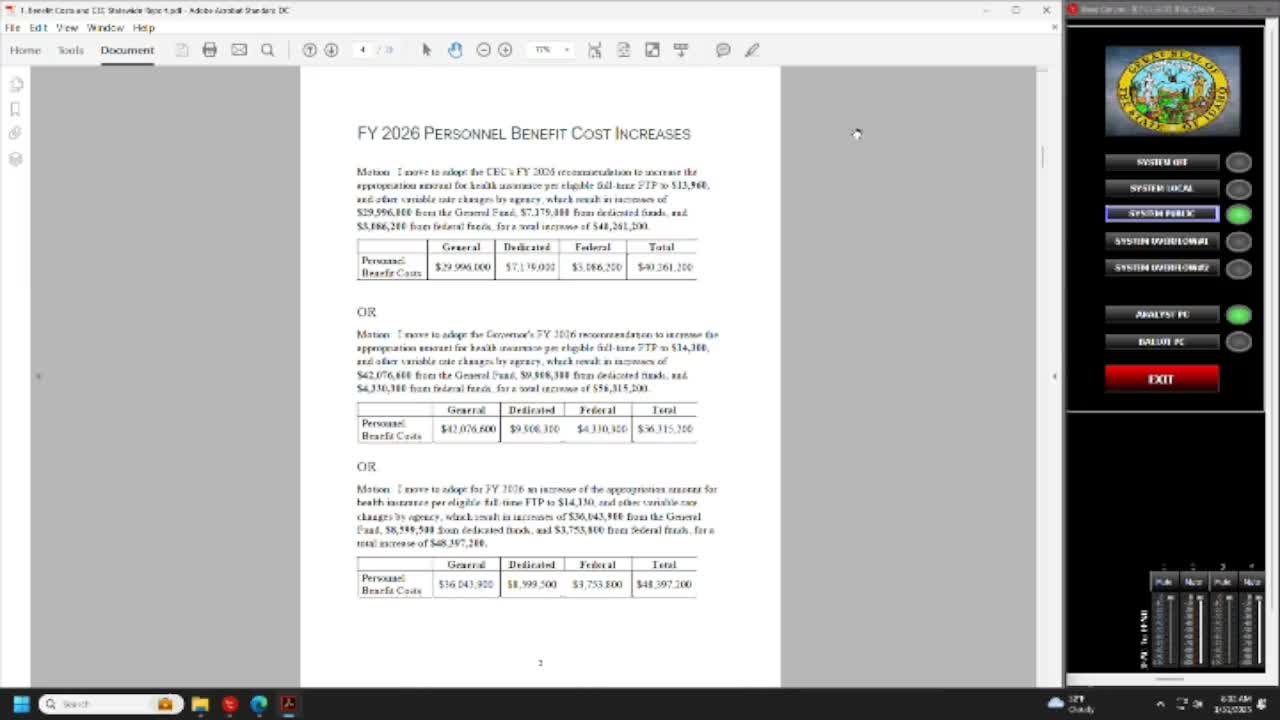
The Joint Finance-Appropriations Committee voted Thursday to set health-insurance funding at $14,130 per eligible full‑time equivalent position for fiscal year 2026, carrying an estimated $48,397,200 in additional personnel benefit costs across state funds.
The motion, moved by Senator Woodward and seconded by Representative Tanner, passed on a joint roll call with 17 ayes, 0 nays and 3 members absent or excused (Senate: 8‑0, two absent; House: 9‑0, one absent). Committee staff said the change also adjusts employer-paid costs such as workers’ compensation and Social Security by agency.
Committee analysts had presented three dollar options: the CEC committee recommendation at $13,960 per FTE, the governor’s recommendation at $14,300 per FTE, and a midpoint compromise at $14,130 per FTE. Mr. Mike Bybee, the committee analyst, said the $14,130 figure is “exactly the midpoint” between the two recommendations and that the most significant driver among the personnel benefit changes is health insurance.
Members debated how the choice would affect the insurance reserve. Bybee told the committee the projected ending reserve balance for fiscal 2026 would be roughly $51.6 million under $13,960 funding, about $61.4 million under $14,300, with the midpoint falling between those figures. Senator Ward Engelking, who spoke in favor of the governor’s higher figure, said the higher number “reflects the actual cost of insurance” and cautioned against using reserves to mask year‑to‑year costs: “If we buy it down again this year, we’re gonna see a big — it’s gonna look like a bigger increase next year than it actually is.”
Representative Furness urged caution about actuarial projections, saying the actuarial firm Milliman has historically produced conservative forecasts and arguing the committee should avoid overfunding the reserve. “If we change insurance policies to save money, we should get a lower discount… and so even by my numbers, the $13,960 that I’m proposing is too high,” Furness said, explaining her preference for the lower recommendation.
After roll call, committee staff directed that the motion carry a due‑pass recommendation. Committee clerks recorded the vote as required and will include the change in the consolidated personnel‑benefit adjustments being sent to the Legislature.