Get Full Government Meeting Transcripts, Videos, & Alerts Forever!
Get email alerts on the Corrections Security Contraband topic
No spam. Unsubscribe anytime.
Idaho corrections seeks tech upgrades, transport expansion after staff shooting
Summary
Following a spring ambush in which three IDOC staff were wounded, the Department of Correction proposed digital mail scanning, drone detection, phone-call transcription and a staffed transport expansion to reduce contraband and improve safety.
The Idaho Department of Correction told the Joint Finance Preparations Committee on Feb. 4 that it is requesting multiple security enhancements after a spring transport incident in which correctional staff were ambushed and three staff members were shot.
Noah Peterson, a Legislative Services Office analyst, summarized supplemental and ongoing requests the agency says are designed to reduce vulnerabilities uncovered after the incident. Peterson described a chain of events in which an inmate being returned from emergency medical care was ambushed by a lone gunman; the transcript states that three IDOC staff were shot and that the suspect and the inmate were suspected of committing two murders before being apprehended about 36 hours later.
The agency asked for a one-time FY2025 package of about $795,000 to implement three technologies across facilities: digital mail scanning (mail is opened and scanned off-site and delivered digitally to limit contraband), a layered drone-detection system, and a "LEO" intelligence system for phone-call transcription and analysis. Peterson estimated the FY2026 annualized cost for all three at roughly $2.397 million, with the digital mail scanning portion at about $1.011 million, drone detection at $385,500 and phone-call transcription and analysis (LEO) at $1 million.
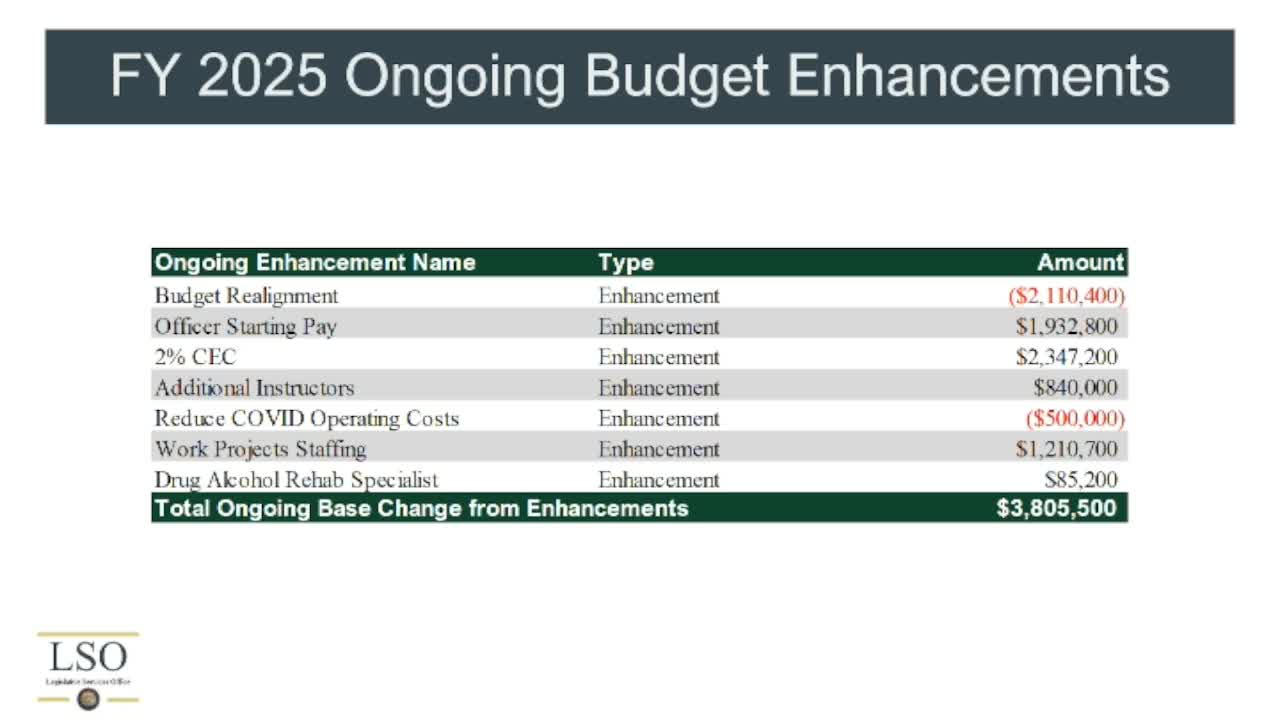
To address vulnerabilities in emergency medical transports, the agency proposed expanding its statewide transport bureau. The supplemental asked for 12 positions and associated equipment as a onetime FY2025 request ($1,148,000 total for the remainder of FY2025, including $455,000 personnel and $693,000 operating to outfit seven vehicles). The ongoing cost to staff the bureau year-round was presented as about $965,500 and 12 full-time positions, according to Peterson. Director Josh Tewalt described how emergency transports had been handled historically as an other duty assignment and said the expansion is intended to provide a trained, specialized resource for high-risk transports instead of repeatedly reassigning facility staff.
The agency also proposed a federal body-worn-camera pilot budgeted at roughly $1,051,000 in FY2025 to equip three sites (Idaho Maximum Security Institution, District 3 probation and parole and the special investigations unit). Peterson said the supplemental would be primarily federally funded with a small state match appearing in FY2026; testimony listed $1,024,000 as federal and $27,000 from the general fund in the FY2025 request.
Lawmakers questioned the cost and trade-offs. Senator Cook asked why the transport expansion required 12 new FTP instead of reallocating existing posts; Peterson and Director Tewalt replied that the overtime and relief-factor implications made reallocations impractical without significantly increasing total staff. Peterson cited thousands of overtime hours at major facilities; Tewalt described the higher training and equipment required for the transport bureau and said alternative options (creating full-time tactical teams or substantially increasing relief factors at maximum-security posts) would be more costly.
Representative Petzke asked about a skid-steer purchase to support snow removal at the St. Anthony work camp. The governor recommended a $30,000 ongoing contract for snow removal rather than the agency's one-time $83,200 equipment purchase; DFM said contracting was chosen to avoid storing and replacing seasonal heavy equipment. Director Tewalt said the department would refine logistics and try to contract for the service rather than buy the loader.
Director Tewalt framed contraband and autonomy-enabled threats as rapidly evolving. He told the committee that technologies and techniques used to introduce contraband—drones, chemically treated inks in printed materials, and cell-phone networks—have grown more sophisticated and argued that mail digitization and phone-call transcription are defensive investments that also produce intelligence useful to state and federal partners.
The governor recommended most items in the packet; the committee requested additional cost and operational detail as it considered the FY2026 base implications.