Get Full Government Meeting Transcripts, Videos, & Alerts Forever!
Get email alerts on the Initiative Process Reform topic
No spam. Unsubscribe anytime.
Committee weighs House Bill 85 to add governor veto and supermajority steps to initiative process; motion to advance fails on 7-7 tie
Summary
House Bill 85, authored by Representative Bruce Skogg, would change Idaho's initiative process to add governor presentment and a higher threshold in some cases; public witnesses and multiple representatives testified for and against the measure; a motion to send the bill to the floor with a 'do pass' recommendation failed on a 7-7 tie.
Representative Bruce Skogg presented House Bill 85 to the House State Affairs Committee, proposing changes to Idaho's initiative and referendum process that would, among other things, insert the governor into the presentment process and create a mechanism tied to a two-thirds threshold for certain initiative outcomes.
Skogg told the committee the bill would make the initiative process more consistent with the legislative process by giving the governor an opportunity to veto initiatives that pass by a simple majority, arguing the governor should have the same presentment role the Legislature has when it enacts laws. "The initiative process is essentially coextensive with the legislature's power to enact legislation," Skogg said, citing Article 3, Section 1 of the state constitution.
Committee members and staff reviewed a flowchart prepared by Representative Achilles illustrating how H-85 would operate: initiatives passing with two-thirds of votes would become law immediately; initiatives that pass with a simple majority would be presented to the governor, who could approve or veto; if vetoed, the Secretary of State could place the question again on the next general election, where a two-thirds vote would be required to override the veto. Achilles and others discussed estimated incremental ballot costs (committee materials estimated about $300,000 if the measure were the only question on a ballot) and clarified existing constitutional and case-law constraints raised in the discussion.
Public testimony was sizable and mixed but leaned against the bill in the hearing record. Dr. Jean Henscheid, co-president of the League of Women Voters of Idaho, testified in opposition, calling H-85 an effort "to block policies popular with citizens" and urging the committee not to send the bill to the floor. Russ Hendricks of the Idaho Farm Bureau testified in support, saying the measure would protect rural interests he said can be overwhelmed by urban vote concentrations. Conservation Voters for Idaho's Ryan McGoldrick, Stefan Qui (a Boise resident), Kathy Dawes, and Jeffrey Watkins each urged the committee to oppose H-85, arguing the initiative process was intended to be independent of executive presentment and warning of concentrating power in the governor's office.
Committee debate reflected the division in written and oral testimony. Representative Boyle said she opposed the motion to advance because she believed the measure would cede political power and that, politically, the Legislature would be unlikely to override a governor who approved an initiative. Representative Mickelson and Representative Achilles also spoke against advancing the bill; Achilles cited public-opinion polling and historical examples of initiatives (Fish and Game, property-tax exemptions, the Sunshine Law, Medicaid expansion) to argue the initiative process has produced long-standing public benefits and that the courts have treated citizen-initiated laws as having equal footing with legislative laws.
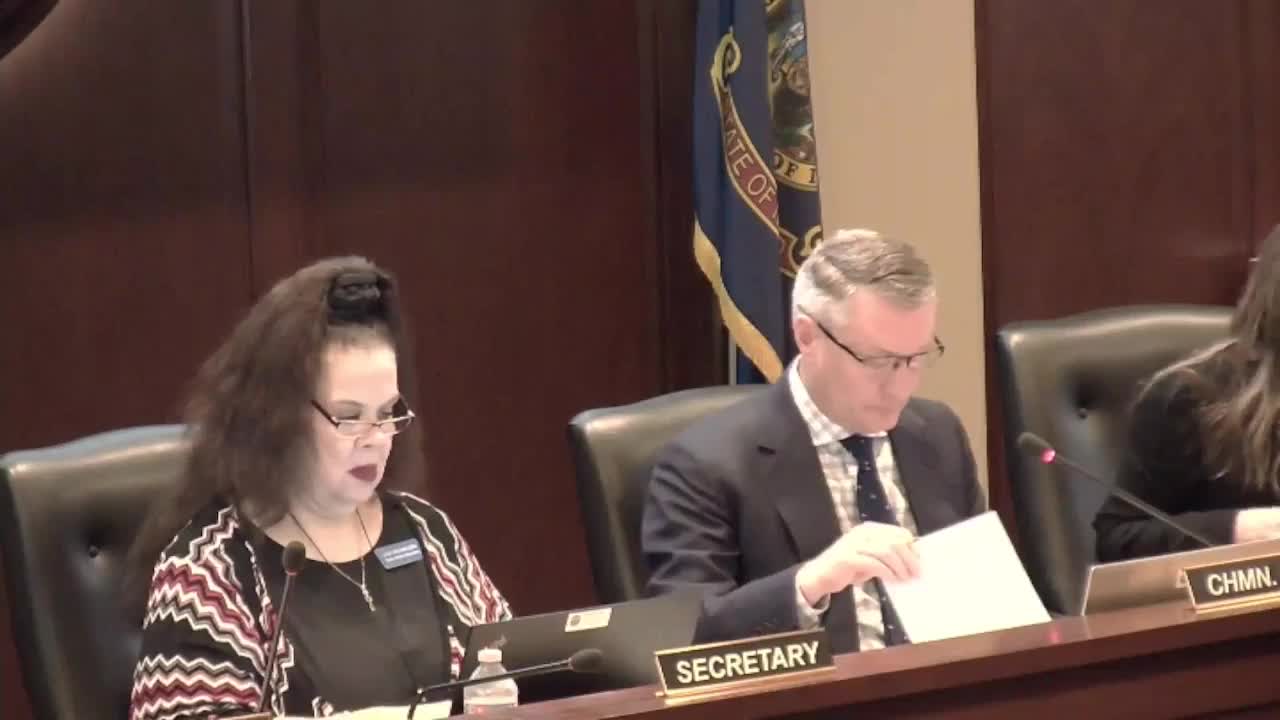
Representative Barbieri moved that the committee send House Bill 85 to the floor with a "do pass" recommendation. The committee secretary then called roll. The roll call recorded a split outcome and the chair announced the motion "fails on a tie vote 7 to 7." Chairman Crane declared the committee adjourned following the vote.
The committee record shows an extended, bipartisan debate and formal public testimony both for and against H-85. The tie vote leaves the bill without a committee 'do pass' recommendation at this time.