Get Full Government Meeting Transcripts, Videos, & Alerts Forever!
Get email alerts on the Child Welfare Reform topic
No spam. Unsubscribe anytime.
JFAC funds 63 FTEs and $21.25 million for child welfare FY2026 enhancements; ties staffing to performance measures
Summary
The committee approved FY2026 enhancements for the Department of Health and Welfare’s Division of Youth Safety and Permanency that add 63 FTEs and $21,245,700 (mix of General and federal funds) and included language tying foster‑licensing staff to a 1:1 foster families‑to‑children ratio goal.
The Joint Finance‑Appropriations Committee on March 14 approved a FY2026 enhancement package for the Department of Health and Welfare’s Division of Youth Safety and Permanency that added 63 full‑time positions and roughly $21.25 million in total funding to support prevention, licensing and foster program clinical staff.
Representative Tanner moved the FY2026 enhancement motion; Senator Cook seconded. The adopted motion added 36 FTEs for a prevention specialist team, 9 FTEs for additional youth safety and permanency staff, 10 FTEs for foster program clinical staff (the governor recommended 10 of 15 requested), 8 FTEs tied to foster program licensing staff, and funding for temporary staff and operations at the Payette Assessment and Care Center. The motion set totals of $13,774,600 General Fund and $7,471,100 federal funds for a combined $21,245,700 and added 63 FTEs. Committee roll call produced 18 ayes, 1 nay and 1 absent/excused.
Analyst Alex Williamson summarized the package and noted the committee and work group had reduced some original agency requests; the prevention specialist team request was substantial and occupies a central role in the committee’s strategy to reduce high‑cost congregate placements. Committee members stressed prevention (in‑home services) as a lower‑cost alternative — members cited a per‑day cost of roughly $1.80 for prevention compared with $380 per day for congregate care — and said the enhancements were an investment that may reduce future outlays.
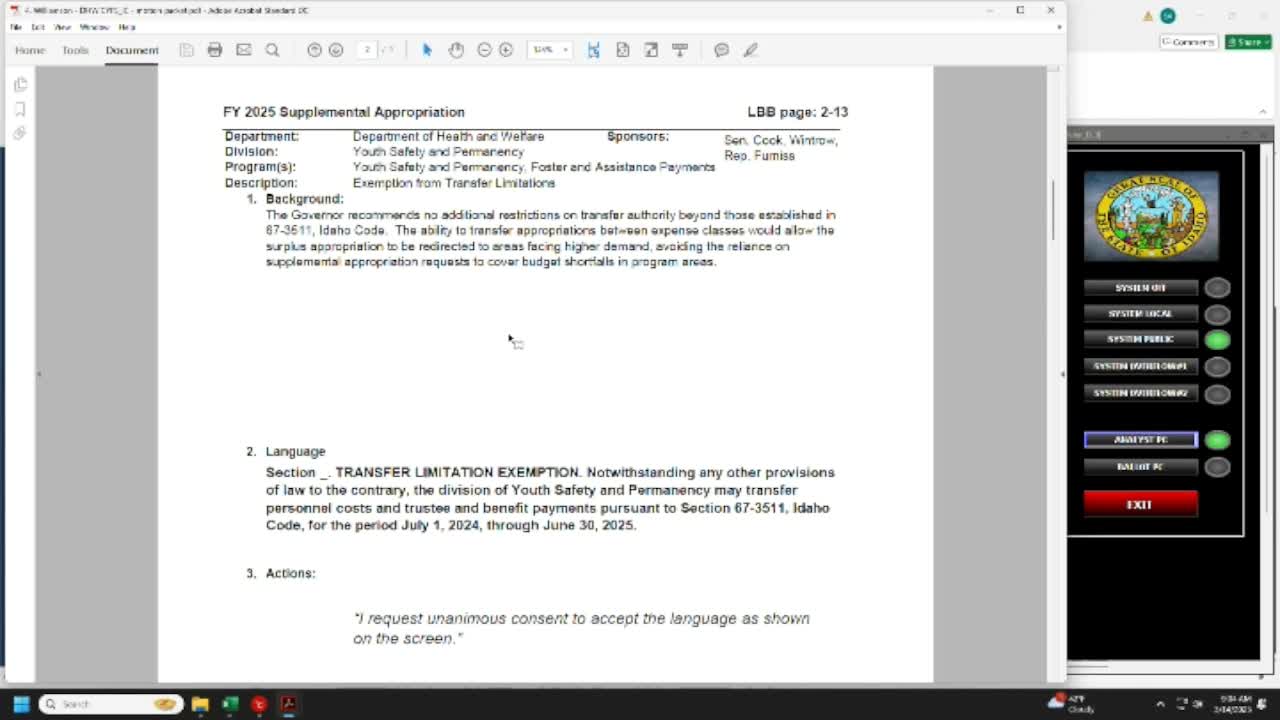
The committee also adopted language that exempts the child welfare division from certain departmental transfer limitations for FY2025 and FY2026 (the language cited committee code references during the hearing). Significantly, the foster licensing piece of the enhancement tied funding for eight of the new positions to a performance target: achieving a one‑to‑one ratio of foster families to foster children by Jan. 1, 2026, with preliminary status reports to the committee and a reporting milestone by Sept. 15.
Committee leaders said they will monitor early outcomes and expect status reports; members stressed that the funding is contingent on delivery of results and that they will evaluate progress during the summer and fall workgroup schedule.
Next steps: The enhancements and the associated performance language will proceed to the floor under the committee’s due‑pass recommendation. The department will implement the approved positions and report progress according to the language adopted by the committee.