Get Full Government Meeting Transcripts, Videos, & Alerts Forever!
Get email alerts on the State Board Rules topic
No spam. Unsubscribe anytime.
State Board presents rules package including teacher-apprenticeship changes; committee pauses votes for review
Summary
Matthew Ryber of the State Board of Education presented a multi-part rules package affecting accreditation, Opportunity Scholarship renewal, school facility reporting, teacher-certification pathways including a registered-apprenticeship route, IDLA final projects, and vocational rehabilitation rules.
The Idaho State Board of Education presented a package of rule changes to the Senate Education Committee addressing accreditation for postsecondary institutions, Opportunity Scholarship renewal criteria, school-facilities reporting, new teacher-apprenticeship pathways and related certification changes, Idaho Digital Learning Academy (IDLA) course finals, and vocational rehabilitation rules.
Matthew Ryber, identified in the hearing as representing the State Board of Education, walked the committee through several distinct rule items. He said the registration rule for private postsecondary institutions would be revised to accept accreditors approved by the U.S. Department of Education rather than limiting recognized accreditors to regional bodies (the change would not affect public 2- and 4-year institutions, which code requires to use the Northwest Accreditation Commission).
Ryber described Opportunity Scholarship rule updates that mirror changes in statute from last session, altering how many credits or semesters a recipient must complete to renew merit-based awards. He also described rule changes to align school-facility funding reporting with House Bill 521: districts will be required to report the district responsible for each student and whether the student is physically on campus.
A lengthy portion of the hearing focused on educator preparation rules tied to a new apprenticeship pathway approved in last year’s legislation (Senate Bill 1069, as referenced). Ryber and committee members discussed changes to “standard instructional certificate” language and the creation of a separate apprenticeship route that — as the presenters described it — can lead to a certified teacher of record without a baccalaureate degree. Ryber said the State Board’s intent is to delineate the traditional degree-based route and a separate registered-apprenticeship pathway, which the Board and Department will vet through their approval process.
Senators raised concerns about quality assurance, program oversight and long-term monitoring. Senator Semeroth asked what ongoing checks would exist beyond initial approval; Ryber said educator-preparation approvals are vetted by State Department of Education staff and later reviewed by the State Board and that the Board expects to monitor programs. Committee members pressed whether nontraditional programs would be subject to the same cyclical review and continuous-improvement expectations that accreditation imposes on 4-year institutions. Ryber noted some apprenticeship programs are federally registered with the U.S. Department of Labor and cited other states’ experience (for example, Tennessee) as a data source while the State Board builds Idaho’s program.
Senators also questioned specific rule edits affecting certificates whose renewal has lapsed. The staff explained rules split processes for applicants who have been lapsed under one year and those beyond one year; “in good standing” language was discussed and senators asked staff to clarify whether personnel records or unresolved personnel matters would affect renewal. Ryber said renewal requires completing steps in the rule and that the committee could follow up for examples.
Other, smaller changes included allowing IDLA courses to use a comprehensive final project (approved at the local site/proctored conditions) as an alternative to a proctored exam, and minor edits to vocational rehabilitation rules to align with federal standards and permit agency flexibility in individualized employment plans and prioritization of services.
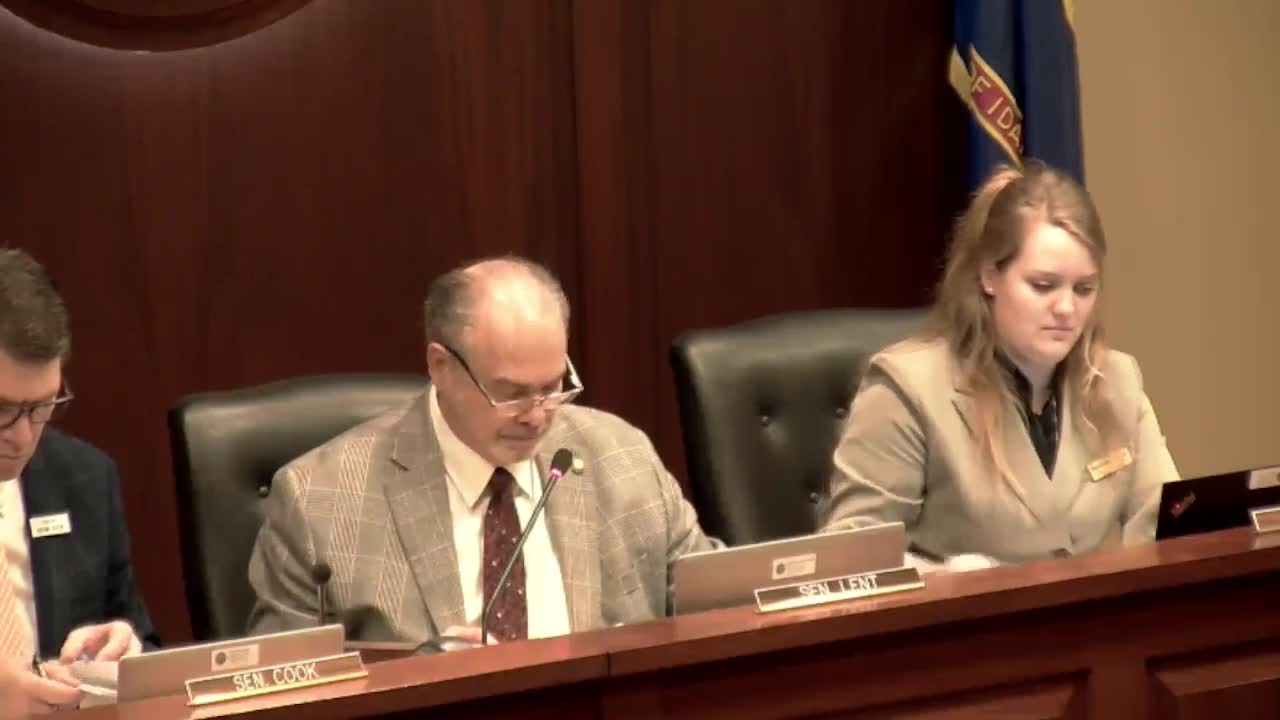
After extended discussion, the committee agreed to postpone voting on the rules package to allow time for review. Vice Chair and other members proposed holding votes at the chair’s call; Senator Cook moved to hold voting on the dockets at the chair’s call, a motion that was seconded and approved by voice vote. The committee tentatively planned to revisit the rules later in the week.
The hearing highlighted substantive policy tradeoffs: the Board argued apprenticeship pathways could expand staffing in rural and hard-to-fill districts, while several senators cautioned that lowering degree requirements for one pathway requires robust oversight and supports for candidates and students. The committee asked State Board staff to provide clarifying examples and propose language or processes addressing continuous oversight, “in good standing” definitions, and credit-requirement details for interim authorizations.