Get Full Government Meeting Transcripts, Videos, & Alerts Forever!
Get email alerts on the School Safety Advisory Board topic
No spam. Unsubscribe anytime.
Idaho House committee trims size of school safety advisory board to ensure quorum
Summary
The Idaho House Committee on Education voted 8-4 to send House Bill 42 to the floor with a “do pass” recommendation. The bill reduces the number of voting members on the state School Safety and Security Advisory Board to make it easier to reach a quorum while keeping a wider list of invited experts.
BOISE — The Idaho House Committee on Education voted 8-4 to send House Bill 42 to the floor with a due-pass recommendation after a lengthy debate over who should have voting seats on the state School Safety and Security Advisory Board.
Representative Ted Hill, R-District 14, said the bill is intended to shrink the board to a smaller, more functional group that can regularly reach quorum while continuing to invite a wide set of experts. "If you get the right people in the right place, good structure, good leadership, leverages resources out there," Hill said. "I like the idea of having a lean, mean fighting machine here that pulls in resources and has the ability."
Supporters and opponents agreed on the board’s purpose but disagreed about losing guaranteed seats for school officials and law enforcement. Matthew Reiber, strategy and planning officer for the State Board of Education, said the board’s invitation list will remain broad. "We still want the experts in the room," Reiber said, and the State Board will work with the governor’s office to appoint members with school and operational expertise.
Quinn Perry, deputy director of the Idaho School Boards Association, told the committee she and colleague organizations are concerned that the bill removes a statutory seat for a local school board member. "We do just wanna be on record that we have some concerns about striking the official affirmative part of having school officials," Perry said. She said the association has school board members who would be willing to serve if statute preserved a seat.
Sheriff Chris Gertz said he was concerned the bill would eliminate law enforcement as an official voting member. "To not have an official seat there and be a voting member…there was a reason this was really done the way it was where you had a Chief of Police, a Sheriff, and the Idaho State Police all on there," Gertz said. He said sheriffs can identify candidates willing to serve, but they want at least one law enforcement voting seat preserved.
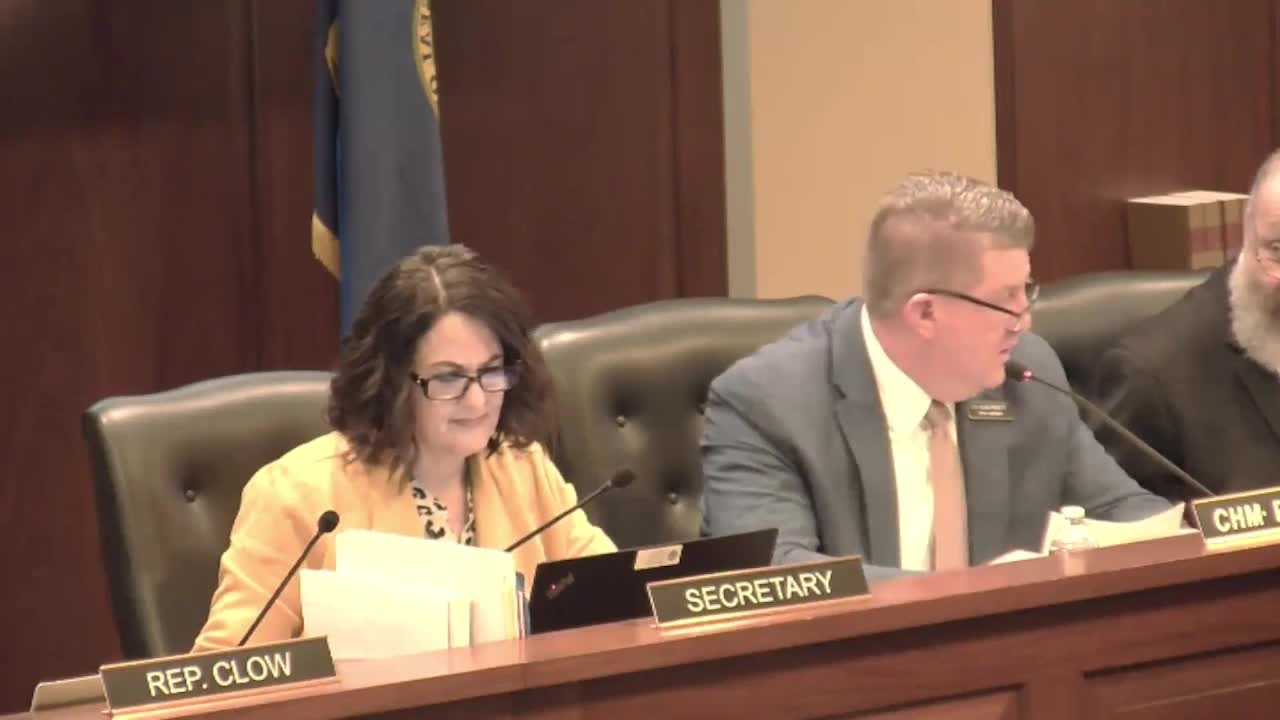
Several lawmakers urged compromise. Representative Garner and Representative Mathias raised concerns that reducing the number of voting seats increases the influence of politically appointed members relative to practitioners who work in schools every day, and Mathias requested a roll-call vote. Representative Clow and others argued quorum problems on the existing 13-member board justified reducing the voting membership so the board can meet and act.
The committee’s substitute motion — to send House Bill 42 to the House floor with a due-pass recommendation — passed on a roll call. Recorded votes in the transcript include Chair Pickett (yes), Vice Chair Hawkins (yes), Representative Lance Clow (yes), Representative Mendy (aye), Representative Wischnewski (aye), Representative Garner (no), Representative Nielsen (aye), Representative Harris (aye), Representative Marmon (aye), Representative Tanner (no) and Representative Mathias (no). The clerk announced the result as 8 to 4 in favor.
The bill as presented reduces the number of voting members in order to address chronic quorum problems; proponents said invited experts (FBI, state police, local law enforcement, school administrators and others) will continue to attend meetings even if they are not designated voting members. Opponents argued advisory votes matter because other parts of state law rely on the board’s recommendations.
With the committee’s recommendation, House Bill 42 will move to the full House for further consideration. The committee record shows lawmakers asked that the governor’s appointees include people with on-the-ground school and security experience, and several lawmakers asked for future amendments that would restore specific seats or otherwise protect school and law-enforcement representation.