Get Full Government Meeting Transcripts, Videos, & Alerts Forever!
Get email alerts on the Personnel Benefits Health Insurance topic
No spam. Unsubscribe anytime.
Joint finance committee approves higher health insurance appropriation for FY2026
Summary
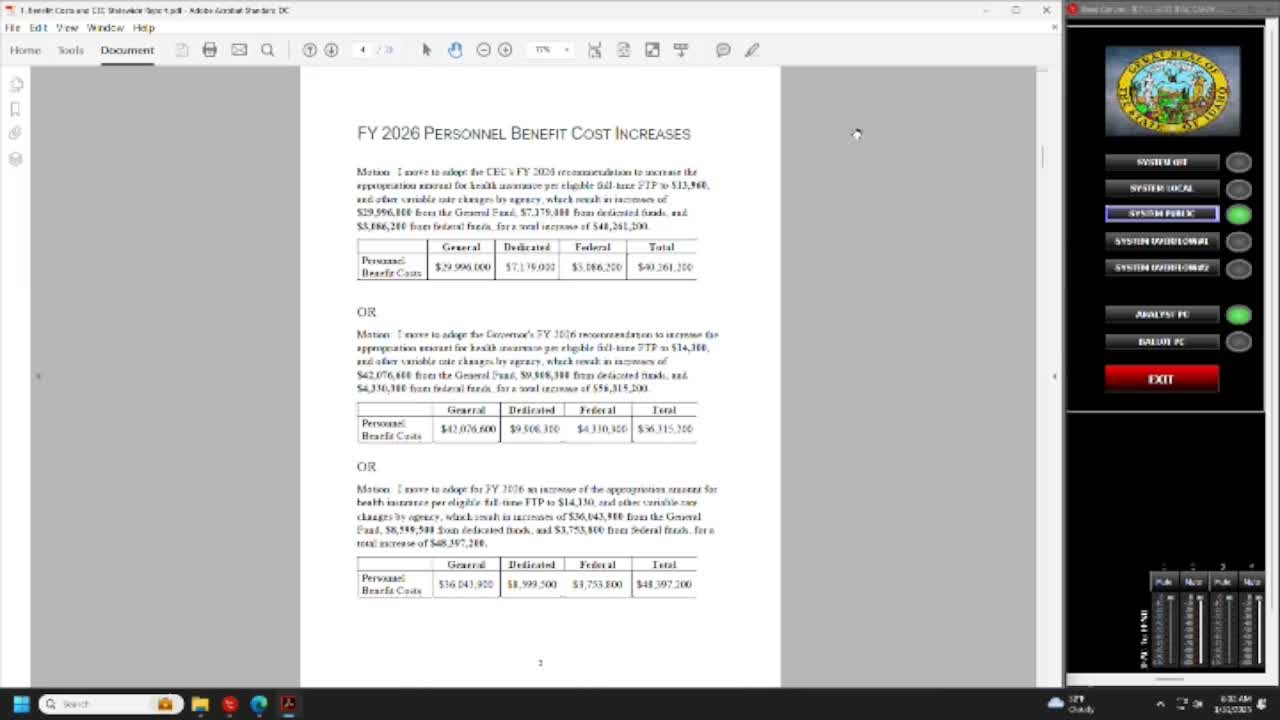
The Joint Finance-Appropriations Committee on Jan. 31 approved raising the state health insurance appropriation per eligible full-time position to $14,130 for fiscal 2026, increasing the projected reserve and adding roughly $48.4 million in new funding across funds.
The Joint Finance-Appropriations Committee voted Friday, Jan. 31, to increase the health insurance appropriation per eligible full-time position to $14,130 for fiscal year 2026, adding approximately $48,397,200 in new funding across general, dedicated and federal funds.
The vote adopted a compromise motion that set the per‑employee appropriation at $14,130. Committee analyst Mr. Bybee described three options for the committee to consider: the CEC recommendation at $13,960 per full‑time equivalent position (FTE), the governor’s recommendation at $14,300 per FTE, and a midpoint at $14,130 per FTE.
The measure funds both the state’s employer share of health insurance and smaller agency-level employer costs such as workers’ compensation and Social Security adjustments. Senator Woodward moved the substitute compromise at $14,130; Representative Tanner seconded. After debate and a roll call, the committee recorded a majority vote in the affirmative and the motion carried with a “due pass” recommendation.
Why it matters: the chosen rate determines how much the state budgets for employee health benefits next year and affects the projected reserve in the state’s employee health insurance fund. Committee members debated whether to reflect the actuarial cost directly or to rely on reserve balances and prior policy changes that they said had reduced premiums in prior years.
Committee debate and evidence: Representative Furness, who supported the lower CEC figure of $13,960, argued the state’s insurance reserve balances and prior plan changes justify a smaller appropriation. "The $13,960 that I'm proposing is too high. We really should look at lowering that down," Furness said during discussion. Bybee summarized the projected ending reserve balances under each option: "The projections with the amended substitute motion ... the projected reserve balance for fiscal year 2026, the ending balance is $51,600,000; for the governor's recommendation at $14,300, the projected ending reserve balance is $61,400,000," he said.
Roll call and outcome: The chair directed committee staff to call the roll on the substitute motion. The committee reported that the Senate voted 8 ayes, 0 nays, 2 absent and excused, and the House voted 9 ayes, 0 nays, 1 absent and excused — for a combined total of 17 ayes, 0 nays, 3 absent and excused. The chair said the motion "has passed and without objection will carry a due pass recommendation."
What the committee did not decide: Committee members discussed, but did not adopt, the alternative funding levels of $13,960 or $14,300; those options were debated and defeated. Members also asked for confirmation of the projected reserve balances and questioned the conservatism of actuarial projections provided to staff.
Next steps: The committee carried the health‑insurance funding recommendation forward with a due pass recommendation. Other personnel benefit items on the agenda remained under consideration by the committee.