Get Full Government Meeting Transcripts, Videos, & Alerts Forever!
Get email alerts on the Psychiatric Hospitals topic
No spam. Unsubscribe anytime.
State hospitals accredited but rising civil‑commitment costs prompt supplemental request, DHW says
Summary
Department officials said all three state psychiatric hospitals have received accreditation and are beginning Medicaid billing, but civil‑commitment costs — shifted to the state by 2022 law — have increased and the department asked for a $2.6 million one‑time supplemental to cover mental‑hold and commitment expenses.
Department of Health and Welfare officials told the Joint Finance‑Appropriations Committee that all three state psychiatric hospitals have achieved accreditation and are beginning Medicaid billing, producing some federal receipts, but civil‑commitment costs have risen and the department asked for a one‑time supplemental.
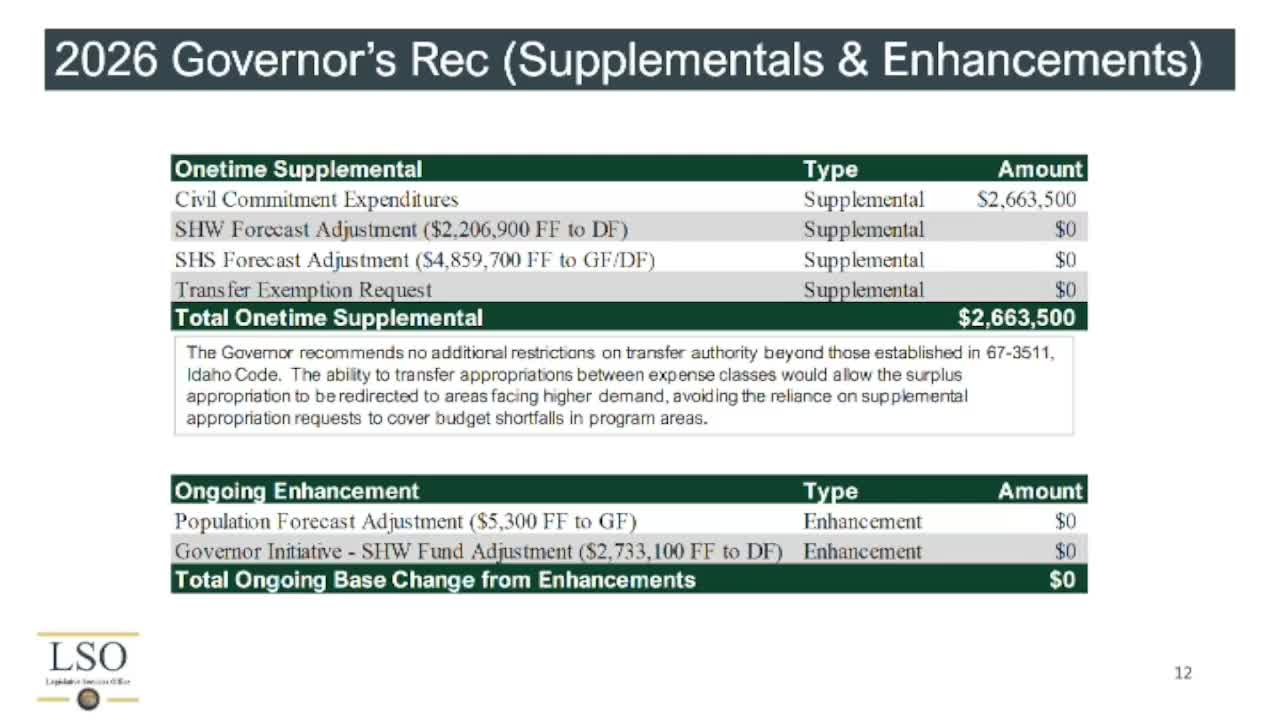
Alex Williamson, legislative services analyst, told the committee the department's 2026 request includes a one‑time supplemental of $2,600,000 from the General Fund to cover increased civil‑commitment expenditures. The request follows a 2022 law — Senate Bill 1327 — that shifted responsibility for those costs to the state.
Director Alex Adams said the accreditation outcome has allowed hospitals to bill Medicaid and recapture federal match; State Hospital West had billed about $1.6 million and received $1.3 million in receipts so far. ‘‘We’re less reliant on the general fund and then we’re recapturing more funds from Medicaid,’’ Adams said.
Adams told members that a federal billing rule affects reimbursement depending on length of stay: if a hospital stay exceeds 60 days for certain categories, Medicaid will not reimburse and the state carries full cost. He said the share of admissions longer than 60 days has increased from about 17% to 37% and that growth drives state costs.
Ross Edmonds, the division administrator for Behavioral Health, testified that the number of holds initiated by law enforcement and health‑care professionals has increased year to year and that ‘‘restoration to competency’’ commitments have risen dramatically over the last decade. Edmonds said restoration cases — defendants evaluated as not competent to stand trial who are then treated until competency is restored — have grown about 600% over 10 years and now occupy a substantial share of state hospital beds; at State Hospital North roughly 75% of beds were occupied by restoration cases.
Committee members questioned staffing and capacity. Director Adams said vacancy rates at the hospitals vary: State Hospital West reported 0% vacancy, State Hospital South 2.8% and State Hospital North 11.5%. Waitlists reported during testimony were eight individuals for North and about 18 for South.
The department also requested a transfer exemption similar to other behavioral health items so it could shift fund sources without seeking committee approval, saying changes in federal match and fund source splits require receipt‑authority adjustments for accurate budgeting.
Committee members pressed whether statutory language or program design could rein in rising costs. Adams and Edmonds said the number of holds and restoration cases are driven by clinical and law enforcement decisions and historical policy choices; they offered to continue conversations with the Behavioral Health Council about statutory language but said the entitlement nature of commitments limits operational control.
No formal action was taken at the hearing; the department said it would provide additional data on billing receipts and trends in long‑stay admissions.