Get Full Government Meeting Transcripts, Videos, & Alerts Forever!
Get email alerts on the Public Health Budget topic
No spam. Unsubscribe anytime.
Health department asks JFAC to restore public‑health programs, seek one‑time and ongoing funds
Summary
Department of Health and Welfare leaders told the Joint Finance-Appropriations Committee they seek restoration of several public‑health programs, one‑time ARPA‑related enhancements, and dedicated funding for immunization and vital records as the division’s budget is restructured after federal pandemic grants wound down.
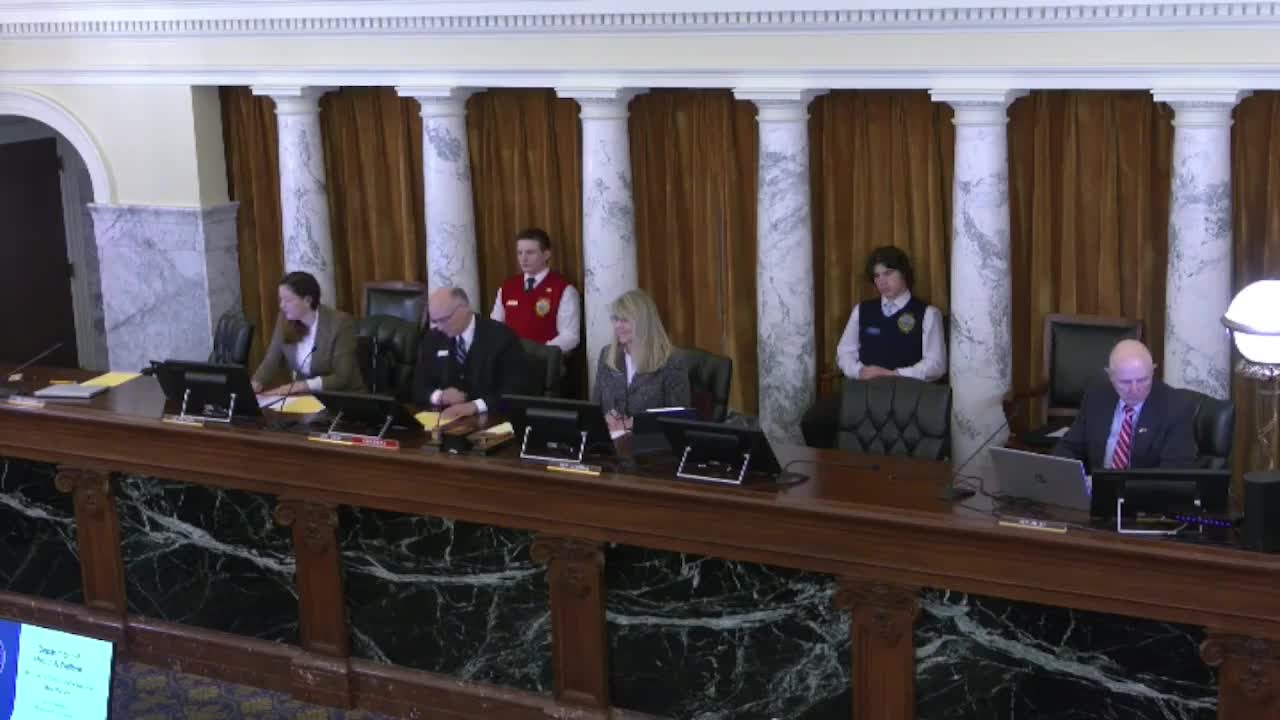
Department of Health and Welfare Director Alex Adams and Division of Public Health Administrator Elke Shaw Tullock told the Joint Finance‑Appropriations Committee (JFAC) that the Division of Public Health Services is seeking a mix of one‑time and ongoing funding to return programs that were previously shifted to one‑time status or reduced as federal pandemic grants expired.
The request centers on restoring core programs and investing in data and workforce systems. “I would characterize it as a healthy exercise,” Adams said, describing a re‑examination of ongoing programs after a multi‑year drawdown of CARES Act and ARPA funding. Committee analysts showed the division’s FY2025 appropriation at about $164,020,000 and said the governor’s recommendation for FY2026 is roughly $154,000,000, representing about a $10 million, or roughly 6 percent, year‑over‑year reduction in the department’s overall public‑health line driven in part by structural changes.
Why it matters: the Division of Public Health Services oversees immunizations, laboratory services, vital records, emergency medical services (EMS), suicide prevention, and other programs that county health districts and provider partners rely on for disease surveillance, outbreak response, and preventive services.
Division structure and spending. Keith Bybee, the department’s budget staff presenting the slides, said the division is organized into five program areas and is funded largely through trustee and benefit payments; he reported roughly half the division’s expenditures go to trustee and benefit payments, with personnel making up about 18.6 percent of the budget and operating costs about $46 million in the FY2025 snapshot. Bybee noted the division was authorized 256.52 full‑time equivalent positions, with four vacancies as of Aug. 31, 2024.
One‑time and federal enhancements. Analysts listed roughly $8,752,500 in one‑time enhancement requests related to ARPA and other federal grants. Among the specific one‑time items cited was a federal communicable‑disease grant in year four for $2,041,800 to support roughly 4.4 limited‑service positions; the committee also voted earlier to correct a technical cancer registry supplemental on Jan. 17.
Program restorations and ongoing requests. The department requested about $20,846,300 in ongoing restorations; the governor recommended roughly $21,464,500. Beebe and Adams walked the committee through restoration requests the agency sought to move back to base funding, including:
- Suicide prevention: $1,807,700 from the general fund and $195,000 federal to support the program established in 2016. - Drug overdose prevention: restore four full‑time equivalents and $2,820,200 ongoing. - Refugee health screening: restore 1.5 FTE and $991,000 ongoing. - Alzheimer’s and dementia program: $275,200 ongoing from the general fund to support statewide coordination and the strategic plan. - Fit and Fall Proof: $140,000 ongoing for the community balance program. - Diabetes, HIV prevention, oral‑health workforce, and integrated hepatitis surveillance: restoration requests ranging from roughly $379,600 to $1,063,700 for those programs as detailed in the department’s materials. - Women, Infants, and Children (WIC) program: a restoration request of $6,944,600 ongoing to support WIC nutritional services, education and supplemental foods for eligible women and children. - Temporary Assistance for Needy Families (TANF) support for related services: $400,000 ongoing.
Immunization and vital records. The department requested ongoing dedicated‑fund support for the Idaho immunization program and for vital records operations. The budget book materials presented to the committee list a request of $2,500,000 ongoing from dedicated funds for the immunization program and a $150,000 ongoing request from dedicated funds for the Bureau of Vital Records and Health Statistics to support processing of birth, death and other sensitive records.
Home visiting and workforce incentives. The division requested $725,900 ongoing from federal funds to expand home‑visiting services in counties identified by a needs assessment; the governor also proposed $500,000 from the general fund for a rural physician incentive program (medical education loan repayment) prioritized for clinicians serving federally designated health‑professional short‑age areas. Administrator Elke Shaw Tullock told the committee that loan repayment programs have a high retention rate: “Almost 91% of the providers that receive these loan repayments stay in the state and practice in the state.”
Data modernization. Committee members asked for more detail on multi‑year ARPA projects to modernize vital‑records and WIC IT systems and to reduce dozens of siloed data systems the department still operates. Adams and staff said they would provide committee members with a summary of system upgrades and progress; Adams noted about 62 siloed systems across the division and said modernization is intended to move many paper‑based workflows into more responsive electronic systems.
Organizational questions. Legislators asked whether some programs could better sit in other agencies. Adams said the department is open to transfers where a program better matches another office’s mission and highlighted a forthcoming bill to move the Bureau of EMS to the Office of Emergency Management as an example of that conversation.
What the committee directed. Members asked analysts and the department for follow‑up materials on IT modernization projects, the performance measures that would demonstrate restored programs’ outcomes, and the loan‑repayment program’s retention data. Staff said they would circulate additional documentation after the hearing.
No formal appropriations were voted at the hearing; the committee took testimony and continued deliberations.
Ending note: Department leaders characterized the rebase and restoration work as a “healthy” but challenging exercise to rebuild core public health services after pandemic grant funding wound down. The committee will weigh the department’s detailed cost and performance information as it drafts final appropriation recommendations.