Get Full Government Meeting Transcripts, Videos, & Alerts Forever!
Get email alerts on the Prisons Security topic
No spam. Unsubscribe anytime.
After staff shooting, Idaho corrections seeks surveillance upgrades, expanded transport unit and body‑worn camera pilot
Summary
Following a spring ambush that left three staff wounded, the Department of Correction requested funds for mail scanning, drone detection, phone-call transcription, expansion of the transport bureau with 12 new positions and a federal body‑worn camera pilot; director argued the changes address identified vulnerabilities.
The Idaho Department of Correction told the Joint Finance Preparations Committee on Feb. 4 that supplemental and ongoing budget requests aim to address vulnerabilities exposed by a spring ambush during an inmate medical transport that left three correctional staff wounded.
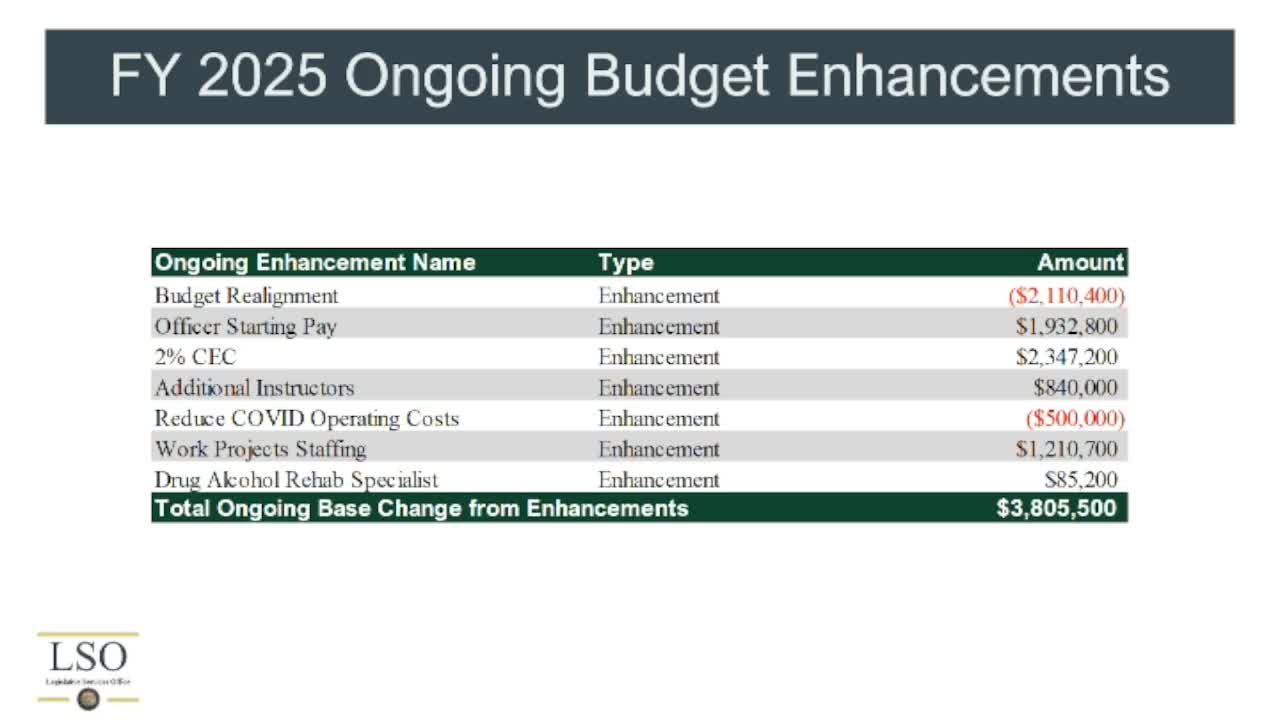
Noah Peterson, the legislative budget analyst, told the committee the state prisons division requested roughly $795,000 in supplemental funds to begin advanced surveillance technologies this fiscal year and $2.4 million ongoing to run the systems in a full year. The package the department described includes digital mail scanning, drone-detection hardware and phone-call transcription and analysis (described in the hearing as the LEO intelligence software). Peterson also said the agency sought a supplemental of $1.15 million to expand the transport bureau—12 full‑time positions and specialized vehicles—and a federal body‑worn camera grant to pilot cameras in three locations.
Director Josh Tewalt said the mail-scanning system would divert physical mail to an offsite unit to be opened, scanned and delivered digitally to inmates, which he said would “completely eliminate our most porous point of entry for contraband” and allow staff to redeploy to other security tasks. He described rising sophistication among suppliers of contraband—drone deliveries, treated ink and other methods—and argued a layered approach was needed.
On transport operations, Tewalt said emergency medical transports had been conducted by on‑duty facility staff as an ‘‘other duty as‑assigned’’ and that the spring attack was a planned event that exploited the department’s transport vulnerabilities. He explained that converting emergency transport to the statewide Transport Bureau would require specialized training, equipment and additional personnel to avoid repeatedly pulling officers off posts and creating overtime. Under the request, the Transport Bureau would add 12 positions and seven vehicles equipped for secure medical movement; Peterson estimated about $965,500 ongoing to maintain the unit and $455,000 personnel costs for the rest of the fiscal year in the supplemental.
Peterson said the proposed body‑worn camera pilot would cost about $1.05 million in the supplemental (primarily federal funds with a small state match). The pilot would cover Idaho Maximum Security Institution, District 3 probation and parole, and special investigations units; ongoing license costs were estimated for future budgets and would require state matching dollars if federal grant funding lapses.
Committee members asked why the expansion required 12 net new full‑time positions rather than shifting duties; Peterson said the agency pointed to thousands of overtime hours used for transports at high‑security facilities. Tewalt said shifting responsibilities would either require a large reallocation of staff or creation of a standing tactical team, both of which the department judged inefficient. He noted that ISCC generated about 20,000 overtime hours and IMSI about 14,000 hours in a prior period and described the transport expansion as an effort to reduce unsustainable overtime and improve safety.
The governor recommended most items with one exception: instead of a one‑time capital purchase of a skid‑steer for snow removal at St. Anthony’s work camp, the governor recommended $30,000 ongoing to contract snow removal. The department said it would accept contracting if that is the preferred approach.
No formal appropriation action was taken at the hearing. Department officials said they would provide additional detail to committee members on implementation and costs if requested.