Get Full Government Meeting Transcripts, Videos, & Alerts Forever!
Get email alerts on the Bsu Budget Launch topic
No spam. Unsubscribe anytime.
Boise State presents budget, LAUNCH impact and campus initiatives; president says lawsuit defense paid with non-tax funds
Summary
Boise State University President Marlene Tromp briefed JFAC on Jan. 29 about the university’s FY2026 budget requests, LAUNCH enrollment, changes to student-support centers, the Institute for Advancing American Values and a lawsuit defense paid from non-tax funds. Tromp also described workforce opportunities tied to semiconductor expansion.
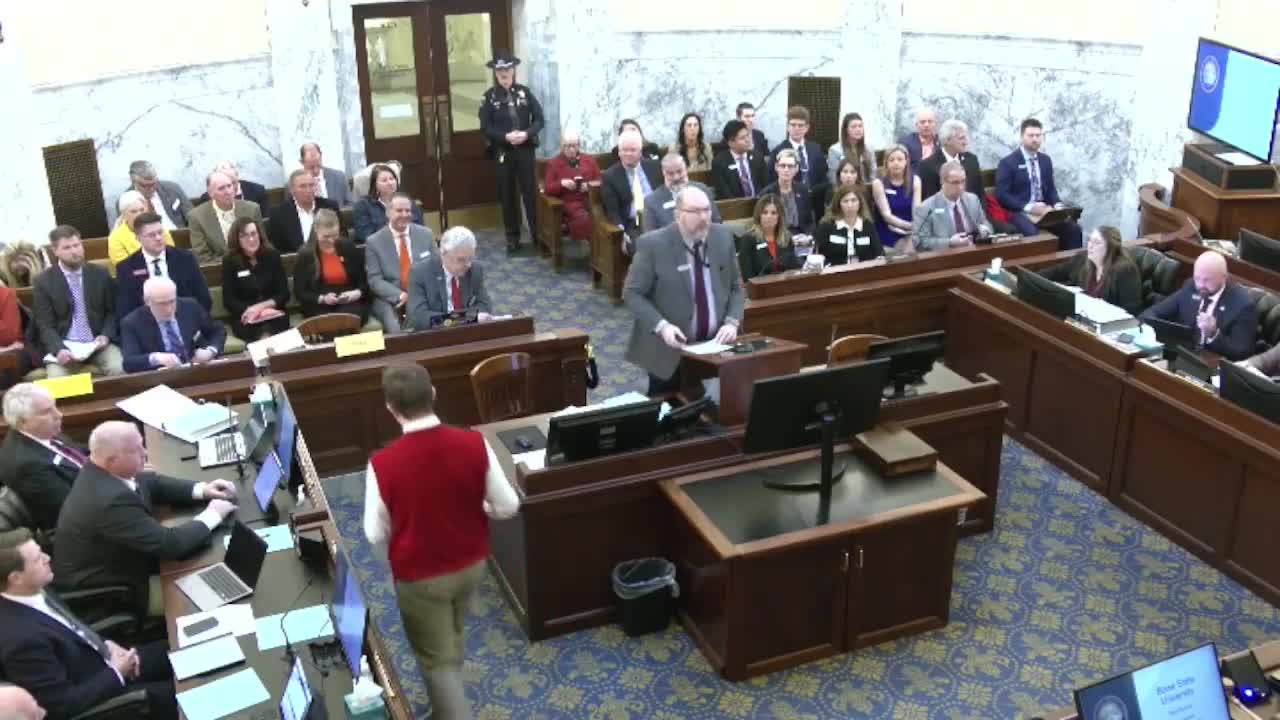
Boise State University President Marlene Tromp told the Joint Finance-Appropriations Committee on Jan. 29 that the university is managing a growing enrollment, emphasizing student success and workforce training, and that the university used non-tax funds to defend a recent lawsuit.
Tromp and Legislative Services Office analyst Kevin Campbell presented BSU figures: the university enrolls more than 27,000 students and reported about 1,980.9 full-time-equivalent positions. Campbell said personnel costs represent roughly 81.8% of Boise State’s expenditures, with operating expenses at 16.5% and capital outlay at 1.7%. For FY2026 the university requested $1,178,110 in operational capacity enhancement (to be used for CEC) and $195,700 in enrollment-workload adjustment funding.
On LAUNCH, Tromp said about 1,300 students are enrolled through the program, with 600 depending on LAUNCH as their only financial support. She told committee members LAUNCH has expanded access in areas including nursing, computer science, radiological sciences, business and education.
Tromp described changes to centers and staff that had been labeled DEI-related in prior years. She said Boise State reduced the number of staff assigned to those functions from eight to five and has intentionally reframed the work toward student success and broader populations such as rural and first-generation students. Tromp said the university’s graduation rate has increased substantially over five years; she credited changes to student-success programming for that improvement.
Tromp described the Institute for Advancing American Values as a campus program designed to bring diverse viewpoints to Boise State and to encourage civil dialogue. She said programming such as "Idaho Listens" has convened state residents and that the faculty senate and student government have adopted the Chicago principles on free expression.
Senators asked about a recent lawsuit involving a campus business (referred to in questions as Big City Coffee). Tromp said Boise State "used only non taxpayer funds to support the defense of that lawsuit" and that the university has spent about $1.5 million defending the case; she said she did not anticipate the appeal would add a significant amount to that total. Tromp told members the university complied with state law that requires defense of employees acting within the scope of employment and said employees who appeared at trial either participated as part of general-counsel duties or used personal time to attend.
Committee members asked about classroom content and academic freedom, including whether courses that discuss gender or diversity subjects are required. Tromp said students must take general-education orientation courses (UF100/UF200) but may select which section to take; no student is required to take a class focused on gender or DEI. She stressed the university follows state and federal law and asked to provide a written assurance of compliance with Idaho Code sections 33-138 and 33-139 if the committee wished.
On workforce alignment, Tromp said Boise State is positioning programs to supply workers for Idaho’s semiconductor and advanced manufacturing expansion, referencing Micron’s growth and federal CHIPS Act investments. She noted Boise State owns an Xtron device used in semiconductor research — the university said it is the only nonprivate institution in North America with that specific equipment — and that the university runs outreach programs such as a Cyberdome cybersecurity service for small rural businesses.
Tromp closed by noting Boise State’s balanced budget work, performance-oriented budgeting, and changes to administrative spending, and she offered to provide requested details about lawsuit-related expenses and federal-grant contingencies to the committee in writing.