Get Full Government Meeting Transcripts, Videos, & Alerts Forever!
Get email alerts on the Personnel Benefit Costs Health Insurance topic
No spam. Unsubscribe anytime.
Joint finance panel votes to fund health insurance at $14,130 per FTE for FY2026
Summary
The Idaho Joint Finance-Appropriations Committee approved an increase in the state's FY2026 health insurance funding to $14,130 per eligible full-time equivalent, adopting a compromise figure after debate over reserve levels and actuarial projections.
The Joint Finance-Appropriations Committee voted on Jan. 31 to increase FY2026 health insurance funding for state employees to $14,130 per eligible full-time equivalent position, a compromise figure the committee adopted after debate over reserve balances and actuarial projections.
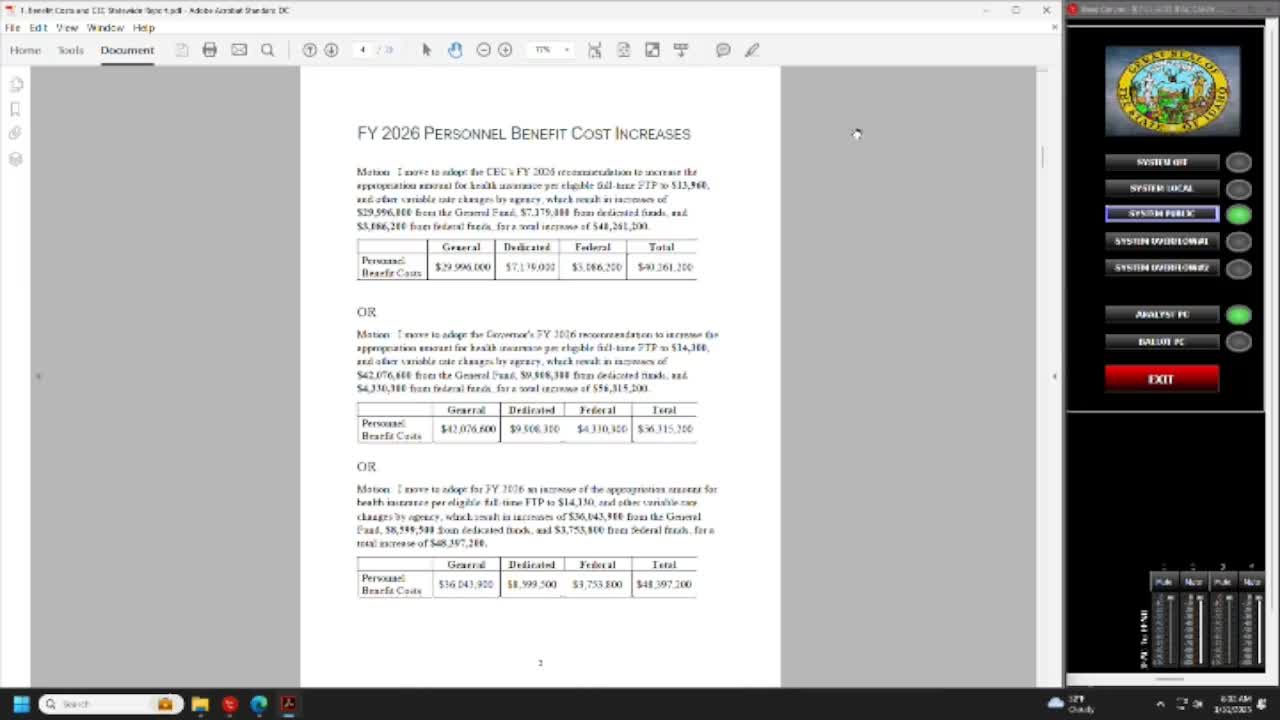
The vote approved an appropriation increase that committee materials show would raise personnel benefit costs by $36,043,900 from the general fund, $8,599,500 from dedicated funds and $3,753,800 from federal funds, for a total increase of $48,397,200. Senator Woodward moved the $14,130 figure and Representative Tanner seconded the motion; the joint committee recorded 17 ayes, 0 nays and 3 absent/excused when the motion passed and was given a due-pass recommendation.
Committee analysts presented three alternative funding levels for health insurance: the committee's CEC recommendation at $13,960 per FTE, the governor's recommendation at $14,300 per FTE and the compromise midpoint at $14,130. Mr. Bybee, the Legislative Services Office analyst, said the largest element of the personnel benefit cost change was health insurance and noted smaller employer-paid adjustments such as workers' compensation and Social Security-related changes.
Discussion centered on whether to reflect the 'actual' projected cost of insurance or to use fund reserves to smooth premium funding. Senator Ward Engelking argued the committee should reflect the actual cost of insurance rather than using reserve funds to buy down the premium because that would distort the year-to-year view of costs. Representative Furness said actuarial projections from Milliman had repeatedly erred on the conservative side and urged a lower funding level; Mr. Bybee responded with reserve-balance projections for the three options.
Bybee told the committee the projected reserve fund ending balances for FY2026 would be roughly $51.6 million under the CEC-recommended $13,960 level and about $61.4 million under the governor's $14,300 recommendation; he did not have a prepared calculation for the midpoint at $14,130 but earlier committee discussion cited intermediary projections.
At multiple points members raised procedural questions about voting thresholds for joint items; staff confirmed the roll call was programmed to require a majority of the quorum present from each chamber for a motion to pass. Ms. Figueroa conducted roll calls during the discussion and final vote.
The committee recorded the passage of the $14,130 health-insurance funding level and moved on to separate agenda items related to the change-in-employee-compensation (CEC) motions.
The committee did not alter insurance plan structure on Jan. 31; the vote addressed the funding level only. Any implementation details or plan-structure changes would require separate action.