Get Full Government Meeting Transcripts, Videos, & Alerts Forever!
Get email alerts on the Recidiviz Case Management topic
No spam. Unsubscribe anytime.
Idaho corrections director urges ongoing funding for Recidiviz case-management tools
Summary
Agency officials and committee members discussed ongoing funding for Recidiviz, a nonprofit data platform the Idaho Department of Correction says streamlines case management and helps target supervision resources; lawmakers asked for evidence of effectiveness and details on data control and philanthropic matching.
The Idaho Department of Correction asked the Joint Finance Preparations Committee on Feb. 4 to approve ongoing general-fund support to continue work with Recidiviz, a nonprofit data and analytics partner the agency says helps automate case triage and produce officer- and population-level outcome data.
Director Josh Tewalt told the panel the Recidiviz partnership “is probably the most transformative partnership we've entered into as an agency in my entire tenure there,” and described the product as a nonprofit service that aggregates data across legacy systems to present case managers with prioritized tasks and outcome comparisons across officers and jurisdictions.
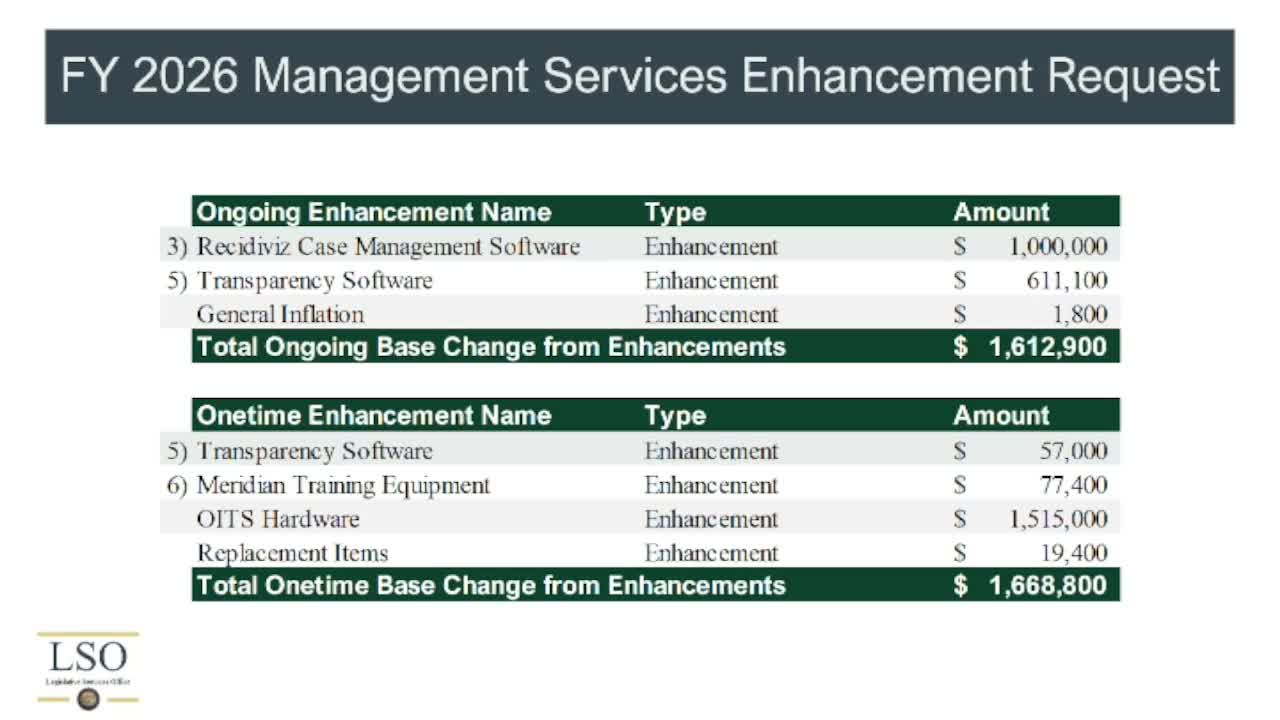
Noah Peterson, budget and policy analyst for the Legislative Services Office, summarized the Management Services Division’s budget request and identified a line item tied to ‘‘recidivism case management software’’ that the agency wants carried forward as an ongoing appropriation. Peterson said prior appropriations to the partnership were one-time funds and that the new request is for continuous development and support.
Lawmakers pressed the agency for evidence. Senator Cook asked for return-on-investment data; Peterson said he did not have hard outcome metrics in hand. Tewalt offered to provide dashboards and said the state controls its data through formal data-sharing agreements with Recidiviz. He said the product pulls data from the department’s systems rather than recreating or altering it, and that Recidiviz matches philanthropic dollars against state spending: “every penny we spend is leveraged against private philanthropic dollars,” he said, describing a matching model that leverages private foundation money to increase impact.
Representative Tanner and other members asked for examples of the platform’s reports, including cost calculators and dashboards; Tewalt said the department could share the visualizations used by leadership, supervisors and officers, but cautioned against using officer-level outcome dashboards to assign blame without context. Committee members also asked whether the agency had compared Recidiviz to commercial alternatives; Tewalt said the department had explored competitors but described Recidiviz’s approach—bringing data together without requiring major workflow changes—as unique.
Petitioners on the committee raised budget concerns. Representative Tanner and Senator Zieterfeld asked for documentation of philanthropic partners and matching amounts; Tewalt said the agency would provide transparency on funders and noted the nonprofit’s neutral stance and focus on helping participating systems meet their own goals.
The request for ongoing funding was presented as part of a larger package of Management Services enhancements; committee staff said prior one-time appropriations for Recidiviz totaled about $1.5 million in 2021 and 2023 and that the new request would convert development and maintenance into an ongoing line.
The director offered to provide the committee with dashboards, outcome metrics and the department’s data-sharing agreements to address questions about control, accuracy and impact. No formal committee action or vote occurred during the hearing.
Looking ahead, the agency said it plans to extend Recidiviz-style tools from probation and parole into prison case-management and classification work to more directly account for in-prison programs and pro-social activities.