Get Full Government Meeting Transcripts, Videos, & Alerts Forever!
Get email alerts on the Mountain Home Afb Update topic
No spam. Unsubscribe anytime.
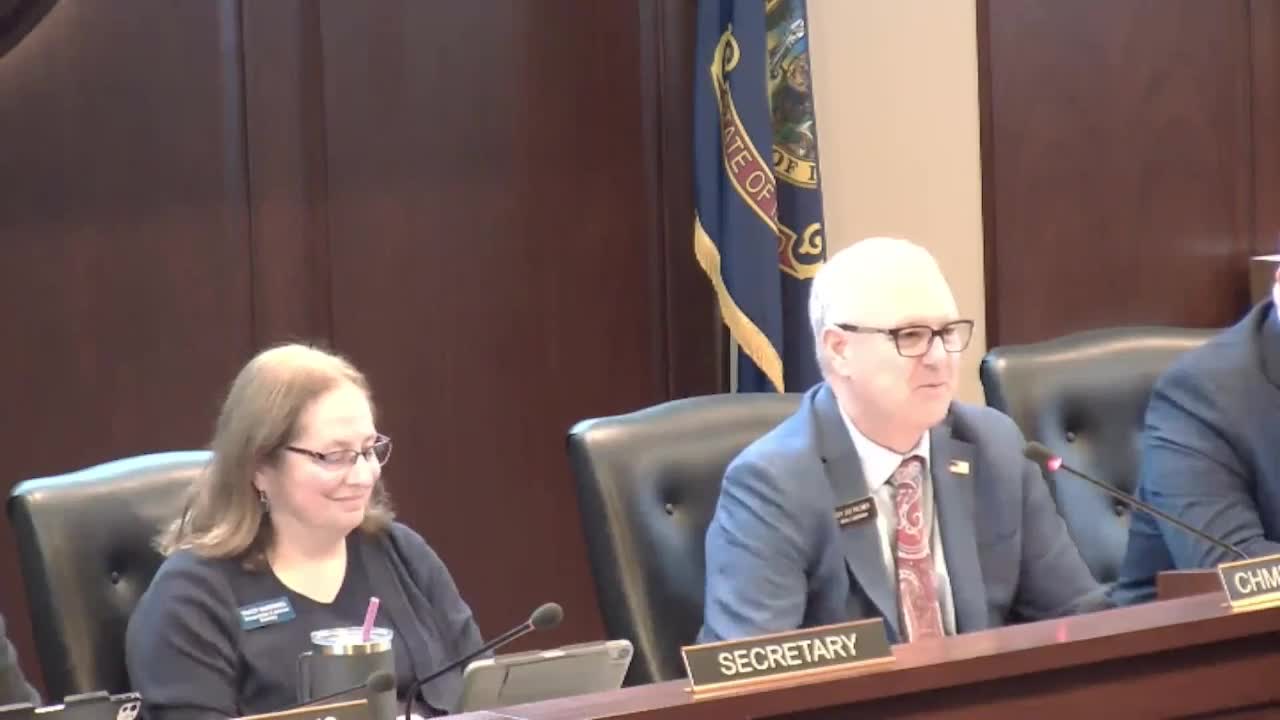
Mountain Home AFB commander briefs Idaho committee on readiness, airspace and school funding
Summary
Colonel Mike Alfaro, wing commander at Mountain Home Air Force Base, told the Idaho House Transportation and Defense Committee that the base is prioritizing people, preparedness and professionalism as it prepares for higher-risk operations and training tied to a renewed focus on great-power competition with China.
Colonel Mike Alfaro, wing commander at Mountain Home Air Force Base, told the Idaho House Transportation and Defense Committee on a presentation day that the base is prioritizing people, preparedness and professionalism as it prepares for higher-risk operations and training tied to a renewed focus on great-power competition with China.
Alfaro told the committee: "our job is to provide mission ready, gunfighters to conduct operations anytime, anywhere," and said Mountain Home is ‘‘laser focused on China, as our pacing threat.’’ He described recent exercises, infrastructure projects and quality-of-life investments for service members assigned to the base.
The briefing summarized several operational and infrastructure items that committee members flagged as priorities. Alfaro highlighted base recognition — Mountain Home won the Commander in Chief Installation Excellence Award for the prior year — and said the award brought more than $1 million to invest in dorm upgrades, kitchens and recreation spaces. He described recent force-generation activity, including the Deployable Combat Wing and Air Base Wing validation exercise (DAVE) and the two-week Raging Gunfighter 25.1 exercise that trained personnel to operate from multiple austere locations. He said the 388th Fighter Squadron was deployed to the Middle East and that other units are preparing to rotate through overseas missions.
On training airspace, Alfaro described a long-running effort to lower the authorized altitude over portions of the Mountain Home Range Complex so pilots can routinely train at terrain-following altitudes. He said the package is back with the Federal Aviation Administration after the base changed an "avoid" designation to an "exclusion" to meet FAA preferences, and that Mountain Home is closer than ever to securing approval that would allow low-altitude training down to about 100 feet mean sea level in some areas. "In order to survive and to be able to be lethal in highly contested environments, you need to get down into the terrain and be able to train to those tactics," he said.
Alfaro reported progress on long-running water infrastructure work. He said a Snake River pipeline delivering surface water to the base should be complete "this summer," and that a base water treatment plant is scheduled to be finished "in October 26." (The transcript did not specify the year for "October 26." ) He characterized the pipeline and treatment plant as complex, long-term projects that are "on track." (Funding, permitting and construction details beyond those comments were not provided in the briefing.)
The commander addressed aircraft modernization and legislative constraints. He said recent language in the National Defense Authorization Act prevents divestment of older F-15 engines through at least fiscal 2027, and that Mountain Home — which hosts squadrons with older engines — is protected from divestment through that fiscal year. He said future redistributions or modernization plans remain under discussion at higher levels of the Air Force.
Alfaro also described international and interservice training ties: the base hosts a Singapore F-15 squadron for long-term training, and he said negotiations are in late stages to host about 12 Qatar Air Force jets and roughly 150 personnel for a future period. He told lawmakers that exercises such as Red Flag and a planned Pacific-range exercise called Bamboo Eagle are part of the base’s readiness regimen.
On quality-of-life issues, the briefing detailed education and family supports. Alfaro said Mountain Home secured a federal Public School on Military Installation grant to cover 80% of the cost for a new Stevenson Elementary School on the base; the commander said the base’s share would be roughly 20 percent and that Representative Mike Simpson’s office helped secure community project funding for that match. He highlighted the Purple Star Initiative for military-connected students and said Stevenson Elementary was the first Purple Star school in Idaho after a September proclamation by Governor Brad Little making Idaho the 43rd Purple Star state.
The commander said Mountain Home will serve as one of six Combat Support Training Range sites the Air Force has designated, bringing additional mission activity. He described one small innovation anecdote — an agile power solution in a Pelican case used during agile combat employment training — as an example of locally developed improvements being adopted more widely.
Committee members asked questions about attrition, airspace restrictions and deployment timelines. Representative Hill, a retired Air Force captain, told Alfaro, "100 feet is seriously sporty," and praised the training. Representative Crane asked whether aircraft upgrades would be funded by state assets; Alfaro replied the aircraft and engine changes were federal decisions. Representative Clow and Representative Harris pressed on the school funding and FAA concerns, respectively; Alfaro said the Public School on Military Installation grant and Representative Simpson’s community project funding would cover the school match and that the FAA issue was largely a terminology change from an "avoid" to an "exclusion" that the FAA preferred.
Procedural votes during the meeting included approval of the Jan. 20 minutes and a motion — made later in the session — to move into executive session for an unclassified intelligence briefing from Mountain Home personnel. Both motions passed on voice votes with no recorded opposition.
The presentation combined strategic context, readiness exercises, infrastructure timelines and family-support work; Alfaro repeatedly framed the work as intended to sustain operational readiness and community partnerships that benefit both the base and local communities.
Looking ahead, Alfaro said several items remain subject to external approvals or later decisions at the Department of the Air Force and Department of Defense levels, including final FAA action on the airspace change, the timing and details of aircraft modernization and any long-term implications from ongoing defense reorganizations.