Get Full Government Meeting Transcripts, Videos, & Alerts Forever!
Get email alerts on the Employee Compensation topic
No spam. Unsubscribe anytime.
Large debate on employee compensation ends with motions withdrawn; committee to revisit
Summary
Committee members engaged in an extended debate over change‑in‑employee‑compensation proposals — a flat dollar increase ($1.55/hour) vs. a percent/merit approach — but prominent substitute and original motions were ultimately withdrawn to allow staff time to recraft numbers and language.
A lengthy and at times heated debate over change‑in‑employee‑compensation (CEC) policy and funding took place but concluded without a committee vote after both the substitute motion and the original motion on the table were withdrawn to allow staff to reconcile numbers and language.
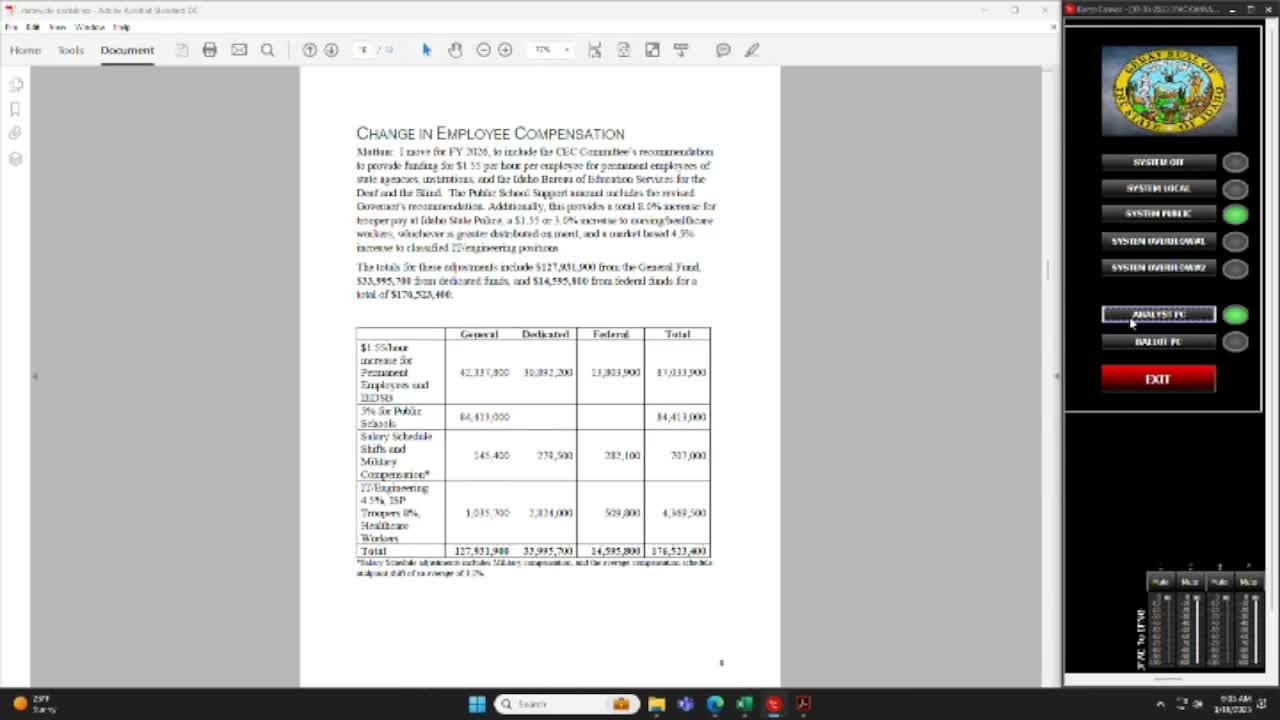
Representative Furness and Senator Cook led competing approaches. Furness presented the CEC committee’s recommendation to provide $1.55 per hour for permanent state employees (a flat dollar increase that produces larger percentage increases for lower-paid workers), a market-based 4.5% increase for IT and engineering positions (later amended to include non‑classified IT/engineering staff), an 8% increase for Idaho State Police trooper pay and a $1.55 or 3% increase for nursing/healthcare workers, whichever is greater. Furness’s motion included public-school support amounts and a total figure that staff later corrected on the record.
Senator Cook offered a substitute framed as a merit or percent‑based option: increase ongoing annual salary for each permanent state employee by $1.55 per hour or 4%, whichever is greater and based on merit; his motion also included targeted increases for troopers, healthcare workers and IT/engineering positions and carried a different fiscal total.
Members debated philosophical and practical concerns: some argued a flat dollar increase better targets lower-paid workers by delivering a higher percentage boost to those salaries; others argued a percent/merit approach preserves incentives and better rewards high‑skill, high‑responsibility positions and avoids artificially pressing private-sector wages upward. Members also discussed statutory language in Idaho Code (chapter 53, title 67), the CEC committee’s charge to produce a competitive compensation package and past commitments to employees.
Committee leaders and staff repeatedly requested more time to reconcile the paperwork and correct omissions (for example, including non‑classified IT staff and public‑school amounts). In the afternoon the two lead proponents withdrew their motions by unanimous consent so staff could rework the proposals. The chair announced the committee would reconvene later and continue work on maintenance budgets the next day; the compensation proposals will be revisited after staff delivers corrected, consolidated numbers and language.
Direct quotes
- “It’s equity breeds entitlement. Merit breeds excellence, high standards, and innovation,” — Senator Cook (addressing philosophical concerns and urging a merit approach).
- “We wanted to make sure we had that covered... it was an omission,” — Senator Galloway, referring to adding non‑classified IT/engineering positions to the motion.
Outcome
No formal compensation action was approved; both primary motions were withdrawn so staff could correct numbers and consolidate language. The committee will take up compensation discussions again at a later session when corrected materials are available.
Ending
Committee members praised staff work and emphasized the need for careful drafting and clear fiscal totals before a final vote on compensation adjustments.