Get Full Government Meeting Transcripts, Videos, & Alerts Forever!
Get email alerts on the Boise State Budget Student Success topic
No spam. Unsubscribe anytime.
Boise State president highlights LAUNCH enrollment, student‑success gains and paid legal defense; outlines workforce funding priorities
Summary
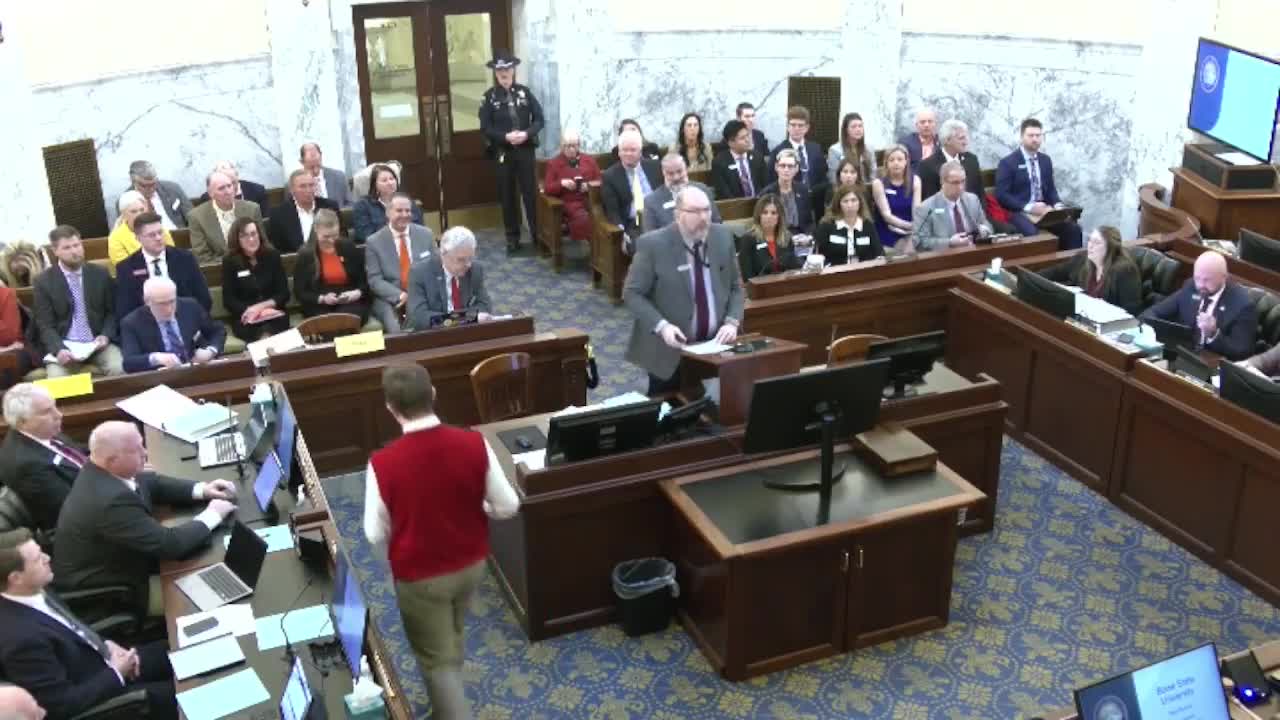
Boise State University President Marlene Tromp told the Joint Finance‑Appropriations Committee Jan. 29 that LAUNCH enrollment stands at about 1,300 students and that the university used non‑tax funds to defend a lawsuit, reporting roughly $1.5 million in defense costs.
Boise State University President Marlene Tromp told the Joint Finance‑Appropriations Committee on Jan. 29 that the university has increased student‑success outcomes while expanding access programs and preparing to support workforce growth tied to semiconductor and cybersecurity development.
Tromp said Boise State has 1,300 students enrolled in the LAUNCH program; about 600 of those students rely on LAUNCH as their only financial support. “What we're really excited about is the way that it's going to give students access to critical areas like nursing, computer science, radiological sciences, health sciences, business, mechanical engineering, elementary education, and criminal justice,” Tromp said.
Tromp told the committee Boise State has restructured student support centers over recent years, consolidating and reframing several programs to focus on student completion. She said the university initially reported eight staff working in centers tied to equity and related services, and that net staff reductions have been five positions; Tromp said some functions have been reframed to support broad student success (rural students, first‑generation students, veterans). She described the Institute for Advancing American Values and related programming that she said aims to broaden campus discussion and foster civility; Tromp said faculty and student government have adopted the Chicago principles on free expression.
On legal costs, Tromp told the committee Boise State “used only non taxpayer funds to support the defense of that lawsuit” and reported the university spent about $1,500,000 on that defense; she said she does not anticipate a substantial additional cost from a pending appeal.
Budget overview and federal grants
Kevin Campbell, the Legislative Services Office analyst, presented Boise State’s FY2026 budget overview, noting Boise State has more than 27,000 students and the presentation showed personnel costs representing 81.8% of overall expenditures, operating costs 16.5% and capital outlay 1.7%. Campbell also noted Boise State does not have legacy endowment funds in the same way older land‑grant institutions do.
Tromp described the university’s responsibility‑centered management model and said performance or responsibility‑centered budgeting has helped Boise State balance its budget and keep administrative spending per student lower than peer institutions. She said the university’s FY2026 requests include operational capacity enhancements and enrollment workload adjustments; detail on specific dollar amounts was presented in the university’s budget submission and Campbell provided those figures to the committee.
Tromp and committee members discussed federal funding uncertainty stemming from a recent Office of Management and Budget directive. Tromp said the university reviewed its federally supported research and student‑support grants and worked with the Division of Financial Management; while the courts issued a temporary injunction that paused the directive, Tromp said the university had short‑term concern about the possible loss of tens of millions of dollars tied to federal awards and was working with national associations to assess impacts.
Workforce, Micron and capacity needs
Tromp discussed opportunities linked to semiconductor industry growth, including training and research equipment. She noted Boise State houses unique equipment (an X‑tron used to deposit crystals on silicon wafers) that supports industry‑relevant research and student training. Asked how state higher‑education capacity funds might be used, Tromp said the university would prioritize nursing (estimating it could add roughly 40 graduates per year with additional funding), expand cybersecurity outreach through its Cyberdome program for small businesses and grow computer science and engineering enrollment if additional faculty and FTE were funded.
Courses and free‑speech issues
Committee members pressed Tromp on course content and whether any gender‑oriented course was mandatory. Tromp said UF‑100 and UF‑200 are required general education courses but students choose among many sections; a gender‑focused section is an elective option, not a required course. She said the university’s curriculum decisions will be aligned with state law and board directives.
Context and next steps
Tromp invited legislators to follow up with requests for breakdowns of legal defense expenses and other budget details; she said she would provide committee members requested itemizations. Boise State will also provide clarifying material on federal grants and the impacts of any sustained federal directive.
Speakers quoted in this article include Kevin Campbell (Legislative Services Office) and Marlene Tromp (president, Boise State University).