Get Full Government Meeting Transcripts, Videos, & Alerts Forever!
Get email alerts on the Education Budget topic
No spam. Unsubscribe anytime.
State education board office requests new workforce grant, cites IT, safety, audit transfers as drivers of staff growth
Summary
Kevin Campbell, a Legislative Services Office analyst, presented the Office of the State Board of Education budget and said recent transfers of IT, audit and school safety staff have driven agency growth while the board seeks a one-time $15 million public-private workforce capacity grant.
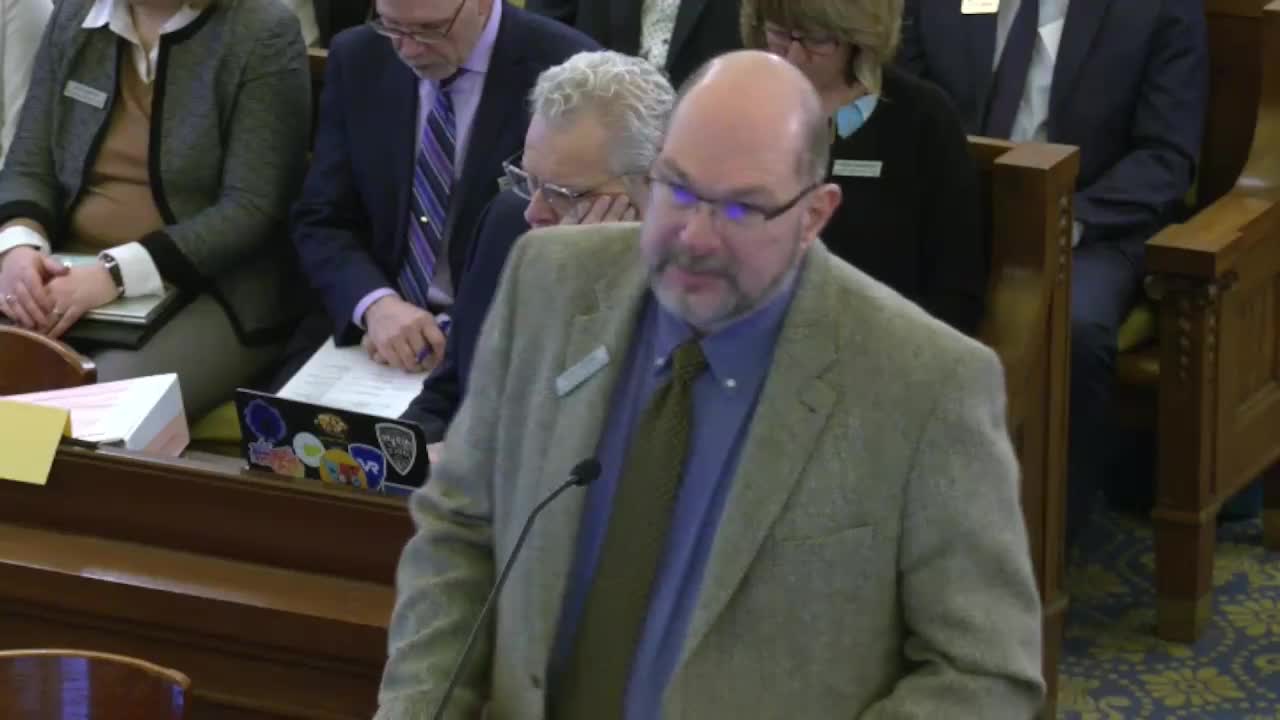
Kevin Campbell, a budget and policy analyst with the Legislative Services Office, presented the Office of the State Board of Education (OSB) budget and described recent program transfers and enhancements. He said Idaho Code section 33-101 creates the state board and that OSB now houses administration, IT and data management, and the school safety and security program. "The executive director of OSB is Mr. Joshua Whitworth," Campbell said, and introduced Whitworth for questions.
OSB Executive Director Joshua Whitworth told the committee the board has centralized functions previously handled by individual institutions, including internal audit, risk management and portions of IT and school safety. "Bringing [audit and risk management] centrally allows us to focus and make sure that we're doing standard policies across all of those," Whitworth said.
Campbell reported OSB has 84.25 authorized FTEs with eight vacancies and a five-year average authorized FTE count of 55.95; he said the lower five-year average reflects relatively recent transfers into OSB. He also described major drivers of the agencybudget in recent years, including a $30 million ongoing appropriation for the Empowering Parents grant created in FY2024 and transfers of IT and other staff from the State Department of Education.
The committee discussed the governor's single largest FY2026 enhancement request for OSB: a one-time, $15 million public-private workforce capacity grant. Whitworth described the grant's matching rules: a 1-to-1 match for Boise State University, Idaho State University and the University of Idaho, and a 1-to-2 match for Lewis-Clark State College and all four community colleges. "This grant will allow institutions to build infrastructure capacity if it relates to workforce training and in-demand careers and incentivize institutions to partner with local community members to raise funds for the projects," Campbell said.
Lawmakers pressed Whitworth on continued growth in centralized staff and dollars. Representative Petzke asked whether the centralized OSB is spending money more efficiently than if funds were routed directly to institutions. Whitworth said the board is trying to eliminate duplication and identify system-wide efficiencies; he cited centralized audit and risk functions and the transfer of the school safety team (six positions) as examples.
Several committee members requested more detail on proposed IT positions. Senator Cook asked whether the new IT roles replace contractors and whether a cost comparison exists; Whitworth replied that OSB currently uses contractors for a custom student access application and said bringing a database engineer in-house would allow broader use across programs and reduce contract costs. "When we can bring a database engineer in-house, we actually can utilize them across more than just one program," Whitworth said.
Members also asked about Independent Study Idaho, a program Whitworth described as a flexible, nontraditional delivery option funded primarily by fees (about $160 per credit). He said parts of the program previously covered by fees are falling short as costs rise and that the request includes a revision to base funding. "The real importance is it's kind of the moving from what was a paper based back in the old days to more of an online delivery," Whitworth said, and added that the committee should consider whether flexible-paced delivery merits additional general-fund support.
Committee members requested follow-up materials: a written IT plan and contractor expenditure detail, an itemization of which FY2026 requests require legislation, a refined list of programs eligible for the workforce grant, and more data on Independent Study Idaho and other user-fee-funded services. Whitworth said the behavioral threat assessment teams request is the only FY2026 request that requires new legislation and that the workforce grant eligibility will be tied to technical advisory committees, business advisory committees and in-demand career lists.
The committee and OSB leadership agreed to return with the requested clarifications in work-group sessions.