Get Full Government Meeting Transcripts, Videos, & Alerts Forever!
Get email alerts on the Public Safety Communications Hazmat topic
No spam. Unsubscribe anytime.
Idaho Military Division seeks immediate funds for vehicle modernization, public‑safety communications and regional hazmat teams
Summary
The military division outlined supplemental requests including vehicle communications installations, IT infrastructure changes to separate public‑safety networks, and a governor‑recommended $8.6 million cash transfer for regional hazardous‑materials response teams.
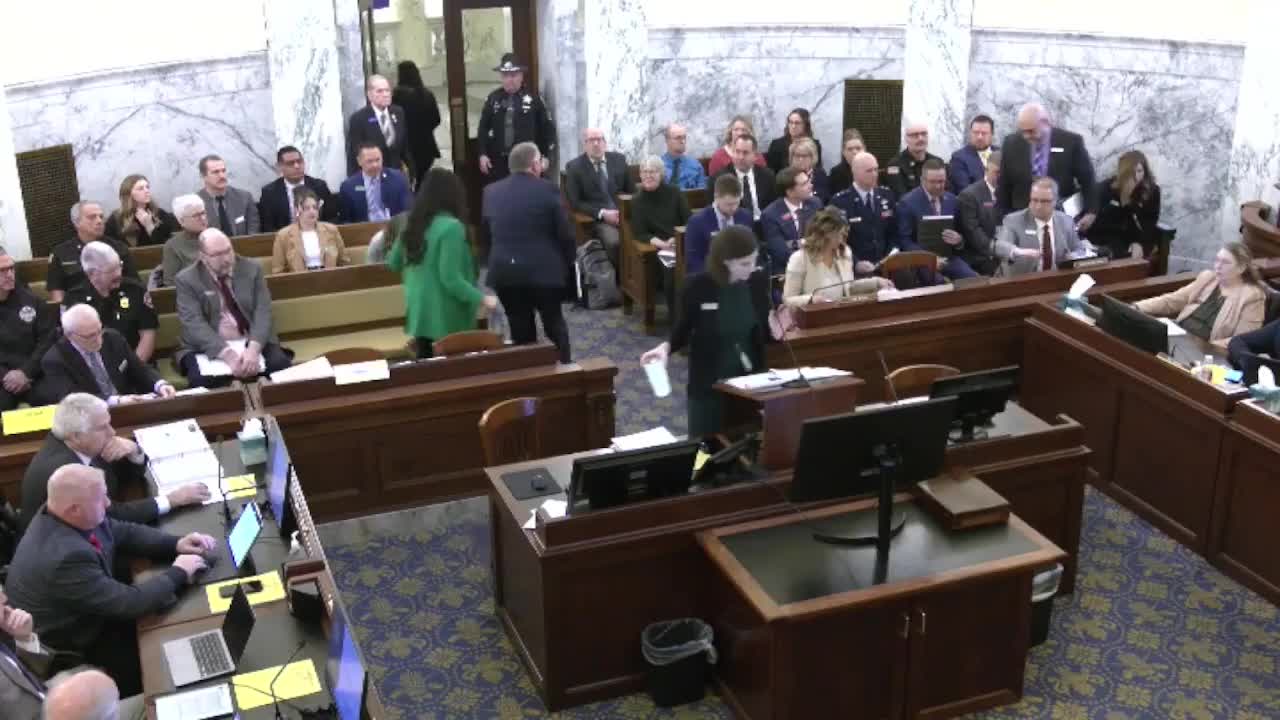
Major General Tim Donilon, Idahoʼs adjutant general, told the Joint Finance‑Appropriations Committee the Idaho Military Division needs supplemental funding to clear a backlog of communications work on law‑enforcement vehicles and to modernize its public‑safety communications infrastructure.
Budget analyst Frances Lippett reviewed the divisionʼs structure and finances and noted the division has three budgeted programs and is authorized about 429.8 full‑time equivalent positions. She described recent federal investments—particularly cybersecurity funding—and explained the divisionʼs request for a deficiency warrant of $34,200 for hazardous‑substance response costs that could not be recouped from incident originators.
General Donilon and staff said a surge of vehicles that arrived after chip shortages has created a backlog: many patrol vehicles delivered without installed critical communications equipment cannot be used until the radios and antennae are fitted. The governor recommended a supplemental that would fund contracting to clear that backlog and fund four additional installation bays to prevent future backlogs. Lippett told the committee the supplemental includes private contract work estimated at $240,000 and construction costs estimated at $300,000 to complete vehicle installation capacity. The presentation also described 40 Dodge Durangos owned by the Idaho State Police that require communications installations before use.
The governor also recommended $759,200 for IT infrastructure and licensing to allow public‑safety communications to establish a network independent of state ITS for improved security, and an $8.6 million appropriation for the Office of Emergency Management to distribute funding to regional hazardous‑materials response teams through a cash transfer from the state emergency relief fund.
Donilon described why the IT change is time‑sensitive: the division must modernize aging servers and separate the microwave‑based public‑safety network from ITS. “We realized that we have gotten behind in the modernization of our servers…we need to get that up to speed in order to tie into the ITS network for the state in order to keep the network secure,” he said. He added the division plans to separate the public‑safety microwave network from ITS and that separation carries hardware and installation costs.
On hazardous‑materials response, division staff told legislators that regional hazmat equipment has not been updated since about 2005 and the state supports seven regional response teams that serve multiple counties. General Donilon cited past incidents—including a propane spill on Highway 95—to underscore the need to update equipment for responders and said the $8.6 million would be distributed through the Idaho Office of Emergency Management to purchase and distribute modern equipment to the seven regional teams.
Committee members asked about timing and whether supplemental requests could be treated as enhancements for FY2026. Donilon said the division believes it can execute much of the supplemental before year‑end, and explained that vehicle work will be split between immediate contractor work and facility expansion to increase long‑term capacity. Representative Handy and others asked whether private contractors could continue to do installations rather than adding facility capacity; Donilon said contracted work tends to be costlier per vehicle and that quality control issues often require state staff to rework contractor installations to meet Idaho standards.
No formal vote or motion was taken during the presentation; Lippett and Donilon answered committee questions and agreed to provide follow‑up details if requested as the committee considers supplemental and budget items.