Get Full Government Meeting Transcripts, Videos, & Alerts Forever!
Get email alerts on the Personnel Benefits Health Insurance topic
No spam. Unsubscribe anytime.
Joint finance committee sets FY2026 state health‑insurance allocation at $14,130 per FTE
Summary
The Joint Finance‑Appropriations Committee approved a FY2026 increase to the state health‑insurance appropriation to $14,130 per eligible full‑time position, a change that raises projected reserve balances and increases general‑fund and other appropriations.
BOISE — The Joint Finance‑Appropriations Committee on Friday voted to increase the state health‑insurance appropriation to $14,130 per eligible full‑time equivalent position for fiscal year 2026.
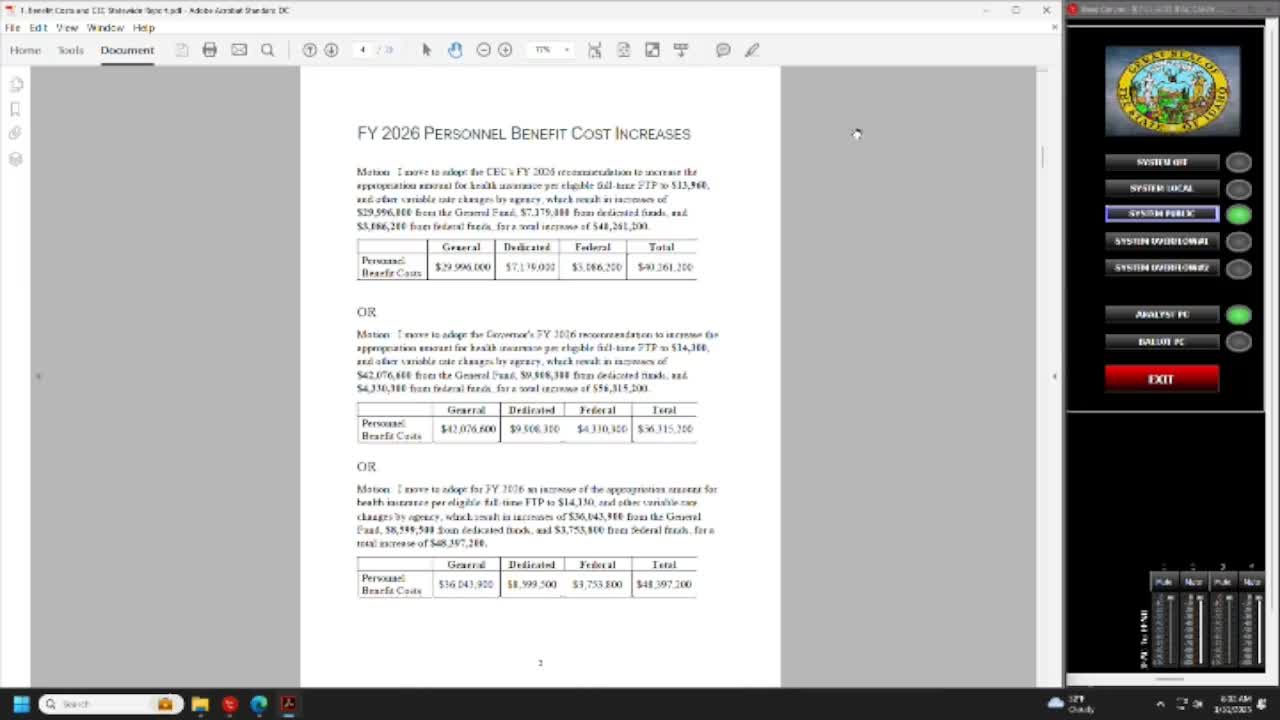
The move, approved by the bicameral committee after multiple competing proposals, carries an estimated statewide cost of $48,397,200 split across the general fund, dedicated funds and federal funds and will be transmitted with a due‑pass recommendation.
Committee analysts described three dollar‑level options on the table: the CEC committee recommendation at $13,960 per FTE, the governor’s recommendation at $14,300 per FTE and a midpoint compromise at $14,130 per FTE. Senator Woodward moved the $14,130 compromise and Representative Tanner seconded the motion. Budget staff told members that the $14,130 option would raise appropriations by $36,043,900 from the general fund, $8,599,500 from dedicated funds and $3,753,800 from federal funds for a total increase of $48,397,200.
The committee also heard projections of the insurance reserve balance under the options. Staff reported that a $13,960 allocation would leave a projected reserve balance of about $51.6 million at the end of FY2026, the governor’s $14,300 recommendation would project about $61.4 million, and the midpoint would fall between those figures.
Supporters of the higher allocation argued it reflects the actual cost of insurance and avoids disguising costs by using reserves to “buy down” premiums. Senator Ward Engelking said the higher figure “reflects the actual cost of insurance” and warned that using reserves to reduce the visible premium in one year can make future increases look larger. Opponents urged caution about reserve growth and actuarial projections. Representative Furness, who had offered the CEC committee’s lower $13,960 figure, said actuarial projections from Milliman have historically been conservative and suggested the committee should consider whether lower funding would be appropriate given prior experience.
Committee clerk Ms. Figueroa called roll on the final motion. The Senate recorded eight ayes, zero nays and two members absent and excused; the House recorded nine ayes, zero nays and one member absent and excused. The combined result reported 17 ayes, 0 nays and 3 absent and excused, and the chair announced the motion had passed and “will carry a due pass recommendation.”
The committee’s approval sets the appropriation level for health insurance used in agency budget worksheets and is expected to be incorporated into subsequent budget drafting and bill language.
Members flagged that implementation details and any related language would be handled following the committee’s vote. The meeting then moved on to debate about broader change‑in‑employee‑compensation proposals.