Get Full Government Meeting Transcripts, Videos, & Alerts Forever!
Get email alerts on the Memorials Veterans Policy topic
No spam. Unsubscribe anytime.
Committee hears emotional, partisan testimony on veterans‑memorials bill; delegates defer action
Summary
House Bill 1884 would impose a 40‑year waiting period and a two‑thirds referendum requirement before a locality could remove, relocate or substantially alter a publicly owned war memorial; the committee heard extensive testimony and passed the bill by for the day amid divided views.
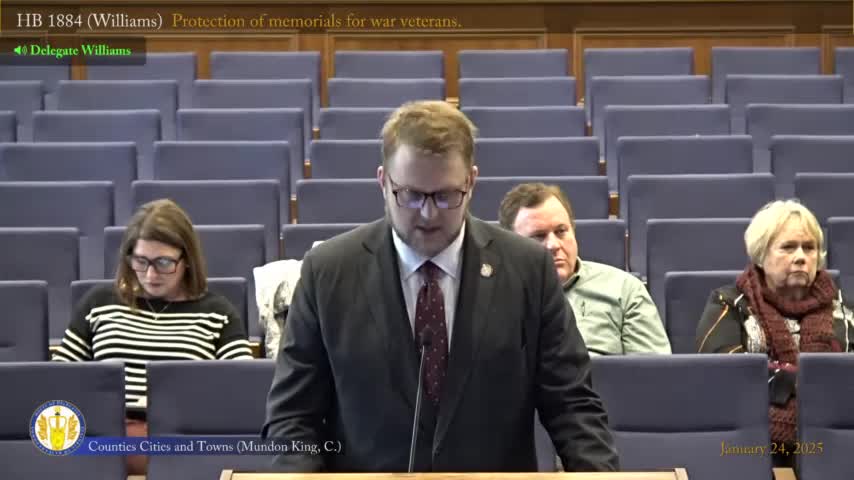
House Bill 1884, presented to the House Committee on Counties, Cities and Towns, proposes a uniform process for changes to war memorials on public property. The bill would impose a 40‑year window after dedication before a memorial could be altered, and requires a two‑thirds voter threshold in a referendum for removal, relocation or other substantial alteration. The sponsor framed the measure as nonpartisan and intended to protect veterans’ memorials across conflicts.
Public testimony included multiple veterans, family members and veterans‑service advocates who urged a high bar for removing memorials. Colonel Jeff Allen, introduced as a 32‑year military veteran, said memorials honor service and families’ sacrifices. Christopher Hicks, a retired Navy veteran who served in Desert Storm and Enduring Freedom, and other witnesses urged the committee to preserve a referendum pathway and to ensure respectful treatment of memorials.
Opponents argued the bill would limit local decision‑making and could operate as a shield for Confederate monuments. A delegate with experience as deputy city attorney in Charlottesville told the committee she was "deeply disturbed by just the fundamental principle that as a state, we are gonna tell localities what they can and cannot do with stuff that is on their public property." She described how statutory restrictions in past years complicated local efforts to address Confederate monuments and said the existing process — notice, public hearing and local action — already balanced competing interests.
Another member criticized the bill for effectively entrenching a sanitized view of history and said the measure could uphold the "lost cause" narrative; that member said it risks conflating Confederate memorials with memorials honoring military service generally. The committee was sharply divided; with time pressure and multiple members indicating the need to prepare for floor votes and caucus, a motion to "pass by for the day" was adopted on a voice vote and the measure was not advanced that day.
Next steps: With the committee divided and additional stakeholder concerns apparent, HB 1884 was passed by for the day to allow further discussion. Sponsors and opponents may submit amendments or continue negotiations before the bill is scheduled again for committee action.