
Southside ISD trustees hold CliftonStrengths workshop to map board strengths
Get AI-powered insights, summaries, and transcripts
Subscribe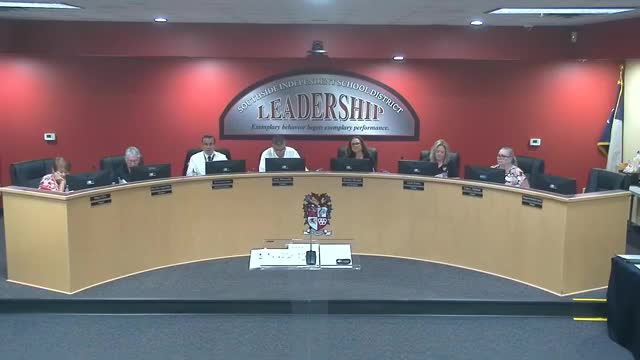
Summary
The Southside Independent School District Board of Trustees held a special meeting Oct. 8 for an interactive CliftonStrengths workshop led by consultant Heather Olague; 13 trustees and staff participated, and no formal business or public comment was taken.
SAN ANTONIO — The Southside Independent School District Board of Trustees met in a special session Wednesday, Oct. 8, for an interactive CliftonStrengths (Gallup) workshop led by Heather Olague aimed at helping trustees identify individual strengths and improve teamwork.
The workshop, the only item on the board’s agenda, began at 6 p.m. and ran about two hours. President Hernandez called the meeting to order and noted a quorum was present. No public comment was taken.
Olague, who identified herself as a certified strengths coach and assistant dean at the Cisneros Institute of Emerging Leaders at A&M San Antonio, led a series of exercises including reviewing each person’s full 34-strength report, selecting photos that represented participants’ top five themes, writing their names with their non-dominant hand, and completing a “best of me” grid to surface how strengths interact and where they can become counterproductive.
“What if we stop thinking about what’s wrong with people and focus on what their strong suits are,” Olague told the trustees during the workshop, citing the method’s emphasis on building from strengths rather than fixing weaknesses.
Trustees and staff took turns describing their top strengths and why they chose photos and examples that reflected those themes. Olague displayed a team grid showing each participant’s top 10 strengths and pointed out patterns across the group — notably a heavy presence in relationship-building themes and several recurring themes such as achiever, learner and individualization. She encouraged the board to use those patterns to assign roles and to adapt communication when members’ approaches differ.
Olague described the difference between a strength’s “power” and its “edge,” explaining that a trait used ineffectively can become a liability. She walked trustees through how to identify when a strength is helping and when it may produce friction with others, and she advised setting explicit expectations or deadlines when deliberative and activating styles clash.
Board members responded that the exercise reflected their experiences. Several trustees noted the session helped them recognize how to adjust communication and teamwork — for example, giving planning time to members who need it and allowing others to lead in networking or implementation tasks.
Olague said she would provide board members with a team spreadsheet showing full 34-strength reports and an Excel “team grid” summarizing the group’s top themes; she told meeting staff she could send the files to staff member Luann. Trustees agreed the material could inform future goal-setting and improve how the board assigns tasks and communicates.
The meeting concluded with a motion to adjourn that was seconded and carried by voice vote. The board adjourned at about 8:05 p.m.
The training did not produce policy decisions or votes on district business; Olague recommended trustees continue reflective conversations and apply the strengths framework to specific board goals going forward.