
Broomfield unveils crash-data dashboard and targeted police training to improve reporting consistency
Get AI-powered insights, summaries, and transcripts
Subscribe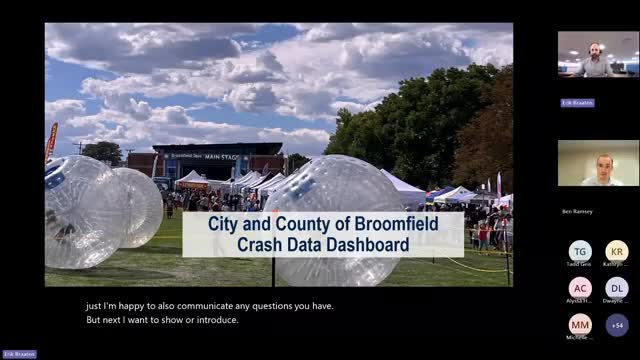
Summary
The City and County of Broomfield described a public-facing crash-data dashboard sourced from police records, a backend editing workflow for traffic staff and short in‑person training for officers to improve field reporting consistency.
Ben Ramsey, GIS analyst for the City and County of Broomfield, demonstrated a new crash-data dashboard that sources two years of crash records (2022–2024) directly from the city’s New World police database, and he described an internal editing workflow that allows traffic staff to correct data for internal analysis.
Ramsey said the dashboard is modeled after DRCOG’s dashboard for usability but includes local customizations: visualization of scooters and motorcycles, a hit-and-run selector, direction-of-travel filters, separation of crashes involving alcohol and drugs and unit-level details in pop-ups. The public dashboard uses a feature layer and a feature-layer view to expose a cleaned, filtered subset of fields publicly while preserving additional identifying fields in the internal layer.
Bryce Hamerton, Broomfield’s traffic engineer, described a short training program the city conducted with patrol sergeants and officers to improve field reporting. The city hired NextPhase Engineering to clean three years of crash history by reading narratives and standardizing coded fields; staff then identified fields reported inconsistently and designed brief, focused training for patrol to improve future data quality.
Hamerton said the training targeted practical priorities: public vs. private location coding; how to code which intersection a crash is associated with (for example, queue-related rear‑end crashes); clarifying approach and turning-movement coding; using direction-of-travel to reflect movement before the crash; and completing pedestrian and bicycle fields. Because scheduling in-person sessions for all shifts proved difficult, Broomfield plans to record the training for its online learning system so sergeants can assign it to officers on varied schedules.
Ramsey discussed geocoding choices: Broomfield geocodes crashes to nearest intersection to capture intersection-related crashes, acknowledging some cases — such as crashes associated with queueing — may snap to a nearby cross street, and the city intends to refine that process with an annual review. He said the GIS schema uses coded domains taken from the police DR3447 report to support editing workflows and to keep the public view stable if the underlying schema changes.
Ramsey and Hamerton cited future dashboard improvements under consideration, including automated data cleaning, refined intersection geocoding, adding non‑motorist location details, and storing individual injury‑severity per person so pop-ups can reflect person-level outcomes.