Get Full Government Meeting Transcripts, Videos, & Alerts Forever!
Get email alerts on the Substance Abuse topic
No spam. Unsubscribe anytime.
State substance-abuse budget uses opioid grants and Millennium funds; agency seeks fund swaps to meet federal admin limits
Summary
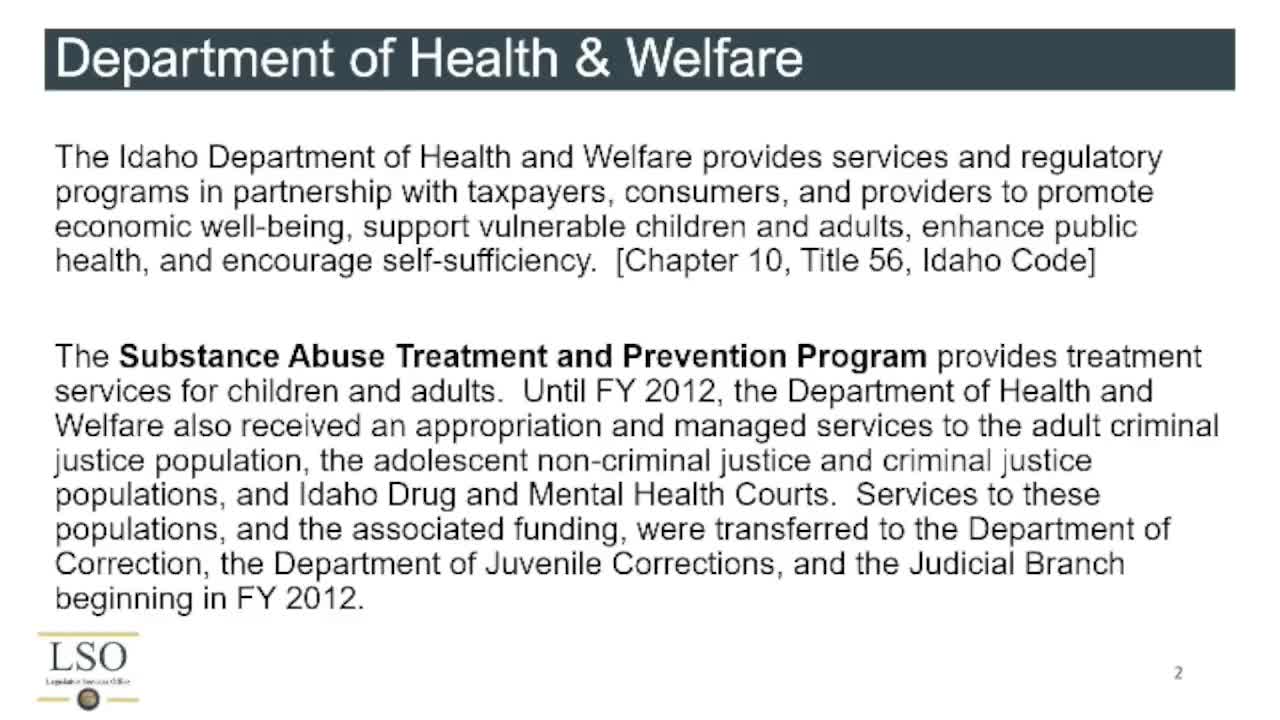
Department leaders told the committee that the Division of Substance Abuse relies on federal opioid grants, Millennium Fund allocations and one-time opioid-settlement dollars, and is proposing interfund shifts so Idaho stays within federal administrative caps for the block grant.
Alex Williamson, the Legislative Services analyst, outlined the Division of Substance Abuse Treatment and Prevention’s recent funding history and requests, saying the program received an $8,000,000 state opioid response appropriation in fiscal 2023 that was made ongoing in fiscal 2024.
Williamson said the division spent about $22.7 million in fiscal 2024 and that 70.6% of that spending went to trustee and benefit payments (grants and subgrants to providers). She described ongoing enhancements tied to Millennium Fund allocations — including $1.35 million for community‑based recovery centers — and one‑time opioid settlement funding of $1.2 million in fiscal 2025.
The department and governor recommended a technical set of net‑zero fund shifts to comply with federal administrative limits on the substance‑use block grant. Williamson said federal guidance placed Idaho on a corrective action plan for exceeding a roughly 5% cap on administrative (personnel) spending in that block grant. The agency proposed moving $533,900 from liquor control dedicated funds to cover personnel costs and shifting $673,900 from personnel costs to trustee and benefit payments on the federal side so the state’s spending mix complies with the cap while preserving current staffing and program activity.
Senator Cook questioned that approach, suggesting the department is “shifting cash” to avoid the federal admonition rather than reducing administrative spending. Williamson and Director Adams said the department had reduced FTP in the program overall and proposed a net reduction in personnel costs while also reallocating dedicated funds to cover personnel that federal guidance limits would otherwise designate as administrative. Adams said his intent was to use available dedicated funds while implementing internal reductions rather than seek additional general‑fund authority.
Williamson also noted a request the committee had already approved in prior decisions to align Millennium Fund amounts from trustee and benefit payments to operating expenditures.
Ending: Committee members asked for follow‑up material on program outcomes and the operation of specific opioid‑settlement projects. Director Adams said the department serves mainly as a pass‑through for some of those grants and that agencies or recipient organizations should be contacted for detailed program outcomes. No formal committee vote on the fund‑swap mechanics was recorded in the transcript.