Get Full Government Meeting Transcripts, Videos, & Alerts Forever!
Get email alerts on the State Public Defender topic
No spam. Unsubscribe anytime.
New Idaho State Public Defender office seeks millions in supplemental and ongoing funds amid rapid onboarding
Summary
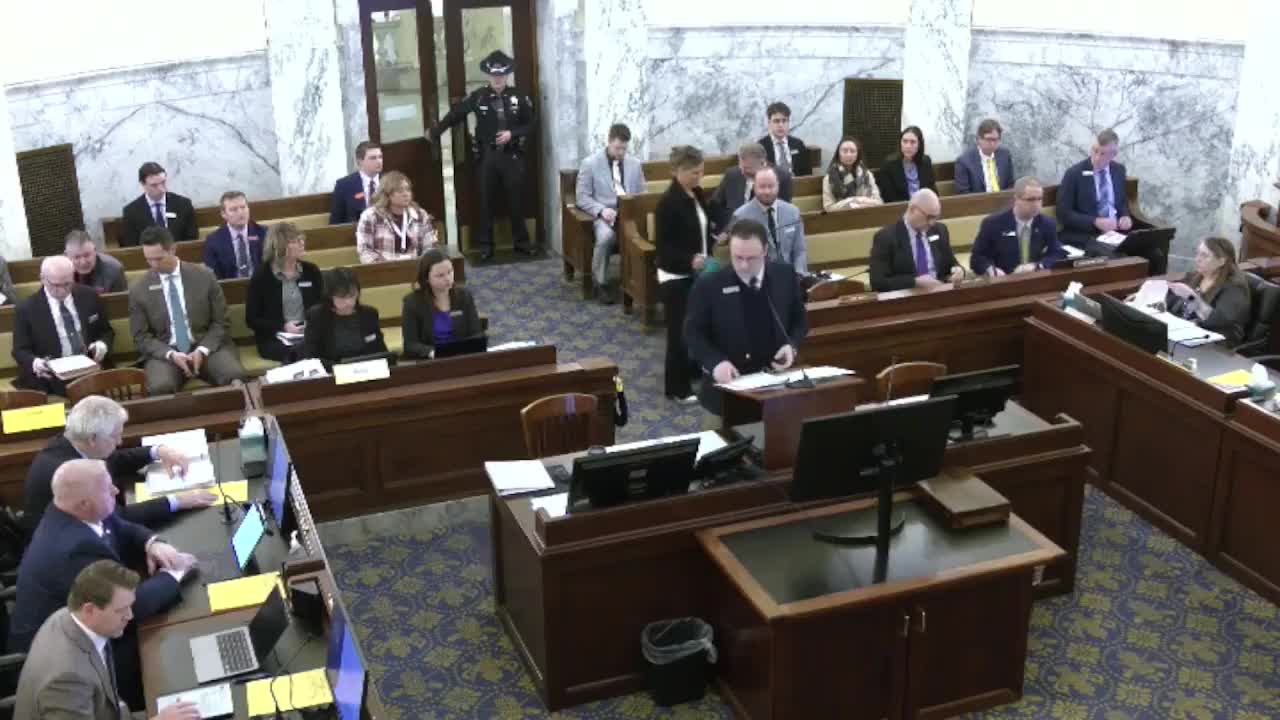
Officials from the new State Public Defender told the Joint Finance-Appropriations Committee they need supplemental and ongoing appropriations to use a $39 million cash transfer, cover transcript costs after a state Supreme Court ruling, raise contract and personnel rates, and onboard several counties into the statewide system.
The newly created Office of the State Public Defender asked the Joint Finance-Appropriations Committee for multiple supplemental and FY26 enhancements to fully implement its responsibilities after transitioning from the prior Public Defense Commission.
Budget analyst Christopher Lahoset outlined the agency’s structure and financing and highlighted a $39 million statutory cash transfer from the tax relief fund to a new State Public Defense Fund (cited as section 57‑8207 of Idaho Code). Lahoset said the agency’s staffing request includes authorization for 17.96 full‑time positions to support onboarding four institutional offices and a personnel budget of about $37.7 million.
Lahoset told the committee the agency requested a $2.5 million one‑time supplemental to fully utilize that $39 million cash transfer, and the governor recommended additional one‑time and ongoing funding for transcript costs and to increase contract rates and salaries. Lahoset also noted the Idaho Supreme Court’s Dec. 5 ruling in State v. Blasick altered transcript cost responsibility, prompting a governor recommendation of $390,200 one‑time and $1,290,200 ongoing to cover transcript expenses.
State Public Defender Eric Frederickson described transition challenges since the agency began Oct. 1: a sudden large number of withdrawals and cases, the loss of contract attorneys and experienced staff, and a need to equalize pay and raise contract rates to recruit attorneys for rural counties. “We walked into 1,300 withdrawals and cases,” Frederickson said, and he told the committee the office had to triage work while building infrastructure including a statewide case management system.
Frederickson said some costs previously borne by counties — for example psychosexual evaluations (about $2,500 each) and other valuation expenses — surfaced as obligations after the transition. He said legislation currently requires counties to provide facilities until 2029 and that statutory clarification will be needed to shift facility responsibilities fully to the state.
The agency reported about 29 vacant positions in its roll at the time of review and that the base appropriation after initial enhancements is just under $49 million. Lahoset summarized FY25 requests: $5,427,600 one‑time for additional personnel and contracting costs, and for FY26 requests the agency sought $2.5 million ongoing to fully utilize transferred cash, $16,000,380 plus $80,800 from the general fund for operating increases (primary/conflict contract attorneys, investigators, experts, transcripts), authorization for 17.96 FTP and $226,700 for onboarding Benewah, Elmore, Jerome and Shoshone counties, and a governor‑recommended one‑time general fund transfer of $16,867,400 for recruiting and rate increases.
Legislators asked whether supplementals could be spent in the short timeframe and about distinctions between the State Public Defender and the State Public Defender’s predecessor (the Public Defense Commission) and the State Public Defender’s relationship with district public defenders. Frederickson said his office is working to make representation uniform across counties and that the statewide case management rollout will help forecast ongoing needs and workload-based staffing.
No formal committee votes were recorded during the hearing; committee members requested additional detail on miscellaneous line‑items, contract rates, and county‑facility arrangements for follow-up before appropriation decisions.