Get Full Government Meeting Transcripts, Videos, & Alerts Forever!
Get email alerts on the Compensation Cec topic
No spam. Unsubscribe anytime.
Heated JFAC debate on pay adjustments ends with motions withdrawn; issue to return
Summary
Committee members debated rival approaches to employee pay — a flat $1.55 hourly bump vs. percentage/merit increases and targeted market adjustments for troopers, nurses and IT — but sponsors withdrew motions to allow staff time to finalize numbers.
A substantive and at times heated debate on change‑in‑employee‑compensation (CEC) recommendations occupied the committee for much of the session before the primary motions were withdrawn to allow staff additional time to reconcile numbers and language.
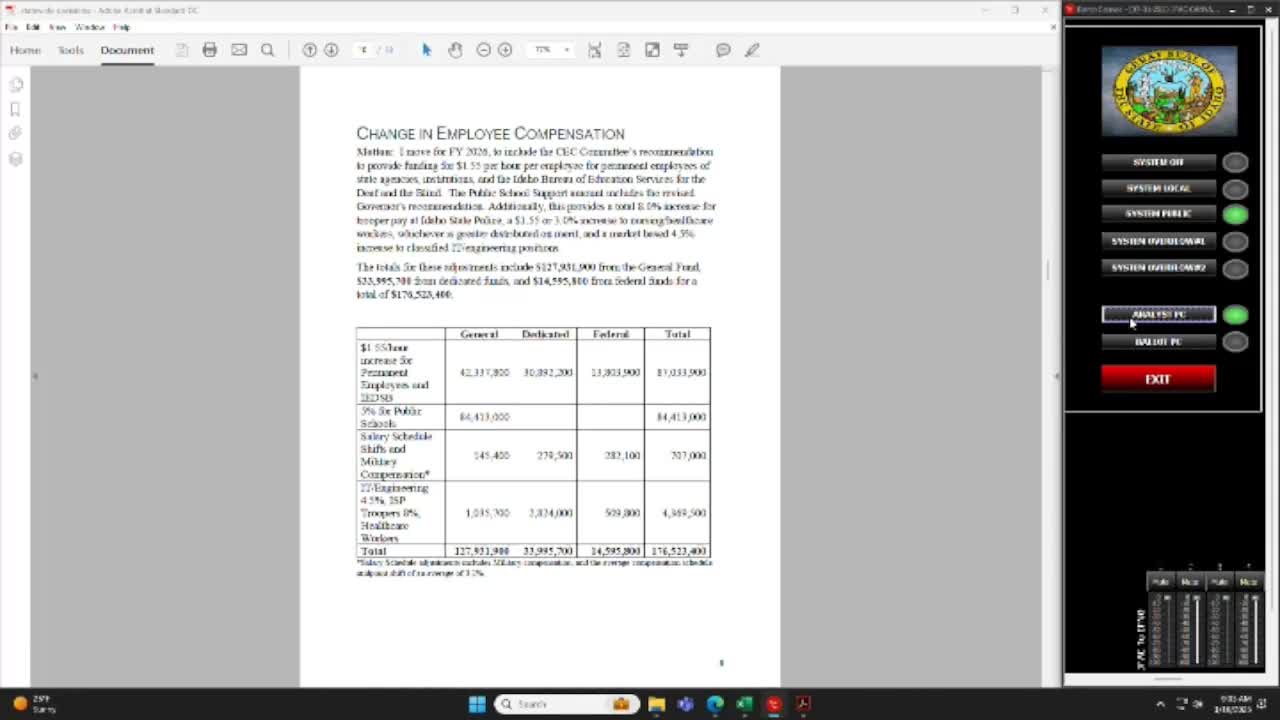
Representative Furness (motion sponsor) presented the CEC committee’s recommendation to provide a $1.55 per hour increase for permanent state employees (or 4% where that is higher), with additional provisions: an 8% increase for Idaho State Police trooper pay; an increase of $1.55 or 3% for nursing and health‑care workers (whichever is greater, to be distributed on merit); and a market‑based 4.5% increase for classified IT and engineering positions. Furness’s original motion included the public‑school support amounts to align with the governor’s revised figures; following corrections the motion was amended to explicitly add nonclassified IT and engineering positions as well.
Senator Cook offered a substitute motion that would raise ongoing annual salary for each permanent state employee by $1.55 per hour or 4%, whichever is higher, and include the same targeted increases for troopers, nurses and IT; the substitute proposed a different funding mix and a lower aggregate cost. Members split on the policy approach: some framed the $1.55 across‑the‑board approach as equitable and more helpful to lower‑paid workers, while others argued it discourages merit and fails to address market competitiveness for high‑skill positions.
Several members referenced statute (Title 67, Chapter 53) requiring the legislature to consider merit and market adjustments when setting compensation policy. The debate featured extended floor remarks on recruitment and retention, market competition, and the risk of pushing pay for specific occupations in ways that could affect the private sector.
In the interest of allowing staff time to prepare corrected numbers and packet materials, both Representative Furness and Senator Cook withdrew their motions by unanimous consent near the adjournment. Chairman Groh said the committee would proceed with maintenance budgets the next day and agreed to return to compensation deliberations after staff provide corrected documents.
Ending: The compensation proposals were not adopted; committee members asked staff to present corrected ballot language and the updated fiscal figures when the item returns for a vote.