Get Full Government Meeting Transcripts, Videos, & Alerts Forever!
Get email alerts on the Village Public Safety topic
No spam. Unsubscribe anytime.
DPS seeks to expand VPSO ranks to 90; officials say retention improving but long-term goals larger
Summary
The Department of Public Safety asked for funding to expand the Village Public Safety Officer program to 90 positions, saying 85 slots are currently filled and retention has improved. Officials described goals to reach 100 positions and noted regional public-safety officers and travel needs for rural policing.
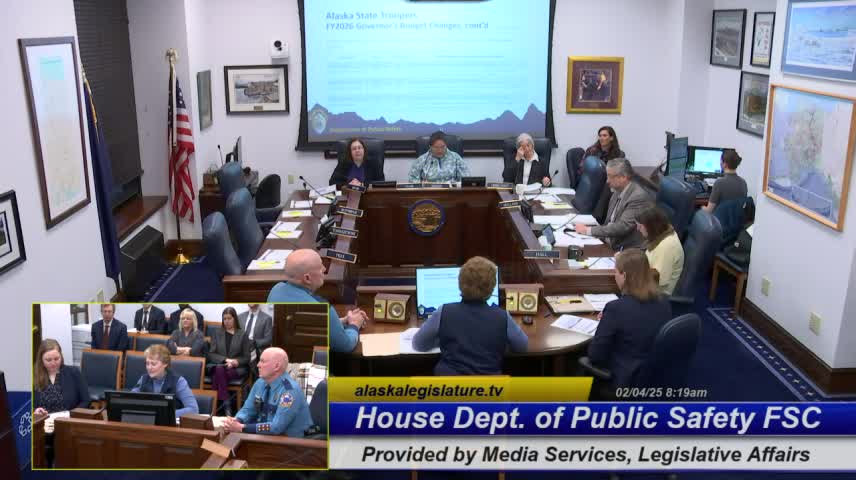
The Alaska Department of Public Safety told the House Finance subcommittee it is proposing an FY26 incremental appropriation of about $1.215 million to expand the Village Public Safety Officer (VPSO) program to 90 positions.
“Within this component, we also established a maintenance and operating component to cover leases and operations,” Diana Thornton, administrative services director, said during the presentation.
Commissioner James Cockrell said the department has grown the program from roughly 40 VPSOs three and a half years ago to 85 currently filled positions and that the department’s short-term goal is to reach 100. “If I had a perfect world, I’d have every village that wanted a VPSO to get one,” Cockrell said. He added the department’s longer-term “dream” would be roughly two VPSOs per village—about 300 officers—while acknowledging the state is unlikely to reach that number quickly.
Committee members pressed for details about retention and staffing. Representative Holland noted turnover has been historically high and asked what the department is doing to improve retention. Thornton and Cockrell said turnover has improved this year and estimated current turnover around 20 percent, down from historical levels in the mid-30s to around 40 percent at worst. Thornton cited higher, competitive pay negotiated with grantees and improved recruitment efforts as major factors.
The department described Regional Public Safety Officers (RPSOs) as a more mobile, higher-responsibility role that can serve multiple villages in a region; Cockrell said six RPSOs are counted as part of the 85 VPSO total. He described RPSOs as “kinda one step above a VPSO” with more training and regional travel responsibilities.
On operational logistics, department staff said VPSOs and RPSOs rely on boats, snow machines, ATVs and aircraft (including department aircraft and occasionally charters) to reach remote communities; one recent homicide response in Selawik required a charter flight because regular transport was unavailable.
Thornton said starting VPSO pay is now “about $38 to $40 an hour,” which the department said has helped recruitment and retention. Lawmakers asked for additional detail on communities requesting VPSOs (committee members referenced roughly 94 communities that had requested services) and how the department prioritizes awards to grantees; Thornton said grantees also use roving models and other creative staffing arrangements when full-time VPSOs are not available.
Ending: Department officials asked lawmakers to view the VPSO expansion as a staged effort to build sustained, long-term staffing rather than rapid hiring that would increase turnover; they said the program is at “probably the strongest it’s ever been” but that expansion will require continued legislative support.