Get Full Government Meeting Transcripts, Videos, & Alerts Forever!
Get email alerts on the Employee Benefits Health Insurance topic
No spam. Unsubscribe anytime.
Tense JFAC debate over health-insurance base rate puts insurance reserve and contract risk in focus
Summary
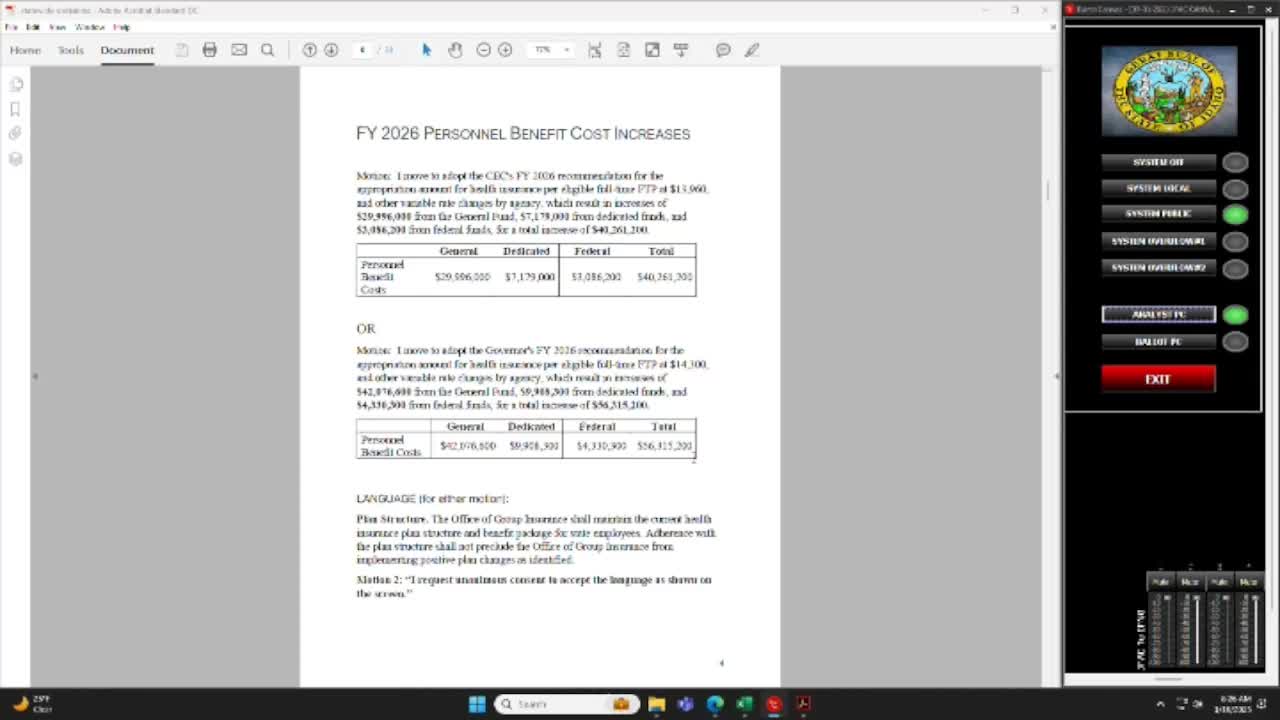
JFAC members debated whether to set the FY2026 health‑insurance base at the Economic Outlook Committee’s $13,960 per eligible FTP or the governor’s $14,300, with actuaries warning the lower figure would reduce the insurance reserve to the contractual 10% contingency.
A lengthy committee debate focused on setting the state’s health‑insurance base amount per eligible full‑time equivalent (FTP) for FY2026 and the reserve balance that funding choice would leave.
Keith Bybee, Division Manager of the Budget Policy Analysis Division, described two competing options: the Economic Outlook Committee (CEC) recommendation that sets the base at $13,960 per eligible FTP (a $960 increase from the prior base), and the governor’s recommendation of $14,300 (a $1,300 increase). Bybee said the governor’s recommendation would increase the state’s health‑insurance base and leave a larger reserve cushion.
Budget analysts and administrators explained the reserve implications. Milliman actuarial projections presented to the committee showed the $13,960 option would reduce the contingency reserve to about $51.6 million — effectively the statutory minimum of 10% of plan costs — while the governor’s $14,300 choice would leave about $61.4 million in reserve. Bybee described the total projected plan cost for FY2026 as roughly $482 million.
Laurie Wolf, administrator for the Division of Financial Management, told the committee the 10% contingency reserve is a contractual floor: “It is not a suggestion. It is actually a contractual obligation that we stay within that 10% minimum,” she said, adding that the 10% level roughly corresponds to a 50–50 chance of meeting the actuarial projection. Faith Knowlton, administrator for the Division of Insurance and Internal Support at the Department of Administration, said falling below the 10% contingency could expose the state to a risk charge assessed by the carrier, and the size of such a charge would depend on how far reserves fell below the contingency.
Committee members offered differing perspectives. Representative Furness (who later sought and secured inclusion of additional nonclassified IT positions in other motions) and others argued for the lower CEC number to avoid over‑funding reserves that have grown historically and to reduce the short‑term fiscal burden. Other members, including Senator Ward‑Engelking and Representative Tanner, raised concerns about staff retention and the unpredictability of large claims, urging a more conservative funding level to preserve the reserve cushion.
Votes on motions to adopt either the governor’s recommendation or the CEC recommendation were taken. A motion to adopt the governor’s $14,300 figure was moved and seconded but failed to achieve a Senate majority; a substitute motion adopting the CEC $13,960 figure likewise failed to achieve both‑chamber majorities. The committee therefore did not adopt either option at this meeting.
Ending: Analysts said adopting the lower number could force a larger increase in future years if claims require reserve rebuilding; members asked staff for follow‑up actuarial detail before a final decision.