Get Full Government Meeting Transcripts, Videos, & Alerts Forever!
Get email alerts on the Committee Procedure topic
No spam. Unsubscribe anytime.
House Commerce Committee tests new electronic voting system; chair urges measured approach to AI
Summary
The Tennessee House Commerce Committee held an organizational meeting and test of a new electronic voting system. Members approved two procedural test votes, staff and clerks were introduced, and Chairman Kevin Vaughn outlined committee priorities including reducing regulatory burdens and a cautious stance on regulating artificial intelligence.
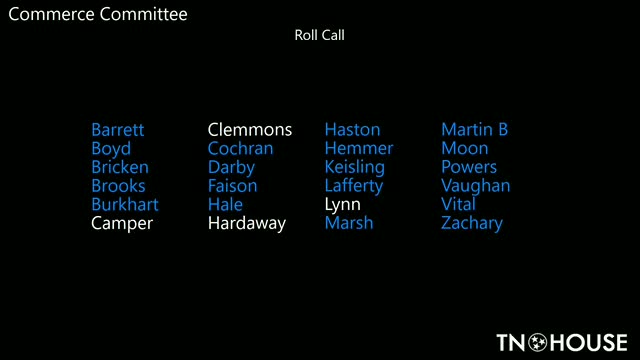
The Tennessee House Commerce Committee met in an organizational session and performed a test of a new electronic voting system on Oct. 25, 2025, Chairman Kevin Vaughn said. Representative Clark Boyd moved to conduct the test votes; clerks operating the system reported two successful tallies during the session.
The test mattered because the committee intends to use the board for binding business later in the session and wanted to confirm the system works before handling substantive votes. "Primarily, the reason that we're meeting today is that we do need to work on this voting system so that we make sure that we take it for a test drive," Chairman Kevin Vaughn said. After the tests, he added, "We did not break the voting machine."
The committee conducted at least two procedural test votes on the electronic board. On the first test, the clerk reported 13 yes, 6 no and 2 present not voting. On a subsequent test the clerk reported 15 yes, 5 no and 1 present not voting. Representative Clark Boyd made the motion to test the board; a recorded second was not specified in the transcript. Representative Jerome Moon later moved to adjourn; a member seconded and the meeting ended without an additional roll-call tally.
Chairman Vaughn used the orientation to outline policy priorities for the Commerce Committee, emphasizing support for the business community and consumer protections while urging restraint on immediate statutory action on emerging technologies. "I want to do our best not to hinder it at this point in time because, a, it's moving so fast," Vaughn said of artificial intelligence. He said the committee should avoid passing statutes that could be obsolete within months and noted conversations with the attorney general's office about existing law's ability to address misuse. Vaughn cited last year's change on name, image and likeness — which he referred to as the "Elvis act" — as an example where the Legislature added language because existing law had not contemplated use of voice.
The chair also introduced committee staff and legal counsel so members would know who would support committee operations. Legal Services attorney Levin Middleton Dunn was introduced as the committee's counsel; Rachel Bennett was introduced as the legislative assistant who would operate the microphone and voting technology; Alex Perry was introduced as a new committee analyst; and Valentina and Jared were named as clerks assigned to the hearing. Representative John Ray Clemens was noted in remarks as having reviewed the voting system manual.
Members briefly covered committee culture and process. Vaughn asked members to focus on maintaining a balance between necessary consumer protections and removing unnecessary regulatory burdens that could hinder businesses. He also urged decorum and respectful disagreement in committee proceedings.
The meeting closed after the voting tests and brief remarks. Vaughn said subcommittees will meet twice in the near term; no formal policy measures were considered or adopted during this session.
Ending: The Commerce Committee's test session confirmed voting-board functionality and established the chair's early priorities; members and staff will reconvene in subcommittee meetings as scheduled.