Get Full Government Meeting Transcripts, Videos, & Alerts Forever!
Get email alerts on the Utilities Water Fire Lines topic
No spam. Unsubscribe anytime.
Salt Lake City public utilities asks council to correct fee schedule after decades-old fire-line charge found missing
Summary
Salt Lake City Public Utilities asked the City Council to approve a correction to the consolidated fee schedule to restore a missing “fire lines” title and the per-inch description for a monthly fire-line charge that staff say was updated in the FY26 rate study.
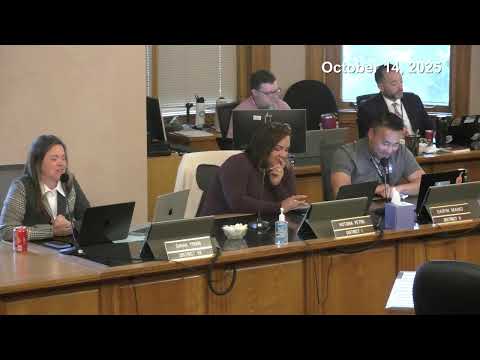
Salt Lake City Public Utilities asked the City Council during a work session to approve a correction to the city’s consolidated fee schedule to restore a missing “fire lines” title and the description stating the charge is assessed “per inch.” Public Utilities staff said the department updated the underlying fire-line fee as part of its FY26 rate study but that the published consolidated fee schedule (CFS) omitted the title and per-inch description, creating a discrepancy that the department says could affect billed revenues.
Public Utilities’ financial analyst Jacob Jorgensen told the council the city had charged “the same rate, $1 per inch of connection, since 1961,” and that the updated fee structure stems from a cost-of-service review in the department’s rate study. A Public Utilities presenter said that if the correction is not approved the department “may have to revert back to the FY25 CFS section with former rates for the fire lines, which could result in about a $740,000 difference in revenue at budgeted set to collect.”
The correction before the council is limited to adding the missing table title and the “per inch” description in the water section of the CFS; Public Utilities said the substantive rate changes for fire lines were considered during the FY26 budget process and the department’s rate study. Laura Briefer, Director of Public Utilities, and Jacob Jorgensen outlined why the city assesses a separate fire-line charge: private fire lines are typically unmetered straight pipes or detector-check connections sized to supply high flow rates for firefighting, and installing and operating that capacity requires upsized pipes, pumps and other system investments.
Council members pressed staff on notice and equity. Councilmember Doolin asked why the change had not prompted a separate public hearing; staff responded the fee change was discussed in the department’s public rate advisory committee meetings and included in budget materials, but that miscellaneous fees are not always pulled into headline budget notices. Councilmember Petrow clarified that the fire-line charge is a monthly fee rather than a one-time connection charge; Public Utilities confirmed it is assessed monthly to the property owner.
Several council members said the increase can be large for some customers and asked whether the department could phase in the change or offer exemptions for low-income housing. Public Utilities said a phased approach is “certainly something we could explore,” while also saying the goal of the rate study is to align fees with the cost of service to avoid cross-subsidies where general ratepayers were covering private fire-line costs.
Staff gave examples to illustrate bills under the new schedule: Public Utilities explained the new per-inch price would be applied across the pipe diameter (one presenter said “we're still taking that $12.04, times it by 10, and they're monthly paying a $122.40” for a 10-inch line in that example) and contrasted meter-based base service charges (a staff example cited a $1,036 meter service charge plus the separate fire-line fee). Staff also said a 12-inch fire line can pump “around 56 gallons per second” and that much larger fire-line flows can be many times greater.
Councilmembers repeatedly requested clearer, earlier communication to residents and additional policy analysis on mitigation options. Councilmember Pui asked whether newer developments had already been charged at the old rate; staff said the $1-per-inch charge had applied to all private fire lines historically and that the update would apply across existing and new connections. Multiple members urged staff to return with options to phase increases or to identify assistance mechanisms for low‑income housing.
No formal vote was taken. Public Utilities asked the council to approve the CFS correction; staff said they would respond in writing to the set of constituent questions forwarded by Council staff and that additional follow-up (including potential phasing or targeted assistance options) could be explored.
Why this matters: Public Utilities says updating the fire-line fee aligns charges with the infrastructure cost to supply high-flow fire suppression and removes a subsidy by other ratepayers. Councilmembers raised equity and notice concerns and asked staff to provide options to mitigate sharp, concentrated impacts on affected property owners.
What’s next: Staff will provide written responses to the council’s and constituents’ questions and may return with proposals to phase in the fee or otherwise limit hardship, but the session recorded no final directive or adopted ordinance.