Get Full Government Meeting Transcripts, Videos, & Alerts Forever!
Get email alerts on the Police Accreditation topic
No spam. Unsubscribe anytime.
Westville Police explain CALEA accreditation, say it improves accountability and training
Summary
City police officials described the Commission on Accreditation for Law Enforcement Agencies (CALEA) process, the administrative work behind maintaining accreditation and how the program affects policy, training and liability during a May 2025 work session.
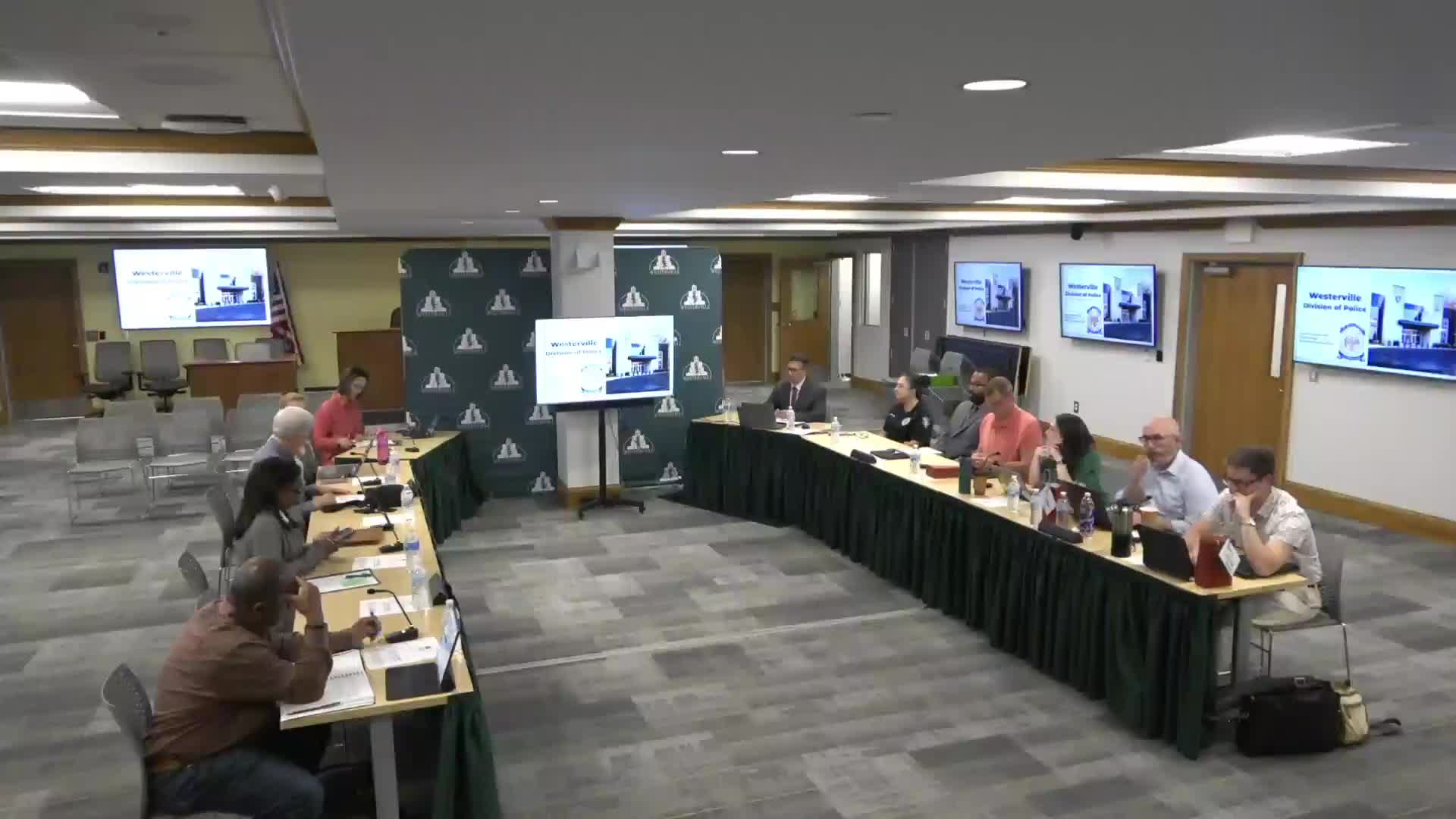
WESTVILLE — Westville police officials told the City Council at a May work session that CALEA accreditation has required them to standardize policies, document compliance and continuously re-evaluate training and operations.
Accreditation manager Dave Magnatelli, who identified himself as the city’s policy compliance and accreditation manager, said CALEA requires agencies both to write policies that meet national standards and provide proofs that those policies are followed. “It’s a way of holding ourselves accountable, to make sure that not only, do we have policies, but we are doing what we say we’re doing,” Magnatelli said.
Magnatelli walked council members through the mechanics of accreditation and daily administration. He said the CALEA program the division follows contains 185 standards and 459 subcomponents — a total he said equates to 644 individual compliance items — and that his office typically uploads “anywhere between 700 and a thousand proofs every year” within a defined proofing year. He described the requirements as time-sensitive, noting CALEA checks exact dates for recurring tasks such as firearms qualification and equipment checks.
CALEA process and cycle
Magnatelli described accreditation as an ongoing four-year cycle after initial approval: an agency earns initial accreditation, then submits annual proofs and undergoes web-based audits in years 1–3 and a combined web and on-site assessment in year 4 before seeking reaccreditation. He said Westville earned initial accreditation in November 2021 and recently passed a web-based audit in May; Magnatelli said an on-site assessor will visit in June and make a recommendation to the CALEA commission about reaccreditation.
Magnatelli said the accreditation software the division uses is PowerDMS, which the division uses for three functions: policy management, training, and accreditation management. He described how the software lets administrators assign courses, run quizzes and track individual completions and test results so supervisors can require remedial training when needed.
Why the city pursues accreditation
Magnatelli and Chief of Police (presented in the meeting as the division chief) told council members the goals are transparency, consistent training and reduced liability. Magnatelli said accreditation forces regular analysis of use-of-force incidents, pursuit policy compliance and other high-liability areas — work he said might otherwise slip amid daily operations.
“There’s absolutely nothing wrong with a group of people who work in a building 8 to 12 hours a day … to want to make it a better place,” Magnatelli said, adding that the process also helps standardize reporting practices that are useful in litigation and court testimony.
Scope and scale
Magnatelli provided data points about accreditation uptake: he said about 69 of roughly 900 Ohio agencies have CALEA accreditation and that nationwide slightly more than 1,000 U.S. agencies (approximately 5% of an estimated 18,000) are accredited. He said fewer agencies hold communications accreditation or academy accreditation: only seven communications sections and two accredited police academies in Ohio, and 56 accredited academies nationwide. He said a national “Tri-Arc” level of multiple-discipline accreditation is held by very few agencies.
Council questions and staffing
Councilmembers pressed on staffing and cost. Magnatelli said the annual CALEA fee is about $4,500 and that travel costs for assessors are included in that fee. He said the primary barrier for many smaller jurisdictions is personnel bandwidth — successful accreditation programs typically require at least one dedicated staff position or a team to manage standards, audits and proofs. He said larger agencies maintain teams or multiple staff for accreditation work; smaller agencies often lack that capacity.
Magnatelli said Westville’s accreditation work is supported by command staff, other bureaus and the city; he emphasized the need for succession planning so accreditation efforts continue if a particular staff member leaves.
Community impact and next steps
Officials said the program is intended to benefit residents through more consistent training, clearer documentation and improved organizational practices. Magnatelli said CALEA’s review process keeps the division aligned with national best practices and evolving case law.
The council did not take formal action on accreditation during the session; staff said an on-site assessment is planned in June and the commission decision would occur after the assessor’s recommendation.