Get Full Government Meeting Transcripts, Videos, & Alerts Forever!
Get email alerts on the Elections Transparency topic
No spam. Unsubscribe anytime.
Idaho lawmakers introduce package of bills targeting election misinformation and campaign-finance transparency
Summary
At a House State Affairs meeting, lawmakers introduced several bills addressing false campaign claims, candidate complaints, and campaign finance disclosure, with sponsors citing concerns about out-of-state money and misleading attacks. The committee voted to introduce the measures for further consideration.
The House State Affairs Committee on an unspecified date introduced several election-related measures aimed at limiting false campaign claims and increasing transparency in campaign finance and lobbying.
Representative Mike Moyle, R-District 10A, told the committee the package responds to novel tactics used in recent campaigns. "I am a firm believer in the First Amendment right. But I also believe that our founding fathers did not include the First Amendment being able to lie about somebody," Moyle said while describing two proposals he sponsored — RS31858 and RS31995 — to create a new criminal prohibition for knowingly false, damaging statements and to give the secretary of state authority to flag demonstrably false candidate claims on a public website.
The bills introduced by Moyle differ in scope. RS31858 would create a felony-level offense for knowingly publishing certain false statements about a candidate or officeholder; Moyle described it as a "higher standard" and said it would allow for restitution and other remedies. RS31995 would create a process for candidates to send disputed claims to the secretary of state for verification; if the secretary determines a claim is untrue and the claim cannot be substantiated, that finding would be posted on the office's website so voters can review it, Moyle said.
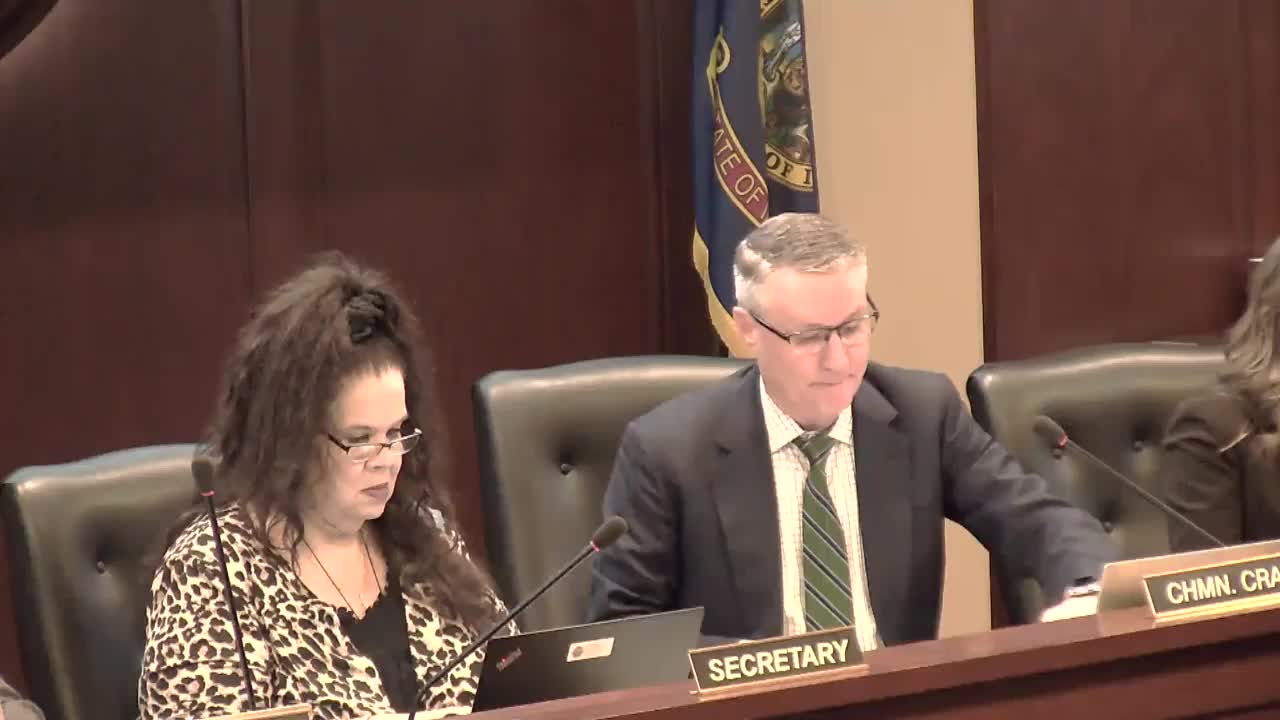
Representative Brent Crane, R-District 13 (Nampa), introduced a broader campaign-finance rewrite, RS32357, which reworks reporting requirements and disclosure rules. Crane said the intent is to move most campaign-finance rules into one part of the code and to counter the influence of out-of-state money. "If I had a magic wand and if I could do what I wanted to do, it would be only Idaho dollars spent on Idaho elections," Crane said.
Key provisions Crane described in RS32357 include: requiring quarterly reporting in non-election years and monthly reporting in election years for certain entities; monthly reporting for PACs; faster reporting of independent expenditures (including thresholds and near-election timing); and required disclosure statements and uploads to the secretary of state's website for many paid communications. Crane said the bill would also increase the individual contribution limit discussed in the draft to $5,000 per election cycle for legislators but acknowledged the committee may tweak that number during the review period.
Committee members asked legal and practical questions. Representative Skog asked to see a legal analysis of how RS31858 would comply with the First Amendment. Representative Dygert (first reference in the meeting as a mover on unrelated business) and others raised concerns about criminalizing false statements and about unintended consequences for positive claims and campaign speech.
Crane also introduced RS32434, a lobbying-transparency measure that would require more frequent reporting by lobbyists during the legislative session and require disclosure of expenditures tied to lobbying activities. Representatives asked whether the draft addresses lobbying of the executive branch; Crane said it did not appear in that draft and that existing statutes cover executive-branch lobbying.
Formal actions recorded in the meeting included motions to introduce each of the measures. The committee approved motions to introduce RS31858 and RS31995 and to introduce RS32357 and RS32434. Votes were taken by voice; the transcript records aye/nay results without roll-call tallies.
The bills were introduced for further consideration; sponsors said they expect legal review and additional drafting before hearings. Several members asked to hold the proposals for a two-week review period so caucuses and stakeholders can examine the drafts and offer changes.
What happens next: each introduced measure will proceed through the committee process; sponsors asked for hearings to vet legal issues, especially potential First Amendment conflicts and the practical effects of changing contribution limits and reporting frequency.