Get Full Government Meeting Transcripts, Videos, & Alerts Forever!
Get email alerts on the Judiciary topic
No spam. Unsubscribe anytime.
Chief Justice John Kittredge urges data, magistrate uniformity and expansion of treatment courts
Summary
In a joint assembly address, South Carolina Chief Justice John W. Kittredge outlined efforts to build public data on trial court workloads, urged uniform magistrate standards and pay, and highlighted the growth and effectiveness of treatment courts such as drug courts.
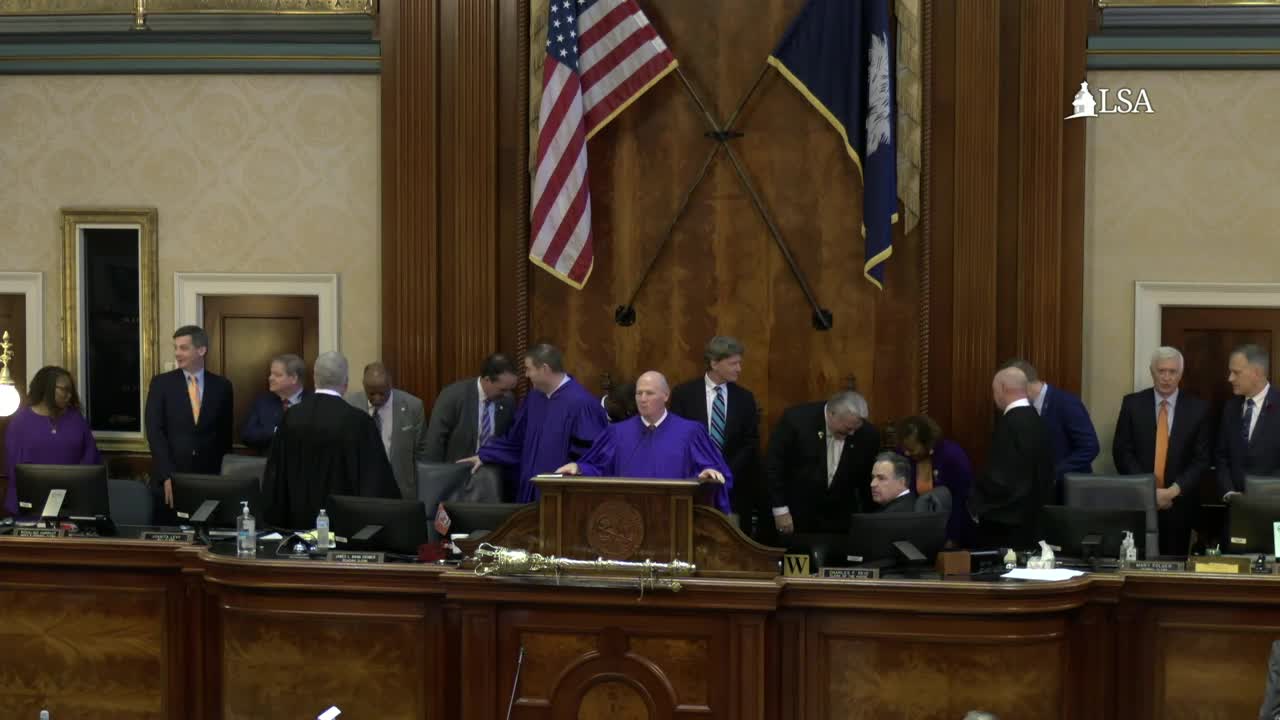
Chief Justice John W. Kittredge addressed a joint assembly of the South Carolina General Assembly on March 5, asking lawmakers for support on three priorities: better public data on trial‑court workloads, uniform standards and pay for magistrates, and continued expansion of treatment courts.
Kittredge said the judicial branch has begun creating an interactive report that will show case filings and dispositions across circuits and counties; he asked legislators to support the work so it can become a public, searchable resource. "We want to know how many cases are filed. We want to know how many hearings take place in our courts," he said, noting that recent limited data show more than 1.5 million filings in 2024 alone and that case hearings substantially exceed filings.
The chief justice also urged attention to magistrate court uniformity, particularly pay for full‑time magistrates. He told the joint assembly that statutory formulas pay magistrates through county allocations tied to population, producing pay disparities that can be "staggering," with the highest full‑time salaries above $130,000 while some are paid as little as about $46,000 despite comparable caseloads. He asked the legislature and governor to include the judicial branch in conversations on magistrate reform, saying improved uniformity and professionalism could make recruitment easier in rural counties.
Kittredge devoted the final portion of his remarks to treatment courts, including drug courts, veterans courts and mental‑health‑court models. He described them as an example of "the merging of mind and heart"—balancing accountability and mercy—and urged continued legislative support. "Drug courts work," he told lawmakers, citing lower recidivism among participants and personal testimonials shown during the address.
He also recognized judicial personnel changes and data‑systems staff working on the new public workload report. Kittredge closed by reaffirming the judiciary's service ethos and said he welcomed legislative collaboration on the magistrate reforms and the data project.
The joint assembly received the remarks and adjourned after additional ceremonial presentations.