Get Full Government Meeting Transcripts, Videos, & Alerts Forever!
Get email alerts on the Indecent Exhibitions topic
No spam. Unsubscribe anytime.
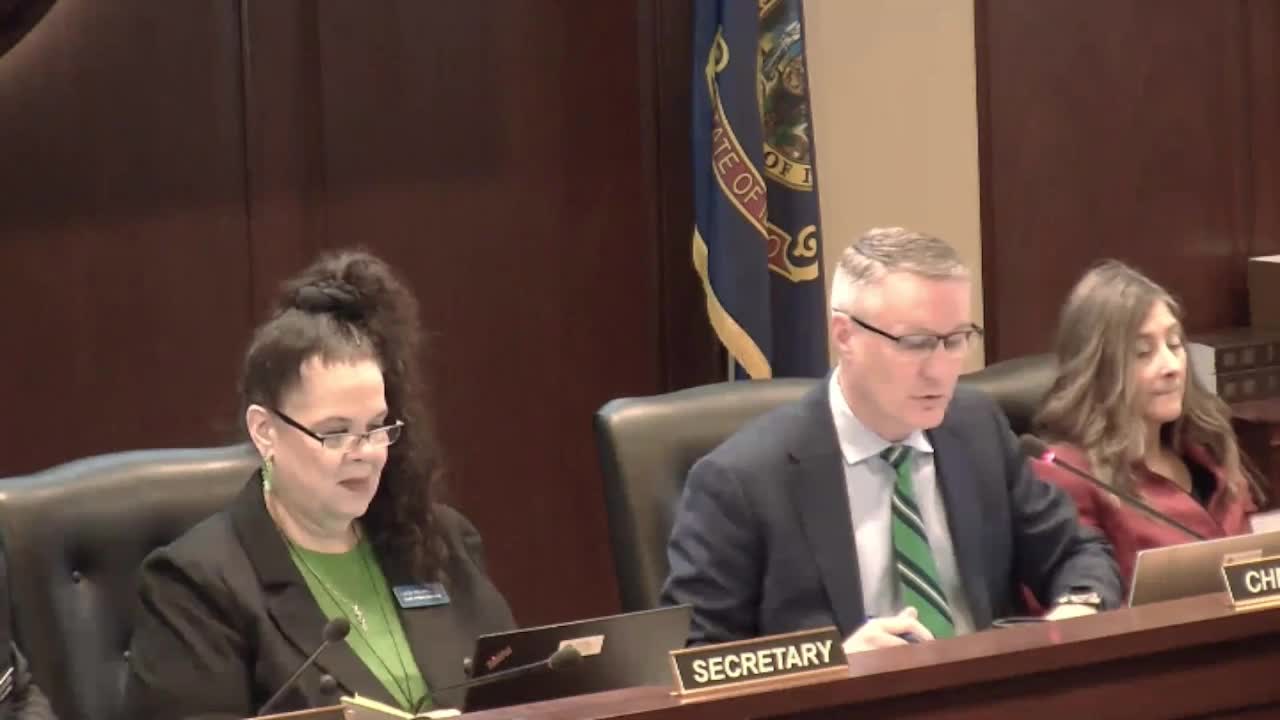
House State Affairs committee sends bill restricting minors’ access to “indecent exhibitions” to the floor after hours of testimony
Summary
The Idaho House State Affairs Committee on Feb. 17 voted to send House Bill 230, which would create civil liability for organizers, hosts and performers of certain "indecent exhibitions" accessible to minors, to the full House with a due-pass recommendation after extensive testimony.
The Idaho House State Affairs Committee on Feb. 17 voted to send House Bill 230, which would create civil liability for organizers, hosts and performers of so-called "indecent exhibitions" accessible to minors, to the full House with a due-pass recommendation after extended sponsor remarks and nearly an hour of public testimony.
The bill’s sponsor, Rep. Ted Hill, R-Eagle and Emmett, told the committee H.B. 230 “creates a duty of care for organizers, hosts and performers of indecent exhibitions to take reasonable steps to restrict the access of minors.” Hill said the bill is intended as a time, place and manner regulation and that it does not criminalize performers: “drag is not mentioned once,” he said, and “private events are exempt.”
Why it matters: The measure would allow private civil lawsuits by or on behalf of minors allegedly exposed to covered conduct and provides several statutory defenses for hosts and organizers. Supporters say the bill protects children; opponents say the language is vague, targets LGBTQ performers and will chill lawful expression and family-friendly events.
The bill defines covered conduct as two elements modeled on the Federal Communications Commission’s indecency standard: (1) the presence of specified sexualized conduct and (2) that the conduct be “patently offensive to an average person applying contemporary community standards” with respect to minors. Edward Clark, policy assistant at the Idaho Family Policy Center, said the bill includes three stakeholder-driven changes: an affirmative-defense clause if a host can produce a contract forbidding prohibited exhibitions; a parental-consent/attendance exception for ticketed events for minors 14 and older; and an explicit exclusion for athletic, cheer or dance team performances associated with secondary schools or institutions of higher education.
Clark also told the committee the bill contains no criminal penalties. “There are no criminal penalties in this bill,” he said.
Public testimony split sharply. Supporters described incidents they said justify the bill. Mary Ellen Nurse, who identified herself as a Boise resident, recounted an episode she said occurred at Cecil Andrus Park in which a performer approached a prayer circle before a children’s event and “proceeded to dance in an impish odd way around a prayer circle” and later “sniffing the men’s crotches.” She urged, “Please support House Bill 230.” Pastor Paul Lure of The Well Reformed Church said lawmakers should “protect the innocence of Bridal children” and urged a yes vote.
Opponents told personal and policy stories urging rejection. Doctor Sarah Lynch, a Kootenai County resident and public-safety liaison, described being involved in security planning for a Coeur d’Alene event and said a doctored video circulated after that event spurred litigation; she called H.B. 230 “a censorship bill that specifically targets LGBTQIA+ folks.” Kai Bostick, 14, speaking for Human Rights Idaho, said the bill’s scope is so broad venues would likely simply bar minors to avoid lawsuits and urged lawmakers to vote no: “I urge you to vote no on House Bill 230 because it is so big, unenforceable, and will harm businesses, performers, and young people like me.” Performer Vincent Diaz said the measure would “empower groups” to target family-friendly events and argued it would waste taxpayer money defending constitutional claims.
Committee members pressed the sponsor and Clark for specifics about the bill’s key terms and enforcement. Rep. John Green (questioning) asked how the bill would treat performances viewers might encounter on television; Clark and other supporters pointed to decades-long FCC case law and urged that the two-part test would limit overreach. Several members sought clarity on the bill’s references to “primary” and “secondary” sexual characteristics and on whether club sports and other non-school-affiliated teams would be exempt; supporters said the exemption was intended for institutional teams and that many ordinary halftime performances would not meet the indecency standard.
After public testimony and deliberation, Rep. Hotseller (Hostetler) moved to send House Bill 230 to the floor with a due-pass recommendation. The motion carried; Rep. Achilles and Rep. Green asked to be recorded as voting no. The committee’s action moves H.B. 230 to the next stage in the legislative process; no final House floor vote is reflected in this transcript.
Other committee business: the panel approved the minutes from the Feb. 17 meeting and voted to introduce several request statutes (RS) and bills with minimal discussion earlier in the session. Those items were carried by voice vote.
What the bill would not do (as explained in committee): supporters and the sponsor repeatedly told the panel H.B. 230 does not change how or where voting occurs (this comment referred to a different introduced RS dealing with elections) and does not create criminal penalties. The bill’s language also provides the following clarifications and defenses, as discussed in committee: hosts are not liable if they can produce a legally enforceable contract forbidding prohibited conduct; parents or legal guardians may accompany minors 14 or older to ticketed performances or give prior written consent for designated adults to accompany them; and dances or gestures by athletic, cheer or dance teams sponsored by secondary schools or institutions of higher education are explicitly excluded from the definition of prohibited conduct.
Committee next steps: House Bill 230 will proceed to the House floor for further consideration. If the House passes the bill, additional committee reports, floor debate and possible amendment would follow.
At a glance: additional actions taken today (voice votes or introductions) - The committee adopted the meeting minutes for Monday, Feb. 17 (motion carried). - RS 32,265 (small-brewer parity legislation) was introduced (motion carried). - RS 32,349 and RS 32,412 (the latter standardizing election timelines and withdrawal/early-voting deadlines) were introduced (motions carried).