Get Full Government Meeting Transcripts, Videos, & Alerts Forever!
Get email alerts on the School Choice Education Accounts topic
No spam. Unsubscribe anytime.
Committee introduces RS 32171, a proposed Idaho Education Opportunity Program (school‑choice accounts)
Summary
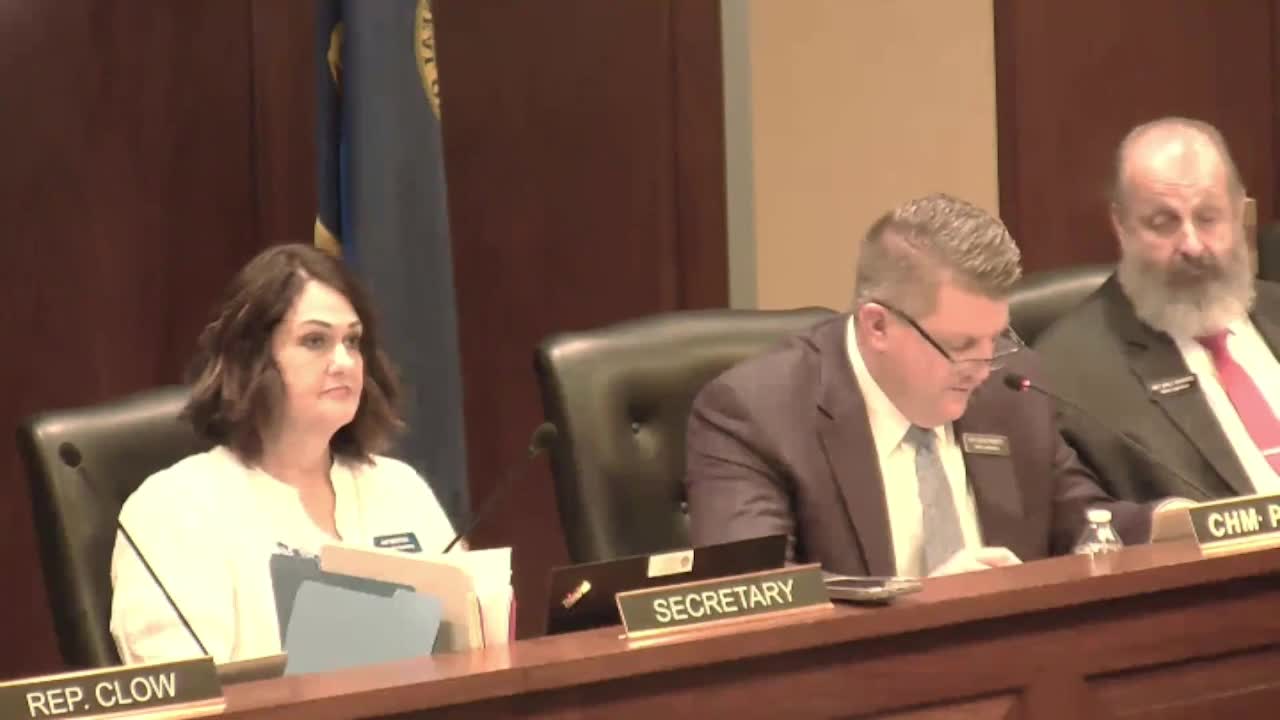
Representative Lance Clow introduced RS 32171, a statewide education‑choice program that would let qualifying families move a state share of public education funding into an individual education account for private school tuition or approved educational expenses; the committee voted to introduce the RS for a full hearing.
Representative Lance Clow presented RS 32171, labeled the Idaho Education Opportunity Program (IEOP). The sponsor described the measure as a school‑choice program allowing qualifying students to transfer the state share of per‑pupil funding into an education opportunity account that parents may use for approved private school tuition, personalized education plans, curriculum, tutors and related educational expenses.
Eligibility and amounts described in the hearing: the candidate must be a prior public‑school student (grades 1‑12) or a kindergarten student entering school; students previously enrolled in private school would not qualify. An adjusted gross income (AGI) limit of $75,000 was stated in the draft. The state portion of funding would be based on the statewide average per‑pupil distribution (the sponsor cited a 2025 average of $8,440), with 80% of that state average following the student into an account (roughly $6,700 by the sponsor’s estimate) and 20% remaining with the district (roughly $1,688) to hold a seat and provide residual services. Special education students would receive the full per‑pupil amount the sponsor said.
Account rules described: funds may be used for a list of approved educational goods and services; funds can roll over year to year if unused and may be applied later to postsecondary education if the student remains eligible and reapplies. Personalized education plans must include reading, writing, mathematics, social studies and science; national norm‑referenced assessments or equivalent local assessments would be required annually to demonstrate progress.
Fiscal estimates presented by the sponsor: he estimated roughly 3,100 students might participate initially (including about 2,000 switchers and other categories), administrative costs for the State Department of Education of roughly $200,000 (two staff, including benefits), third‑party account administration capped at 3.5% (estimated around $730,000), and estimated income‑tax reductions of about $8.6 million; he summarized the total near‑term fiscal impact as approximately $14 million. The sponsor also said the bill would permit parents to deduct private‑school tuition from taxable income under certain conditions.
Committee members asked implementation questions including administration by the State Department of Education, treatment of homeschool families, and whether students must be admitted to a private school before account funds are released. The sponsor said implementation details and many operational questions will be addressed in a full hearing. Representative Mendoza moved to introduce RS 32171; the motion carried and the RS was printed for a hearing.