Get Full Government Meeting Transcripts, Videos, & Alerts Forever!
Get email alerts on the Public Safety Police Budget topic
No spam. Unsubscribe anytime.
Idaho State Police seeks funding for fentanyl unit, forensic lab staff and housing as trooper vacancies climb
Summary
Agency requested enhancements for fentanyl investigations, a deputy forensic lab manager, housing in a remote location and conversion of contractors to full‑time investigators; director said vacancies and pay competition are hampering patrol staffing.
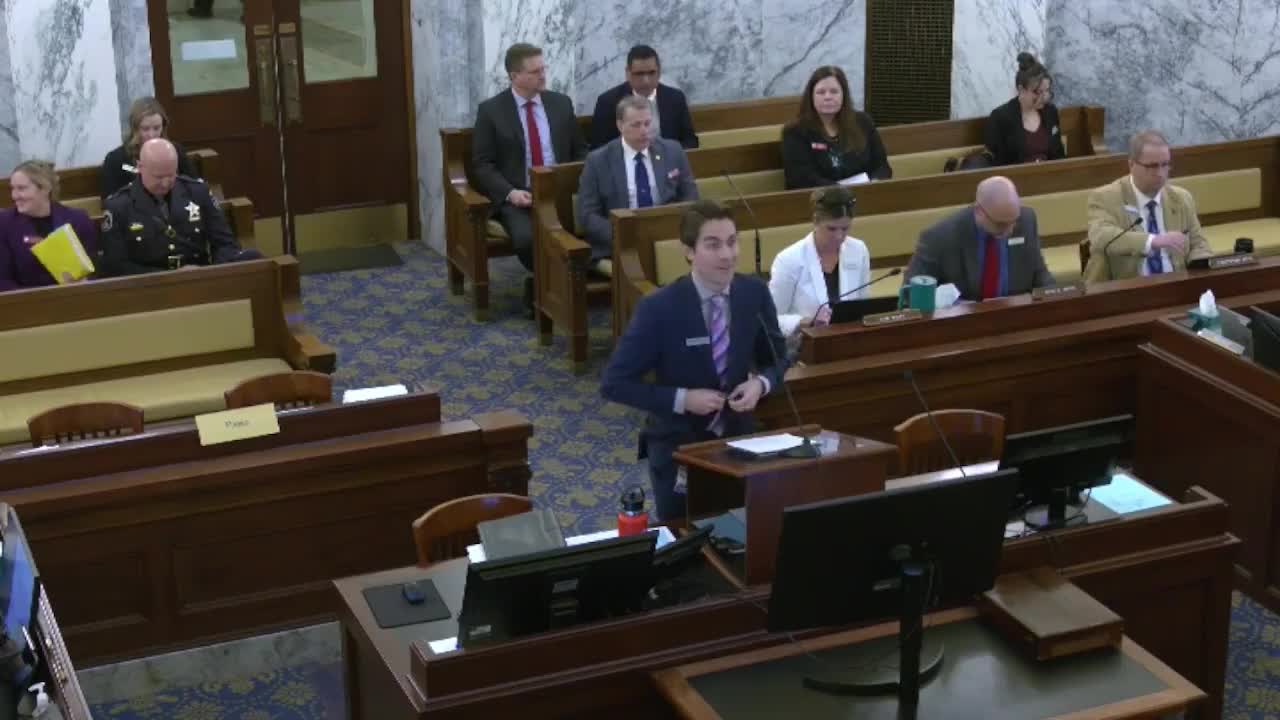
The Idaho State Police told the Joint Finance and Appropriations Committee on Feb. 12 that it is seeking a range of budget changes for fiscal 2026, including resources for fentanyl enforcement, forensic staffing for a new laboratory, remote housing for personnel and changes to how certain IT positions are centralized.
Noah Peterson, budget policy analyst with the Legislative Services Office, reviewed the Division of Idaho State Police request and said the division has 583.67 FTP and reported 38.67 positions vacant as of last August. Peterson said recent one‑time appropriations in fiscal 2023 and re‑appropriations in 2024 affected year‑to‑year expenditure comparisons.
“This enhancement added 10 FTP and $1,043,300 to create a unit with a focus on fentanyl trafficking and mitigation,” Peterson said of a prior appropriation. He also summarized a requested transfer of $4,995,500 and 37.48 FTP related to the highway distribution account (HDA) shift that agency officials said would allow patrol to maintain current operations if approved.
Colonel Bill Gardner, director of the Idaho State Police, told the committee he supports converting some contractors into permanent employees for certain investigative roles. On the Sexual Assault Kit Initiative, he said the agency determined retired part‑time contractors would not have sufficient privileges and now intends to hire investigators as permanent employees so they can become POST‑certified.
Gardner stressed that staffing and retention are the agency’s top operational problems. He said turnover has been acute in parts of northern Idaho and that pay differentials have drawn troopers to city and county agencies and to other states. Gardner said the department is taking steps including modified shift schedules and other internal changes, and that he is working with human resources and the Department of Finance on longer‑term pay solutions.
“We’ve seized over 65,000 fentanyl pills, over a pound of fentanyl powder and 150 pounds of methamphetamine from this specific team,” Gardner said of the state drug‑interdiction team, and he described recent operations that yielded large methamphetamine seizures.
Christine Otto, ISP financial executive officer, told legislators that converting investigators to employee status is not intended to increase program costs materially; the change primarily affects employment status and benefits and will allow investigators to obtain necessary certifications. She also explained that some federal grants are being shifted to nonfederal appropriation lines because existing contracts are structured as nonfederal.
Other fiscal requests included: - A requested 1 FTP deputy forensic lab manager ($118,200 ongoing) to help manage a growing forensic services program and a new laboratory in Meridian. - A special investigations unit for Idaho Department of Correction facilities, four FTP and $757,300 total (ongoing and one‑time items for vehicles and computers). - A supplemental of $268,100 for a remote housing unit; ISP said the site was originally planned for Mackay and later moved to Fairfield with no change in cost. - An appropriation request tied to implementation of legislation to require DNA collection for certain misdemeanors, estimated at $168,100 (assuming 1,681 samples at $100 each). - A $50,000 federal grant request for SORNA (Adam Walsh Act) compliance, and an ongoing $233,000 request from the Idaho Law Enforcement Telecommunications Fund for an ILETS disaster recovery database.
Peterson and legislators also discussed a governor’s recommendation to provide $500,000 one‑time from the Millennium Fund for a fentanyl communications campaign; Division of Financial Management confirmed the governor recommended the amount as one‑time Millennium Fund funding and that the Millennium Fund committee would review that appropriation.
Lawmakers repeatedly pressed the director for details on vacancy and turnover rates and asked for additional data. Senator Woodward noted Idaho’s population growth and said patrol staffing has not kept pace, describing a ratio change from roughly one trooper per 4,600 residents to about one per 6,300 residents since 2002. Gardner confirmed shortages and said the agency often sends troopers from other regions to cover gaps.
The presentation was largely informational; no formal committee vote on the ISP budget enhancements was recorded during the session. Committee members asked for follow‑up documents on appropriation transfers, federal grant balances for the Sexual Assault Kit Initiative and additional detail on where OITS modernization positions would be reassigned.