Get Full Government Meeting Transcripts, Videos, & Alerts Forever!
Get email alerts on the Higher Education Budget topic
No spam. Unsubscribe anytime.
LSO presents FY2026 higher education budget overview; OSB proposes $15M matching grant, health programs request more residency and dental seats
Summary
Kevin Campbell of the Legislative Services Office briefed the House Committee on Education on FY2026 higher‑education budgets, highlighting CTE instructor requests, health‑program residency increases, and a proposed $15 million OSB matching grant program to expand workforce‑related capacity.
Kevin Campbell, senior budget and policy analyst with the Legislative Services Office, presented an overview of FY2026 budgets for higher education programs and institutions to the House Committee on Education.
Campbell summarized seven budget groupings: Ag Research and Extension; Career Technical Education (CTE); colleges and universities (including endowment distributions and enrollment/workload adjustments); community colleges; health education programs (including WAMI and residencies); special programs (scholarships, tech help, Small Business Development Center, Idaho Geologic Survey); and the Office of the State Board of Education (OSB).
Notable base budgets and requests Campbell identified include: - Ag Research and Extension: base $37,966,900; 341.33 FTE; requests for a viticulture/small‑fruits professor and $250,100 for maintenance at a research dairy. - CTE: base $94,426,500; 569.14 FTE; requests include $664,000 for additional instructors in high‑demand programs, $2,273,700 in spending authority for anticipated federal grants, $128,400 for a business/industry engagement manager, and $50,000 for adult literacy and basic education. - Colleges and universities (system-wide): base $709,431,200; 4,921.68 FTE; request includes $1,388,700 in endowment distributions and an operational capacity enhancement request ($3,369,900 across institutions). - Community colleges: enrollment workload adjustment (EWA) request totaling $707,100; institutions may gain or lose funding depending on the formula. - Health education programs: base $28,206,800; Campbell noted the FTP count understates total participants because residents and students are often not state employees. Requests include $60,000 for one Boise Internal Medicine resident; $240,000 for four psychiatry residents at Eastern Idaho Medical Residency; $420,000 ongoing for six family medicine residents and one fellowship in Nampa (in partnership with St. Alphonsus Nampa and Mountain States Institute); and $54,000 for one additional Idaho Dental Education Program seat to move the program toward 36 students. - Special programs: base $35,937,600, including Opportunity Scholarship and Rural and Underserved Educator Incentive Program. - OSB: base $55,800,000; 84.25 FTE; one significant request is a $15,000,000 one‑time grant program to build institutional workforce/in‑demand career capacity. Campbell explained the program will match private fundraising: Boise State, Idaho State and University of Idaho would receive a 1:1 match (state:private), while Lewis‑Clark State College and the four community colleges would receive a 2:1 match (state provides $2 for each $1 raised) to offset lower fundraising capacity.
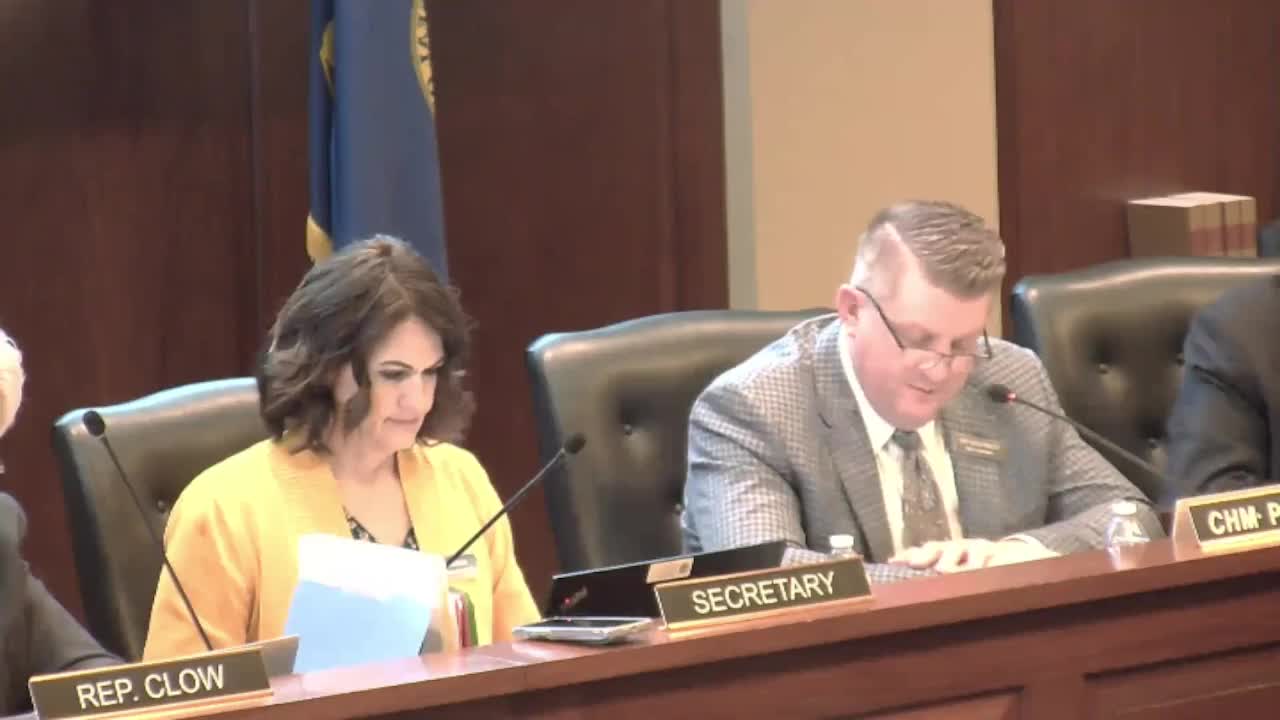
Committee members asked clarifying questions. Representative Thais asked whether FTE/FTE counts are headcounts or full‑time equivalencies; Campbell said FTP is an equivalency. Representative Hart asked whether endowment distributions add to or draw from an endowment; Campbell explained they are annual distributions from assets managed by the Endowment Fund Investment Board and distributed to institutions. Representative Clow questioned the OSB matching ratios; Campbell explained the higher ratio for smaller institutions is designed to offset fundraising capacity differences. Representative Hawkins asked about federal-grant spending authority; Campbell confirmed the legislature appropriates authority for anticipated grants and if grants do not materialize, no money is spent.
Members also raised concerns about clinical sites and residency capacity for medical students who train out of state. Several members noted that without adequate clinical sites and residency slots students cannot return to Idaho to practice; Campbell and members identified clinical-site availability and residency capacity as constraints to expanding the pipeline of Idaho physicians.
Campbell closed by directing members to the Legislative Budget Book and related dashboards for deeper detail and offered to meet individually with members to review budget pages and answer follow‑up questions.