Get Full Government Meeting Transcripts, Videos, & Alerts Forever!
Get email alerts on the County Finance topic
No spam. Unsubscribe anytime.
Barnstable County finance director warns of 10‑year ‘cliff’ in operating budget
Summary
Finance Director Carol Coppola presented a 10-year operating forecast showing projected deficits and major liabilities, including PFAS cleanup and $45 million in authorized borrowing, prompting commissioners to discuss service reductions, reassessing revenue sources and using reserves only as one‑time fixes.
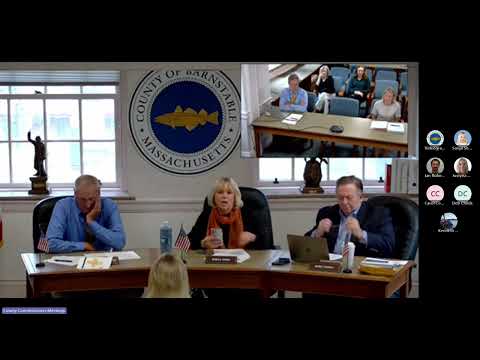
Barnstable County Finance Director Carol Coppola told commissioners on Oct. 22 that a 10-year forecast of the county general fund shows a small surplus in fiscal 2027 followed by growing structural deficits as expenditures outpace projected revenues.
Coppola presented a projection built from 10 years of historical data, heavier weighting on fiscal 2023–25 actuals and conservative assumptions for major revenue streams such as registry of deeds receipts, courthouse lease income and investment yields. "We're here today to present to you a 10‑year financial forecast for the operating budget," Coppola said as she opened the presentation.
The nut of the forecast: personnel costs (salary and fringe) account for about 67% of projected expenditures, and major liabilities — notably estimated PFAS remediation and deferred maintenance — would push debt service toward or above an internal 10% budget ceiling in the early 2030s. Coppola said the draft outlook included $45 million added to the county's debt outlook for PFAS work and cited an early estimate of roughly $60 million in PFAS‑related needs, with $4 million covered from ARPA and $11 million already authorized.
Commissioners and staff emphasized the forecast is intended to be conservative. Coppola described methods used: trimming an overly optimistic compound annual growth rate for registry revenue to a lower weighted average (ultimately projecting 2.18% for that stream), applying a 2.5% cap for county assessment increases and using regression or actuarial approaches for retirement and insurance projections. She also said the county is assuming a steady $25 million investment balance yielding about 3.25% annually and that sheriff retirement reimbursement of $500,000 is currently scheduled through 02/1934.
Megan Rogers, a financial analyst who joined the county in May and helped build the expenditure side of the forecast, said salary projections averaged about 6% annual growth in the projection and that fringe costs (retirements, group insurance) were modeled with a mix of regression analysis and stress scenarios; retiree plans used a blended rate of 12.25% with an alternative stress scenario rising near term then moderating to 7% in later years.
Coppola and Rogers walked the board through scenarios showing operating deficits even if PFAS borrowing were excluded; with the PFAS borrowing and its debt service included, projected debt service would approach the county's 10% internal guideline, creating a policy decision point about which capital projects to pursue and how to cover future debt service. "As we reach the cliff, here it is," Coppola said, pointing to a chart that showed expenses exceeding revenues in the out years.
Commissioners discussed options the county could pursue to narrow the gap: identify additional revenue streams, consider targeted assessment increases in coordination with towns, expand regional services that can be cost‑shared with municipalities (for example IT and dredging operations), and evaluate operating reductions. Several commissioners stressed that reserve balances and stabilization funds provide only one‑time relief and are not a sustainable answer for ongoing operational shortfalls.
Board members also connected the forecast to broader pressures: rising health‑care and personnel costs, declining external support for services previously funded by state or federal programs (dredging was cited), and the uncertainty of registry of deeds revenue because of swings in real‑estate activity. One commissioner noted the fiscal challenge is not unique to Barnstable County and said statewide finance managers are seeing similar trends.
The finance office offered to provide an overall single percentage number for projected annual revenue growth to help commissioners match revenue assumptions to projected expenditure increases and agreed to share the underlying spreadsheets. Coppola said staff will return with the requested consolidated percentages and with proposals for next steps, including potential capital budget policy changes and recommended budget directions for departments.
Ending: Coppola and staff framed the forecast as a planning tool to give commissioners time to consider service priorities and revenue options before debt service pressures and major remediation projects begin to bite. The board signaled it will use the forecast to develop options — including service reductions and revised assessment strategies — ahead of the FY2026–FY2028 budget cycles.