Appeals court hears challenge to dismissal after judge insisted fentanyl be produced at suppression hearing
Loading...
Summary
An Appeals Court panel considered whether a Boston Municipal Court judge abused his discretion by dismissing Commonwealth v. Jesus Caraballo Nieves for lack of prosecution after requiring the physical presence of alleged fentanyl at a motion-to-suppress hearing, in tension with a court policy that bans bringing fentanyl into court.
An Appeals Court panel — led by Judge Vicki Henry and joined by Judges Hand and Brennan — heard arguments over whether a Boston Municipal Court judge abused his discretion by dismissing Commonwealth v. Jesus Caraballo Nieves for lack of prosecution after the judge insisted the alleged fentanyl be brought into a suppression hearing.
The issue matters because trial-court policies that bar bringing fentanyl into courthouses intersect with a judge’s authority to require particular proof at a suppression hearing. The parties asked the panel to decide whether a judge may treat the absence of a particular type of evidence as a basis for dismissal, or whether alternative proof (officer testimony, photographs or video) suffices under existing law.
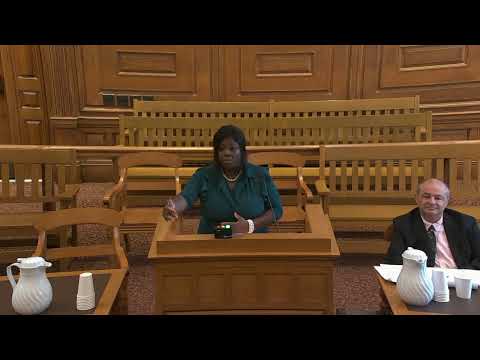
Attorney Kenneth Steinfeld, arguing for the Commonwealth of Massachusetts, told the panel the record does not support dismissal for lack of prosecution and invoked the state Supreme Judicial Court standard from Pimentel. Steinfeld said the trial-court policy banning fentanyl from the courtroom meant the Commonwealth had no obligation to produce the physical drug and instead could rely on testimony or photographs. "It is a ban," Steinfeld said of the policy, and added that the policy "contemplates" introduction of photographs or officer testimony rather than the substance itself. He argued a judge cannot demand a particular kind or quantum of evidence as a prerequisite to holding a hearing: "What he cannot do is demand as a prerequisite that a certain type of evidence or a certain quantum of evidence before he'll even hold the hearing." Steinfeld told the panel the transcript shows the trial judge repeatedly expressed a preference that the physical drugs be present, citing the judge as saying, "I don't do motions to suppress without the evidence." He urged the court to find that treating the absence of fentanyl as the decisive basis for dismissal was an abuse of discretion.
Members of the panel questioned the interplay between the trial-court policy and the duties of prosecutors and court personnel; Judge Hand asked why the assistant district attorney would be entitled to raise a trial-court policy except as it was effected through a judge, clerk or court officer. Steinfeld responded that the policy affects how drugs are presented and handled in court and that prosecutors have a duty as officers of the court to ensure dangerous substances are not brought into the courtroom.
Defense counsel (identified in the record as Attorney Derez), appearing for Jesus Caraballo Nieves, described the matter as tense at the trial level and argued the practice is not limited to a single judge. Derez said in several cases judges have dismissed cases when the Commonwealth did not bring specific evidence to critical court appearances. Defense counsel characterized a motion to suppress as a critical stage where the defense and prosecution alike must confront evidence, argued that in some cases photographs or videos were not taken or were inadequate, and said the Commonwealth had opportunities on prior dates to produce photographs or other proof but did not. Derez told the panel the trial judge offered the parties recesses and that the officers and evidence were available that day — including a statement that the drugs were "literally across the street" at a police station — but that the Commonwealth declined to bring the physical evidence into court.
The parties also debated exceptions to the ban on bringing fentanyl into the courthouse. The panel noted two exceptions in briefing: when someone needs medication, and when a party seeks to introduce the substance because it is necessary to that party's case. Steinfeld said neither exception applied here and that the policy contemplates a party seeking to introduce evidence rather than a judge ordering it by fiat.
Both sides asked the Appeals Court for guidance. Steinfeld asked the court to clarify that a judge may not draw an adverse inference or dismiss a case solely because the physical substance was absent at the hearing. Derez framed the question around whether trial judges routinely direct the parties on the manner of proof and whether such directives are permissible. The panel ended oral argument after questioning; the matter was submitted to the court.
The transcript shows the panel enforced a 15-minute time standard for argument and that the attorneys relied on existing case law (Pimentel and related authorities) and the trial-court fentanyl policy in framing their positions. The Appeals Court did not announce a decision during the argument.