Get Full Government Meeting Transcripts, Videos, & Alerts Forever!
Get email alerts on the Wastewater Capacity Fees topic
No spam. Unsubscribe anytime.
Queen Creek council initiates process to raise wastewater capacity fees; public hearing set for Dec. 3
Summary
The Queen Creek Town Council voted 5-0 to begin a statutorily required 60-day notice procedure to raise wastewater capacity fees and set a Dec. 3 public hearing; the motion proposed a Jan. 5, 2026 effective date if adopted.
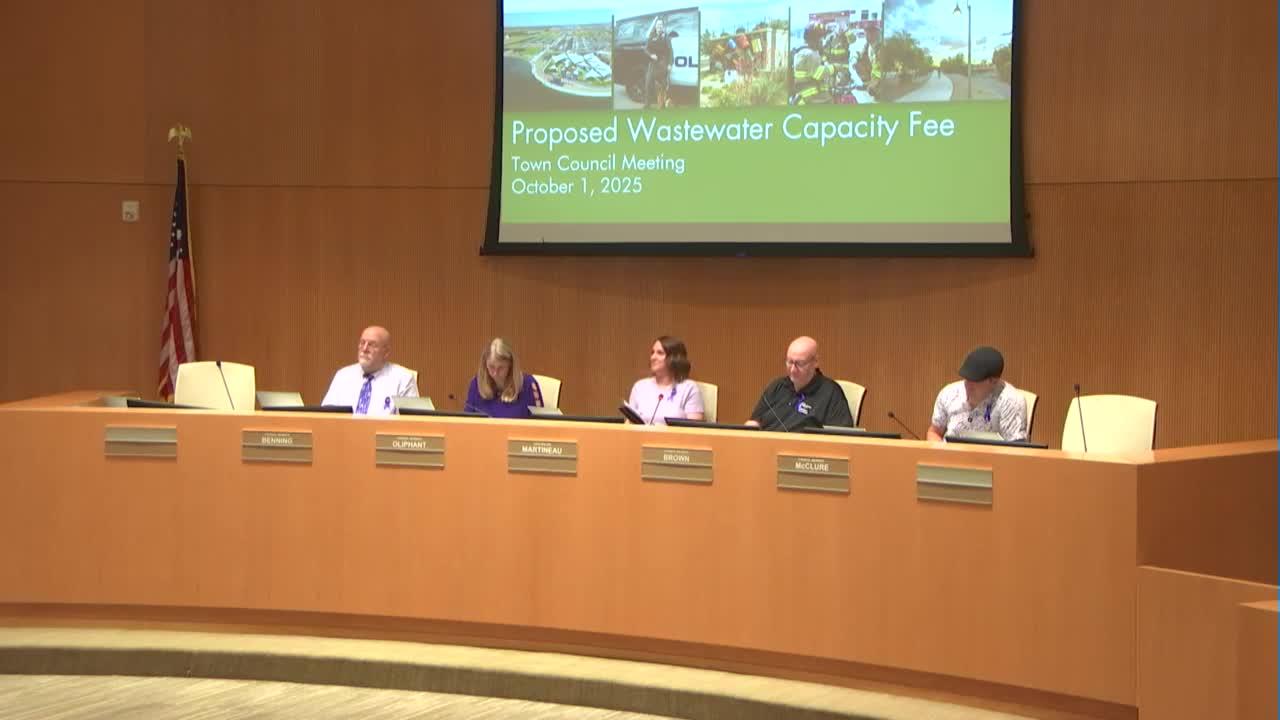
The Queen Creek Town Council voted 5-0 on a motion to publish a 60-day notice of intention to increase wastewater capacity fees and to set a public hearing for 6:30 p.m. on Dec. 3, 2025; the motion, as read into the record, set a proposed effective date of Jan. 5, 2026.
Council action followed a technical presentation from Deputy Town Manager and CFO Scott McCarty, Utilities Director Mark Skocific and consultant Kuda Wekwe of DTA Public Finance explaining why the town plans to expand treatment capacity and how growth should pay for that expansion. McCarty said the fee update is required to “generate the money to be able to pay for the new treatment plant from those people who are coming here that are causing the new treatment plant to be built.”
Why it matters: Town staff and the consultant told the council that the regional Greenfield Water Reclamation Plant (GWARP), which Queen Creek co-owns with Mesa and Gilbert, has about 4 million gallons per day (MGD) of current capacity and is planned to be expanded by 2 MGD (to 6 MGD) as part of the town’s near-term plan. Kuda Wekwe said the study found the net fee per equivalent residential unit (ERU) would be about $6,100 — a roughly 112% increase from the current fee — to fund the 2 MGD expansion and related transmission projects, after accounting for existing revenues and offsets.
Details of the proposal and methodology changes presented to the council included:
- Demand and planning horizon: Staff used a 10-year planning horizon and estimated the town will add about 14,600 ERUs across all land uses in that period. The presentation used 168 gallons per day as the ERU wastewater estimate for a typical single-family home.
- Allocation by land use: Staff showed that roughly 70% of the 10-year capacity need is driven by new single-family homes and 17% by multifamily. The consultant recommended changing how multifamily is charged: instead of relying on meter-size-based allocations, multifamily would be charged at 75% of a single-family ERU to reflect observed person-per-unit differences. Kuda said the 75% figure aligns with census and local wastewater-flow data.
- Projected costs and offsets: The presentation identified approximately $20 million of related infrastructure, of which about $6.6 million was attributed to growth and included in the fee calculation. The town also expects to incur about $2.6 million to lease partner capacity while projects proceed, and to apply about $10 million in state Title 42 funds and an earlier $15 million payment made in connection with an exchange agreement to offset costs. Scott McCarty described the 80% growth-attribution assumption for the plant expansion as a conservative approach until detailed designs clarify benefits to existing customers.
- Special cases: Staff proposed a more project-specific review for large commercial/industrial meter sizes (2 inches and larger) when capacity-based estimates appear to underestimate actual annual flows. Paul Gardiner, the town’s water resources director, said industrial applicants will be reviewed for discharge standards and may require on-site pretreatment.
Stakeholder input: The town said it convened a stakeholder focus group that included the Home Builders Association; James Ashley of the Home Builders Association commended the town’s outreach and said his members appreciated the transparent process while continuing to discuss mitigation and implementation timing with staff.
Council discussion and vote: Council members asked about timing, the budgetary and equity effects of prior methodology choices (especially for multifamily) and whether existing customers had been subsidizing growth. Scott McCarty and Kuda explained that prior meter-based calculations for multifamily had produced significant per-unit disparities across projects, which helped prompt the recommended methodology change. Council member Brown moved the 60-day notice motion; the council voted 5-0 to approve the notice and set the Dec. 3 public hearing.
Next steps and effective date: The 60-day notice period required by state statute begins with the council’s action. Staff told the council that under the statutory timeline the earliest the new fee could take effect would be in January 2026 if adopted after the Dec. 3 hearing; the motion as read specified an effective date of Jan. 5, 2026. Staff said they will continue outreach with stakeholders, including the multi-housing association, during the 60-day comment period and will return to council on Dec. 3 for a public hearing and final action.